Viva Goals Is Shutting Down, Here’s What Companies Want Next
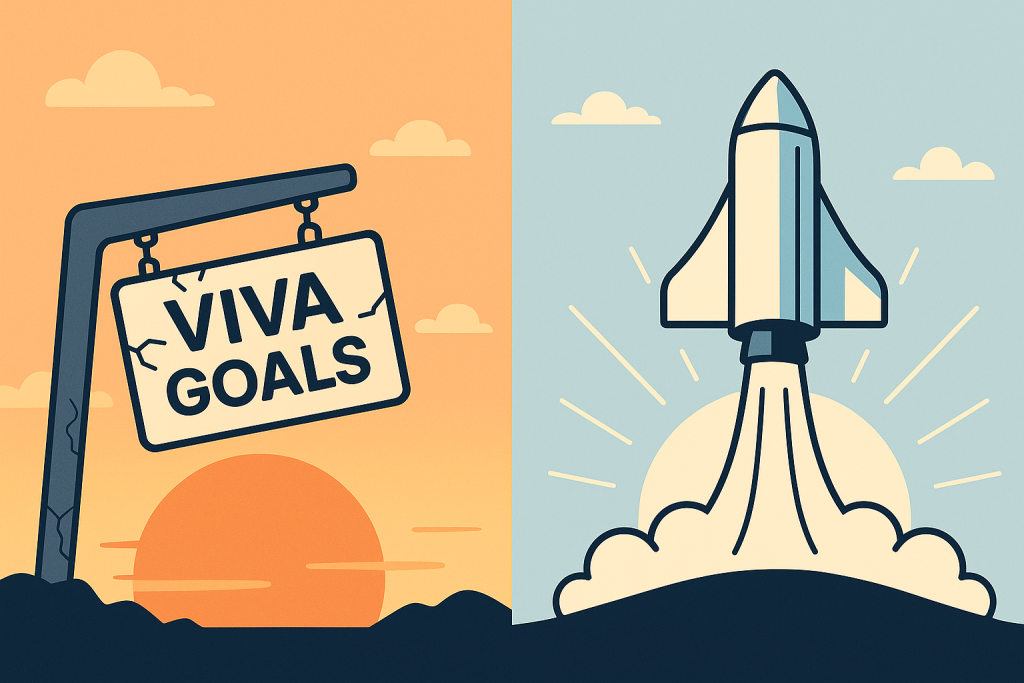
Viva Goals will retire by December 31, 2025. That’s THIS month.
For many organisations, that means a sudden need to migrate, not just data, but process, habit, and trust.
And for those evaluating a new OKR platform, it’s a moment to rethink: what went wrong, and what should go right next time?
We looked at user feedback, community forums, migration guides and industry commentary to understand the common pitfalls of Viva Goals and used these insights to outline what a robust replacement must deliver.
5 Common Complaints from Viva Goals Users
These are issues repeatedly raised by organisations when discussing Viva Goals’ sunset, and why many are searching for better alternatives.
1. Hard to onboard, even for seasoned OKR teams
One independent review described their Viva Goals trial as a year of “frustration and failure.” Even experienced OKR practitioners found the tool difficult to set up and adopt.
Viva Goals’ configuration felt burdensome: templates, corporate-level OKRs, dashboards, and integration setup, all manual and time-consuming.
2. OKRs felt disconnected from actual work
Despite being part of Microsoft 365, many customers found that Viva Goals didn’t integrate meaningfully into daily workflows.
As one former user on the Microsoft Tech Community wrote about the shutdown:
“This is a terrible decision and a waste of time and resources for so many.”
The complaint: goals became static, not living tools. Updates lagged, Teams/Planner integration felt superficial, and OKRs often stayed untouched.
3. Lack of execution support — just goal tracking
Another common criticism: Viva Goals tracked objectives, but offered minimal mechanisms to drive execution. No built-in rhythm. Limited nudges. No sense of habit.
According to a detailed critique from a former user: “Coaching, Training and User support … was almost non-existent.”
4. UX / UI felt overly complex and clunky
For many users, Viva’s interface created unnecessary friction. Navigation felt heavy, dashboards were cumbersome, and cascading OKRs often became confusing once team size grew. Community threads after the shutdown call it “messy,” “hard to roll out,” and “not intuitive.”.
5. No real support for cultural adoption or change management
OKRs are a cultural shift as much as a process shift — yet many companies using Viva Goals struggled because the platform offered no training, coaching, or guidance. As one migration-analysis article bluntly states: “OKR alone is not enough.”
Without proper enablement, many initiatives stalled or failed altogether, leaving teams with empty dashboards instead of real impact.
What to Look for in Your Next OKR Platform (Post-Viva Goals)
Given those issues, here’s what your next OKR software should deliver, not just functionally, but structurally and culturally.
Fast, guided onboarding with expert support
- Templates and frameworks pre-configured for enterprise workflows
- Coaching and guided rollout to build habits, not just dump a tool on teams
OKRs tightly integrated with day-to-day work
- Deep integrations (chat, project tools, data pipelines) so OKRs aren’t “another tool” but part of workflow
- Real-time sync, minimal friction for updates
Built-in execution support — not just goal storage
- Weekly check-ins or prompts to maintain momentum
- Progress tracking, blockers, and course-correction workflows, not just static dashboards
Clear, intuitive UX with scalable alignment views
- Clean UI, easy navigation even for large orgs
- Cascading strategy-to-team-to-person views without complexity overload
Culture & change-management support embedded in the platform
- Onboarding resources, optional coaching or training modules, and support for habit adoption
- Tools to surface engagement and alignment data, not just OKR completion
Why Futureworks Is a Fit for Post-Viva Goals Teams
If you’re looking for an OKR platform built to meet the demands Viva Goals couldn’t, here’s how Futureworks aligns with those needs, especially for Nordic enterprises and public-sector organisations.
- Guided rollouts and expert OKR coaching, not just a software license, so organisations adopt with confidence and avoid the “empty dashboard” trap.
- Strategy-to-execution flow: upload your strategic plan (PowerPoint, PDF, doc), and Futureworks’ AI Context Engine helps translate it into structured, aligned OKRs, automating what used to be manual and error-prone.
- Weekly execution rhythm: built-in check-ins, AI nudges, team-meeting mode, helping OKRs stay alive, not forgotten.
- Real-time alignment & engagement dashboard: see which teams update regularly, who’s falling behind, and where alignment drifts, so leadership can act early.
- Enterprise-grade readiness: designed for large organisations and public-sector compliance, secure identity, scalable rollouts, and support for complex org structures.
How to Make the Transition from Viva Goals Work for You
- Export your data early, goals, OKRs, teams, progress logs. Most retirement guides recommend exporting before December 31, 2025.
- Define what your teams really need, not just a new OKR tracker, but a platform that supports execution, accountability, and habit formation.
- Pilot with a core team, test onboarding, alignment, check-ins; see how the workflows embed before organisation-wide rollout.
- Support the human side, training, internal communication, change management: OKRs are only as good as the adoption behind them.
- Monitor engagement and alignment from day one, use dashboards and data to track adoption, spot drop-offs, and intervene early.
Final Thoughts
The shutdown of Viva Goals creates disruption, but also opportunity.
If you choose your next OKR tool carefully, one built for execution, not just tracking, you can transform this disruption into a chance to improve how your organisation executes strategy.
For Nordic enterprises and public-sector teams, Futureworks offers a compelling path forward: anchored in clarity, execution, alignment, and real results.
Explore Futureworks and sign up for a free trial.