Can ChatGPT Write Your OKRs? Yes. Should It? Not Without You.

Can ChatGPT write your OKRs? Yes. Should it? Not without you.
Here's something that surprises most leadership teams when they first try it: paste a decent prompt into ChatGPT, and it will spit out a set of OKRs that look... pretty good. Structured, outcome-focused, reasonably ambitious.
Which immediately raises two questions. First, why are we paying consultants? Second, should we actually use these?
The answer to the second one is "maybe, but carefully", and understanding why tells you something important about where AI actually fits into strategy execution.
What AI gets right
The honest answer is quite a lot, at least on the surface.
Give ChatGPT enough context, your industry, your team's remit, your rough priorities, and it will generate a usable first draft faster than most leadership teams can agree on a meeting time. That's not nothing. Blank pages are brutal, and a lot of OKR workshops get bogged down in wordsmithing before anyone has even agreed on what actually matters.
AI is also surprisingly good at pushing vague thinking toward sharper language. "Improve customer experience" is the kind of objective that sounds meaningful until you try to measure it. A decent prompt will push back on that and offer something more concrete: Become our customers' first choice by delivering the industry's best support experience. Still directional, but at least it points somewhere.
The same goes for Key Results. One of the most common mistakes in OKR-setting is measuring activity instead of outcome. Teams write things like "launch a new onboarding process" and call it a Key Result. AI tends to catch this. It will push toward something like "increase onboarding completion from 65% to 90%", which is actually measuring whether the work did anything.
So for drafting, refining, and spotting sloppy thinking, it's a legitimate tool.
What AI can't do
The hard parts of OKRs were never the writing. They were the deciding. Which market do we focus on? Do we prioritize growth or profitability this year? Which team gets resources and which one waits? These aren't questions with objectively correct answers, they're judgment calls that depend on context, history, relationships, and a reading of the organization that no AI has access to.
There's also the question of ambition. Should your growth target be 15%? 40%? ChatGPT has no idea. It doesn't know what your team actually delivered last year, what's happening in your market, or how much runway you have. It will give you a number that sounds reasonable. Whether it's right is entirely up to you.
And then there's commitment, which might be the most important variable of all. People work hard on goals they helped create. Goals handed down from software, no matter how well-written, don't carry the same weight. The back-and-forth of an OKR workshop, the arguments about what's realistic versus what's lazy, the moment a team lands on something they actually believe in, that process has value that a prompt can't replicate.
Where AI actually earns its keep
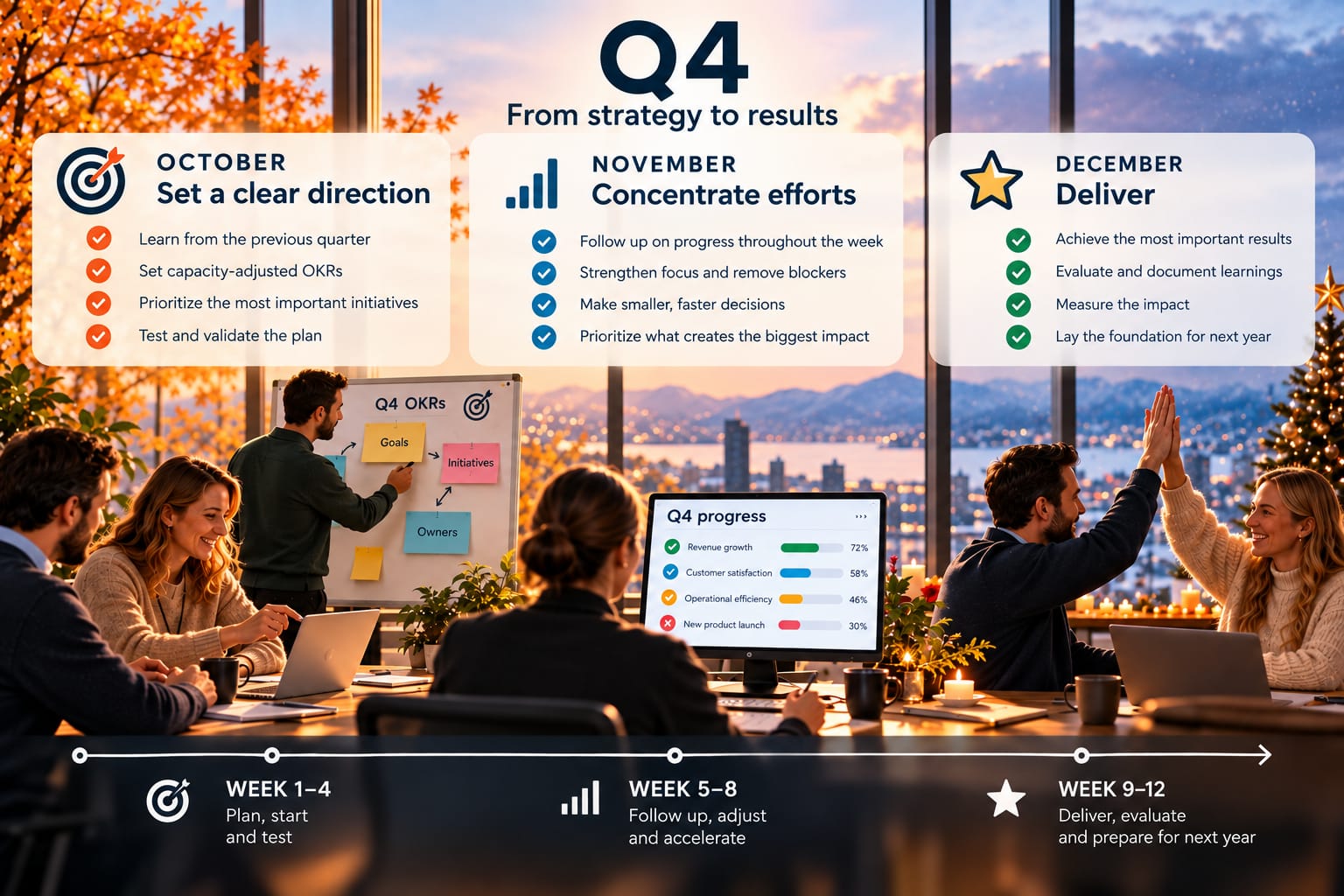
Ironically, AI's biggest contribution to OKRs probably isn't writing them. It's everything that happens afterward.
Preparing for weekly check-ins. Summarizing progress across Key Results. Flagging which initiatives have gone quiet. Pulling together a leadership meeting brief so people walk in already oriented rather than spending the first twenty minutes catching up. Looking back at a quarter and identifying patterns: which teams consistently hit their goals, where the blockers kept appearing, what kinds of objectives the organization is good at and which ones tend to stall.
This is where AI saves real time, because this is the work that leaders often deprioritize when things get busy. And it's exactly the work that keeps execution on track.
The risk worth watching
The biggest danger of AI-generated OKRs isn't that they'll be poorly written. It's that they'll be well-written and still fail.
A beautiful set of OKRs doesn't execute itself. Execution happens in the weekly meetings, the prioritization decisions, the willingness to say no to things that feel urgent but aren't important. None of that lives in ChatGPT. And there's a real risk that organizations spend time polishing goals and walk away feeling like they've done something, when the hard work hasn't started yet.
The practical takeaway
Think of AI as a thinking partner for the parts of strategy that are mostly administrative, drafting, refining language, suggesting metrics, organizing retrospectives. Use it there, and use it freely. It will save you hours.
But the strategic questions, what matters most, what you're willing to trade off, how hard to push, those stay with leadership. They always did. AI just removes some of the friction around the edges, which means you can spend less time staring at a blank page and more time actually debating the things that matter.
That's a good trade. Just don't confuse the time you saved with the work being done.
At Futureworks, we help leadership teams build the habits that turn strategy into consistent execution, with or without AI in the mix.
Ready to put OKRs into practice?
See how Futureworks helps teams align, track, and execute every week.