OKR Cadence: Annual vs Quarterly vs Monthly — Which Is Right?

One of the first decisions every organisation faces when implementing OKRs is how often to set and review them. Should OKRs run annually? Quarterly? Monthly? And does the answer change depending on whether you are talking about company-level objectives or team-level key results?
Cadence is one of the most consequential decisions in an OKR programme and one of the least discussed. Get it right and OKRs become the operating rhythm of the organisation, a living system that keeps teams focused and leadership informed. Get it wrong and you either have goals that are so long-lived they lose their grip on daily decisions, or goals that reset so frequently that teams spend more time planning than executing.
This guide covers every cadence option, when to use each one, how to stack cadences across different levels of the organisation, and how to build the weekly rhythm that makes any cadence work in practice.
What is OKR cadence?
OKR cadence refers to how frequently objectives and key results are set, reviewed, and reset. It defines the tempo of the goal-setting cycle, how long a set of OKRs remains active before the organisation reflects, learns, and sets new ones.
Cadence operates at two levels. The first is the cycle length, how long an OKR runs before it is formally closed and replaced. The second is the review rhythm, how often teams check in on progress within a cycle. These are separate decisions, and confusing them is one of the most common sources of cadence problems.
A quarterly cadence with a weekly check-in rhythm means OKRs run for thirteen weeks, with teams reviewing progress every week within that cycle. A quarterly cadence with a monthly check-in means the same thirteen-week cycle, but progress is only formally reviewed three times. The first approach maintains momentum. The second is where goals quietly die.
The most common OKR cadences
| Cadence | Best for | Pros | Cons |
|---|---|---|---|
| Annual | Company-level strategic direction | Long enough to drive meaningful change; fits budget and planning cycles | Too slow to respond to market shifts; teams lose focus between reviews |
| Quarterly | Department and team OKRs | Right balance of ambition and adaptability; standard for most organisations | Can feel rushed for complex goals; requires disciplined reset each quarter |
| Monthly | Fast-moving teams or early OKR programmes | Frequent feedback loops; easy to correct course | Goals lack sufficient depth; constant resets create planning fatigue |
| 6-week | Product and engineering sprints | Aligns with agile delivery cycles; reduces lag between work and results | Non-standard; harder to align with company-wide quarterly rhythm |
Annual OKRs
Annual OKRs are typically reserved for company-level or executive-level objectives, the strategic priorities that define where the organisation is headed over a twelve-month period. They provide the stable north star that quarterly OKRs navigate towards.
The strength of annual OKRs is their scope. Some meaningful changes simply cannot be achieved in a quarter. Building a new market position, transforming customer experience, or restructuring an organisation are goals that require sustained focus over multiple quarters. Annual OKRs give that focus a formal home.
The risk is drift. An annual objective that is not broken down into quarterly milestones can lose its connection to daily work within weeks. Annual OKRs work best when they are explicitly linked to quarterly OKRs that represent each cycle's contribution to the longer-term goal, not left as standalone aspirations reviewed once at year-end.
Quarterly OKRs
Quarterly is the most widely used OKR cadence, and for most organisations it is the right default. Thirteen weeks is long enough to drive meaningful outcomes, to change something that matters rather than just complete a project, and short enough to stay responsive to a changing environment.
The quarterly cadence also aligns naturally with the business rhythms most organisations already operate on: budget cycles, board reporting, leadership reviews, and planning processes. This alignment makes it easier to connect OKRs to the decisions that actually shape what gets funded and prioritised.
The main risk with quarterly OKRs is rushing the reset. When the planning and review process at the end of each quarter is compressed, teams carry forward goals without genuine reflection, set new goals without adequate thought, and lose the learning that makes each cycle more effective than the last. A strong quarterly cadence requires treating the close and the open of each cycle as seriously as the execution within it.
Monthly OKRs
Monthly OKRs can make sense in specific contexts, fast-moving startups in the early stages of growth, teams that are new to OKRs and need shorter cycles to build confidence, or environments where market conditions change rapidly enough that a three-month goal is genuinely too long.
In most enterprise environments, however, monthly OKRs create more problems than they solve. Thirteen days of effective execution in a four-week cycle is not enough to drive meaningful outcomes. The planning and review overhead is disproportionate to the execution time. And the constant reset creates a planning fatigue that erodes engagement with the programme over time.
If a team feels that quarterly is too long because things change too fast, the solution is usually not a shorter cycle, it is a better mid-cycle adjustment process within the quarterly cadence, and more explicit permission to update key results when circumstances change significantly.
How to stack cadences across the organisation
The most effective OKR programmes use different cadences at different levels of the organisation, with each layer explicitly connected to the ones above and below it.
| Level | Recommended cadence | Who sets them | Review rhythm |
|---|---|---|---|
| Company / executive | Annual + quarterly | CEO and leadership team | Monthly leadership review |
| Department / function | Quarterly | Department head | Weekly check-in + quarterly close |
| Team | Quarterly | Team lead | Weekly check-in + quarterly close |
| Individual | Quarterly (optional) | Individual with manager | 1-on-1 weekly or bi-weekly |
The key principle is that lower-level OKRs should be shorter in cycle than higher-level ones, and every team OKR should be traceable to a department or company objective.
Annual company objectives provide the direction. Quarterly department OKRs define what each function will contribute in each cycle. Team OKRs translate department priorities into the work that actually happens week by week.
When this stack is working well, a team member can look at any key result they own and answer two questions without hesitation: what company priority does this support, and what will be different at the end of this quarter if I achieve it?
The weekly check-in: the cadence within the cadence
Whatever cycle length an organisation chooses, the single most important rhythm is the weekly check-in. This is the cadence within the cadence, the habit that keeps OKRs alive between the quarterly planning session and the quarterly review.
An OKR programme without a weekly check-in rhythm is not a programme, it is a goal documentation exercise. Goals that are written at the start of a quarter and not revisited until the end have no mechanism to influence daily decisions, surface blockers, or course-correct when priorities shift. The weekly check-in is that mechanism.
A good weekly check-in does not need to be long. Fifteen to twenty minutes is sufficient if the format is consistent. The questions that matter are: what progress was made on key results this week, what is blocking progress, and what is the priority for next week? Everything else is secondary.
The organisations that sustain OKR programmes successfully over multiple years are almost universally the ones that treat the weekly check-in as non-negotiable, not a nice-to-have when there is time, but a fixed part of how the team operates every week without exception.
How to choose the right cadence for your organisation
The right cadence depends on three factors: organisational size and complexity, the pace of change in the operating environment, and the maturity of the OKR programme.
Organisational size and complexity
Larger organisations with multiple layers of leadership, many departments, and complex planning processes almost always benefit from a quarterly cadence at team and department level and an annual cadence at company level. The coordination overhead of more frequent resets is too high, and the value of stability, knowing that the priorities set at the start of the quarter will still be the priorities in week eight, outweighs the flexibility of shorter cycles.
Smaller, flatter organisations have more options. A startup with ten people can run monthly OKRs effectively because the coordination overhead is minimal and the whole team has direct visibility of everything. As soon as the organisation grows beyond a single team, quarterly becomes more appropriate.
Pace of change
Organisations in rapidly changing environments, technology companies, early-stage startups, or teams managing crisis situations, sometimes benefit from shorter cycles. But the answer to a fast-changing environment is rarely a shorter OKR cycle. It is a better mid-cycle adjustment process: explicit permission to update key results when circumstances change materially, combined with a disciplined communication process so the whole team understands what changed and why.
OKR maturity
Organisations that are new to OKRs often find quarterly cycles demanding. The planning and retrospective process takes longer when teams are still learning how to write good OKRs, and the pressure to produce a finished set of goals at the start of a new quarter can feel overwhelming. In these cases, it can help to treat the first one or two quarters as a learning phase, where the goal is to build the habit of setting and reviewing goals, not to produce a perfectly calibrated set of OKRs from day one.
Common cadence mistakes
Setting annual OKRs at team level
Annual OKRs work at company level because they describe a strategic direction that genuinely takes twelve months to achieve. At team level, annual OKRs are almost always too long, they lose their connection to daily work within weeks, and the review mechanism that keeps them alive is too infrequent to create accountability.
No formal cycle close
Organisations that simply roll from one quarter into the next without a formal close and retrospective lose the learning that makes each cycle better. The end of a quarter is as important as the start. A disciplined close process, scoring, reflecting, and drawing explicit conclusions for the next cycle, is what turns OKR from a goal-setting exercise into an execution improvement system.
Confusing cycle length with review frequency
A quarterly OKR does not mean a quarterly review. It means a quarterly cycle with weekly check-ins throughout. This confusion is surprisingly common and is one of the main reasons OKRs fade after the first few weeks of a cycle.
Changing cadence every quarter
Some organisations that are dissatisfied with their OKR results try to fix the problem by changing the cadence, switching from quarterly to monthly, or from monthly to six-weekly. In most cases, cadence is not the problem. The problem is goal quality, check-in discipline, or leadership engagement. Changing the cycle length is a visible change that does not address what is actually broken.
Building a cadence calendar
A practical way to make cadence concrete is to map the full year into a cadence calendar before the first quarter begins. This makes the planning and review commitments visible, ensures they are scheduled rather than improvised, and prevents the common pattern where quarter-end reviews get compressed because there is no time set aside for them.
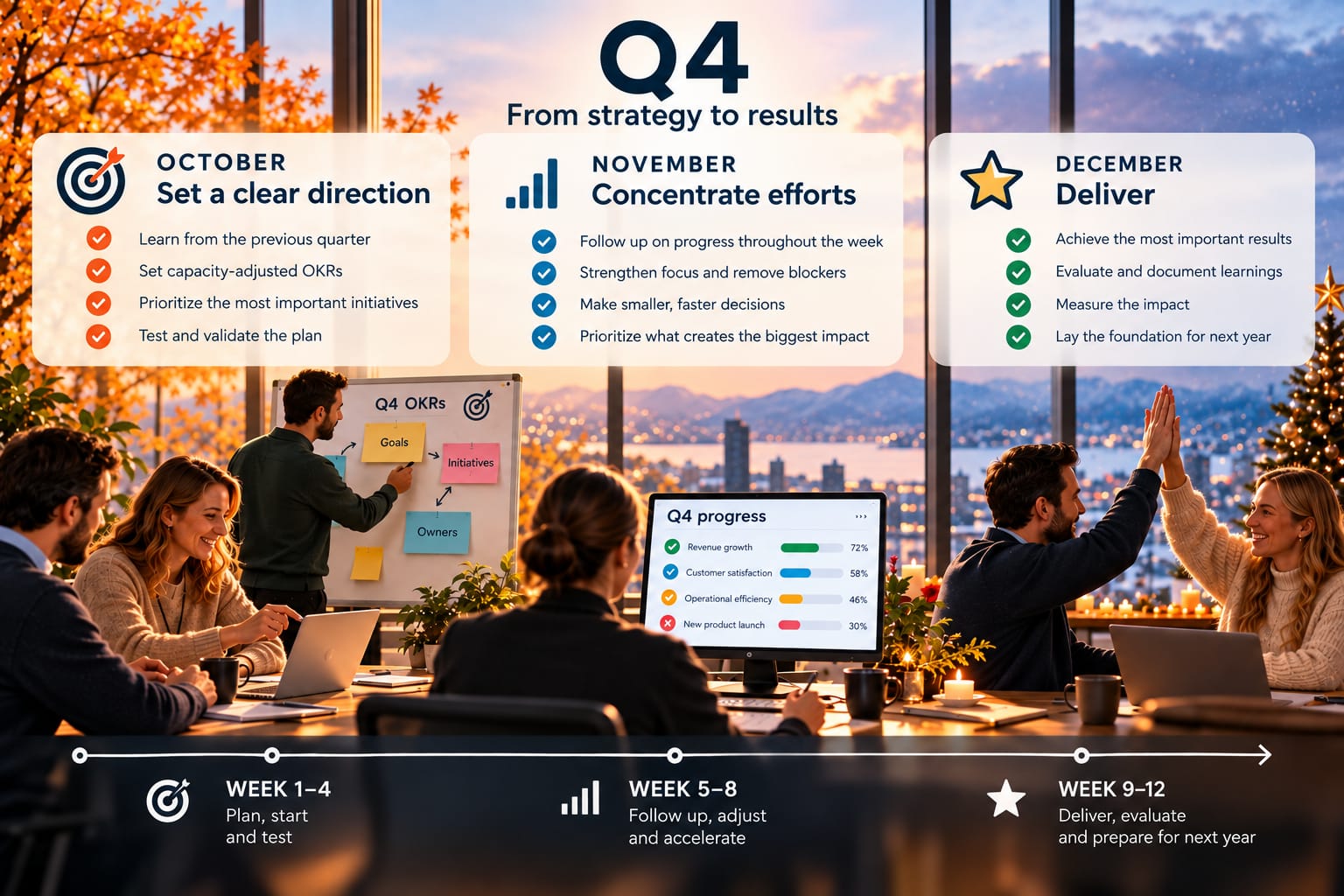
A typical annual cadence calendar for a quarterly programme looks like this. In the final two weeks of each quarter, teams run their retrospective and scoring process and draft OKRs for the next quarter. In the first week of the new quarter, OKRs are finalised, published, and cascaded. From week two through week twelve, weekly check-ins run on a fixed schedule. In week six or seven, an optional mid-cycle review gives teams the chance to course-correct before the quarter is over.
Mapping this out explicitly at the start of the year, and putting the key sessions in every leader's calendar, is one of the simplest and most effective things an organisation can do to ensure the cadence holds throughout the year.
How Futureworks supports OKR cadence
Futureworks is built around the principle that cadence is the foundation of execution.
The platform automates the weekly check-in rhythm, delivering structured reminders through Slack and Teams so the habit runs without being manually managed. Meeting Mode provides a consistent format for each check-in, with timed agendas, OKR status updates, and action tracking built in.
The 360 Vision alignment view makes the connection between annual company objectives, quarterly department OKRs, and team key results visible in real time, so every team member can see exactly where their work sits in the broader cadence structure.
And at the end of each quarter, the platform provides the progress data that feeds directly into the retrospective, making the cycle close as easy to run as the cycle itself.
If you want to see how cadence works in practice, request a demo to explore the platform.
Ready to put OKRs into practice?
See how Futureworks helps teams align, track, and execute every week.