OKRs for Leaders: The Complete Guide to Goal Setting That Actually Works

Many leaders set goals once a year and hope the organization finds its own way forward.
It rarely does.
OKRs (Objectives and Key Results) are a goal-setting framework that helps leaders close the gap between strategy and execution, making goals an active part of how teams work week after week.
This guide is written for leaders, whether you're new to OKRs, considering implementing them, or looking to make your current OKR practice more effective.
Executive Summary for Busy Leaders
Don't have time to read the entire article? Here's what matters most:
- OKR stands for Objectives and Key Results. It is a goal-setting framework developed at Intel and popularized by Google.
- An Objective describes what you want to achieve: ambitious, inspiring, and qualitative.
- Key Results describe how you'll know you've succeeded: specific, measurable, and time-bound.
- Set a maximum of 3 objectives and 2–4 key results per objective. Less is more.
- OKRs work best in quarterly cycles with weekly or bi-weekly check-ins.
- Leadership is critical: OKRs fail when leadership teams don't actively use them in meetings and decision-making.
- The most common mistake is setting too many goals and failing to follow up consistently.
- Use a retrospective at the end of each cycle to learn and adjust.
- OKRs are not a reporting system, instead they are a focus tool.
What Are OKRs?
OKR stands for Objectives and Key Results.
It is a goal-setting framework that helps organizations define clear objectives and measure progress in a structured way.
The framework was originally developed by Andy Grove, CEO of Intel, in the 1970s. It was later adopted by Google in 1999 and has since become a standard approach to goal management in technology companies and beyond.
Organizations such as Google, Spotify, LinkedIn, Airbnb, and Netflix use OKRs to align teams and drive execution.
What Makes OKRs Different?
Traditional goals are often vague, top-down, and rarely revisited.
OKRs are designed to create:
- Focus – Choose the most important priorities, not everything you wish you could do.
- Transparency – Everyone can see the goals, not just senior leadership.
- Alignment – Teams and individuals connect their work to organizational priorities.
- Learning – Regular reviews make it possible to adjust course along the way.
OKRs vs KPIs: What's the Difference?
This is one of the most common questions leaders ask.
The answer is simple: they are not competitors, instead they complement each other.
| OKRs | KPIs | |
|---|---|---|
| Purpose | Drive change and strategic progress | Monitor ongoing performance |
| Time horizon | Quarterly or semi-annual | Continuous or monthly |
| Ambition level | Stretch goals | Expected performance |
| Focus | What we want to improve now | What we must maintain |
| Quantity | Few | Often many |
A useful rule of thumb:
- KPIs tell you whether the ship is staying afloat or not.
- OKRs tell you whether you're sailing in the right direction.
How to Build an Effective OKR Set
A strong OKR structure contains:
- 1–3 Objectives
- 2–4 Key Results per Objective
What Makes a Good Objective?
A good Objective should:
- Describe a clear direction
- Be inspiring and motivating
- Avoid numbers
- Answer the question: What do we want to achieve?
Weak Objective: Improve customer service.
Strong Objective: Make our customers the most satisfied in the industry.
What Makes a Good Key Result?
Key Results should:
- Be measurable
- Have a deadline
- Be ambitious but achievable
- Answer the question: How will we know we've succeeded?
Example Leadership Team OKR
Objective: Make our customers the most satisfied in the industry.
Key Results:
- Increase NPS from 32 to 50 by the end of the quarter
- Reduce average response time from 4 hours to 1 hour
- Resolve 90% of customer complaints at first contact (up from 65%)
Objective: Build a team ready for growth.
Key Results:
- Hire and onboard 3 new employees by Q3
- Complete performance and development conversations with 100% of team members
- Increase employee engagement score from 68 to 80
The OKR Cycle: How It Works in Practice
OKRs are not something you set once per quarter and forget. They are a rhythm.
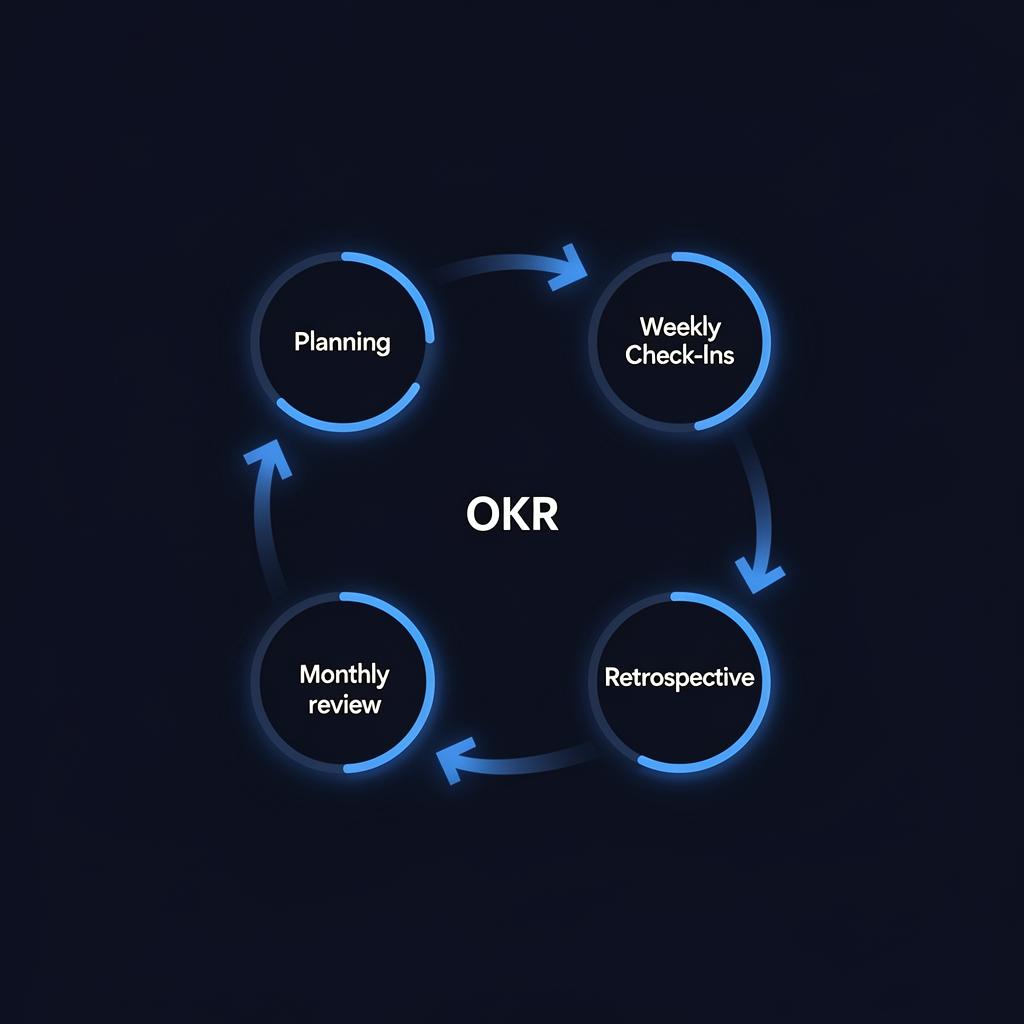
1. Planning (Beginning of the Quarter)
- Leadership defines company OKRs
- Teams create supporting OKRs
- Alignment is reviewed across departments
2. Weekly Check-Ins
Short meetings focused on:
- Progress since last week
- Priorities for the coming week
- Obstacles and blockers
3. Monthly Reviews
A deeper review focused on:
- Progress
- Learnings
- Potential adjustments
4. Quarterly Retrospectives
At the end of the quarter:
- Score each Key Result
- Review lessons learned
- Define improvements for the next cycle
The Leader's Role in OKR Success
Here's a truth many organizations discover the hard way:
OKRs succeed or fail based on leadership behavior.
Implementing OKRs is not enough. Leaders must actively use them.

Use OKRs in Daily Leadership
Ask questions such as:
- Which Key Results are we focused on right now?
- What have we learned since the last review?
- How does this initiative support our OKRs?
When leaders consistently ask these questions, OKRs become part of everyday work rather than a quarterly exercise.
Create Psychological Safety
People must feel comfortable reporting challenges.
If teams are afraid to show red status indicators, leaders lose visibility into the problems they need to solve.
Respond to setbacks with curiosity:
- "What is making this difficult?"
- "What support do you need?"
Model Focus
Nothing kills OKRs faster than leaders who continuously introduce competing priorities.
Strong OKR leadership means being willing to say no.
Common OKR Mistakes
Too Many Goals
The most common mistake. If everything is a priority, nothing is. Stick to a maximum of three Objectives.
No Connection to Strategy
Every Objective should answer: Why is this important right now? If it doesn't, reconsider it.
Set and Forget
Without regular reviews, OKRs become a list of good intentions. The rhythm is what creates results.
Using OKRs as a Control Mechanism
OKRs should encourage focus, learning, and progress, not fear. They are not performance management systems.
Lack of Leadership Buy-In
If managers and team leaders don't feel ownership, engagement disappears quickly. Involve teams in creating their own OKRs within the broader strategic framework.
Unrealistic Ambition
OKRs should stretch people without discouraging them. Google's well-known guideline suggests that achieving around 70% of Key Results often represents success.
How to Implement OKRs in Your Organization
Step 1: Start With Why
What challenge are you trying to solve? More focus? Better execution? Improved alignment? The clearer the reason, the easier adoption becomes.
Step 2: Start Small
Don't launch OKRs across the entire organization immediately. Begin with:
- The leadership team
- One department
- One pilot team
Learn and adjust before scaling.
Step 3: Invest in Training
OKRs are simple to understand but difficult to master. Make sure everyone understands:
- What makes a good Objective
- What differentiates a Key Result from a task
- How reviews and check-ins work
Step 4: Make Goals Visible
Goals hidden in a document rarely influence behavior. Keep OKRs visible in:
- Dashboards
- Meeting agendas
- Weekly updates
- Team discussions
Step 5: Celebrate Progress
Recognize wins and learning along the way. Organizations that celebrate progress maintain engagement over time.
Step 6: Be Patient
It often takes one to two years for OKRs to become embedded in company culture. Organizations that succeed with OKRs continuously refine their approach.
OKRs in Different Contexts
OKRs for Leadership Teams
Leadership OKRs should:
- Reflect the organization's most important strategic priorities
- Be clearly communicated
- Be integrated into leadership meetings and decisions
OKRs for Teams
Teams should create their own OKRs within the strategic framework provided by leadership. Ownership matters.
OKRs in the Public Sector
OKRs work equally well in public organizations. Focus on outcomes rather than outputs.
Instead of: "We will publish three reports."
Try: "Citizens will experience shorter processing times."
Frequently Asked Questions
How often should we set OKRs?
Quarterly cycles are most common. Some organizations use annual strategic objectives with quarterly Key Results.
Should OKRs be tied to bonuses?
Most experts recommend against it. When compensation is tied to OKRs, people tend to set safer goals.
What if priorities change mid-quarter?
OKRs are not contracts. If circumstances change significantly, adjust them. The key is making changes consciously and transparently.
Do we need OKR software?
Not necessarily. Many teams begin successfully with spreadsheets or shared documents. As organizations grow, dedicated OKR platforms can improve visibility and alignment. The tool matters less than the habits.
Conclusion: OKRs Are a Leadership and Culture Tool
OKRs are not software. They are not reporting. They are not simply another management process.
OKRs are a leadership discipline.
Organizations that succeed with OKRs share several characteristics:
- Leaders actively use OKRs in meetings and decisions
- Teams own their goals
- The organization values focus over endless priorities
- Learning is prioritized alongside performance
Building that culture takes time. The reward is an organization capable of turning strategy into action week after week, quarter after quarter.
Because ultimately, strategy only creates value when it gets executed.
Futureworks helps leaders and leadership teams implement OKRs as part of a stronger strategy execution culture. Contact us to learn more.
Related Articles
Ready to put OKRs into practice?
See how Futureworks helps teams align, track, and execute every week.