Futureworks vs. Weekdone: Which OKR Platform Is Best for You?

Futureworks vs. Weekdone: Built to Last or Built to Start?
Weekdone has a lot of fans. And for good reason, it is easy to set up, affordable, and does a decent job of keeping small teams aligned around weekly priorities. For a department pilot or an early experiment with OKRs, it gets people moving quickly.
The problem shows up when organisations try to grow with it.
What works for a team of fifteen starts to crack under the weight of a hundred. Alignment views that made sense at department level stop holding together when strategy needs to travel across divisions, leadership layers, and hundreds of individual contributors.
The weekly check-in habit that felt like a feature becomes a limitation when it is the only execution mechanism on offer.
Futureworks is built for what comes after Weekdone. Not as a heavier, more complex version of the same thing, but as a platform designed from the ground up for the scale, structure, and accountability demands of Nordic enterprise and public-sector organisations.
Why compare Futureworks and Weekdone?
Weekdone frequently appears on Nordic shortlists because of its European roots and accessible price point. It is a familiar name, easy to demo, and quick to spin up. For organisations just starting out with OKRs, that combination is genuinely appealing.
But the comparison changes significantly once organisational complexity enters the picture. Weekdone was designed around the weekly planning rhythm of small, flat teams.
It was not designed to carry the weight of a 500-person enterprise running OKRs across ten departments, three leadership tiers, and a board that wants strategic visibility in real time.
Futureworks was. The permissions model, the alignment dashboards, the coaching infrastructure, and the AI-assisted execution tools are all built for that environment, not bolted on as the product scaled up, but present from the beginning because that is the audience it was designed to serve.
If your organisation is already feeling the limits of what Weekdone can hold, or if you are evaluating platforms before those limits are reached, this comparison will help you understand exactly what you would be moving towards.
Futureworks vs. Weekdone: head-to-head comparison
See how the platforms compare on the capabilities that matter most for enterprise execution.
| Feature | Futureworks | Weekdone |
|---|---|---|
| Origin & ICP Fit | Born in Norway. Built for Nordic enterprises and public-sector orgs. | Estonian-built. Originally designed for small teams and weekly status reporting. |
| Core Focus | Strategy execution, alignment, habits, and accountability at scale. | Weekly planning and OKR check-ins for small-to-mid-size teams. |
| Ease of Use | Nordic-simple design with an execution rhythm built for complex orgs. | Simple interface optimised for individual and small team use. |
| Check-ins & Habits | Weekly check-ins, AI nudges, and execution rituals across the whole org. | Weekly check-ins are central, works well at team level, struggles at scale. |
| AI Capabilities | AI Context Engine turns strategy docs into OKRs, contextual suggestions. | Limited AI capabilities, primarily a manual planning and reporting tool. |
| Alignment View | Deep multi-level visibility from company to individual OKRs. | Basic alignment views, limited visibility across departments and leadership layers. |
| Org-Wide Dashboards | Tracks engagement, alignment health, and progress across the full organisation. | Team-level summaries, not designed for org-wide strategic visibility. |
| Coaching & Onboarding | Hands-on Nordic OKR coaching and rollout support included. | Self-serve onboarding, no coaching offering. |
| Enterprise Readiness | Advanced permissions, Nordic security, built for large org-wide rollouts. | Suited to small-to-mid teams, enterprise features limited. |
| Public Sector Fit | Proven deployments in Nordic government and public institutions. | No meaningful public-sector references or compliance positioning. |
| Integrations | Slack, Teams, Jira, Power BI, Excel, Azure AD, Google Workspace. | Slack, Teams, Jira, Google Workspace, adequate for small team needs. |
| Pricing | Transparent enterprise plans, coaching available. | Low entry price point designed for small teams and departments. |
Which OKR platform is right for your organisation?
Choose Futureworks if you want:
1. OKRs that scale across the whole organisation, not just one team
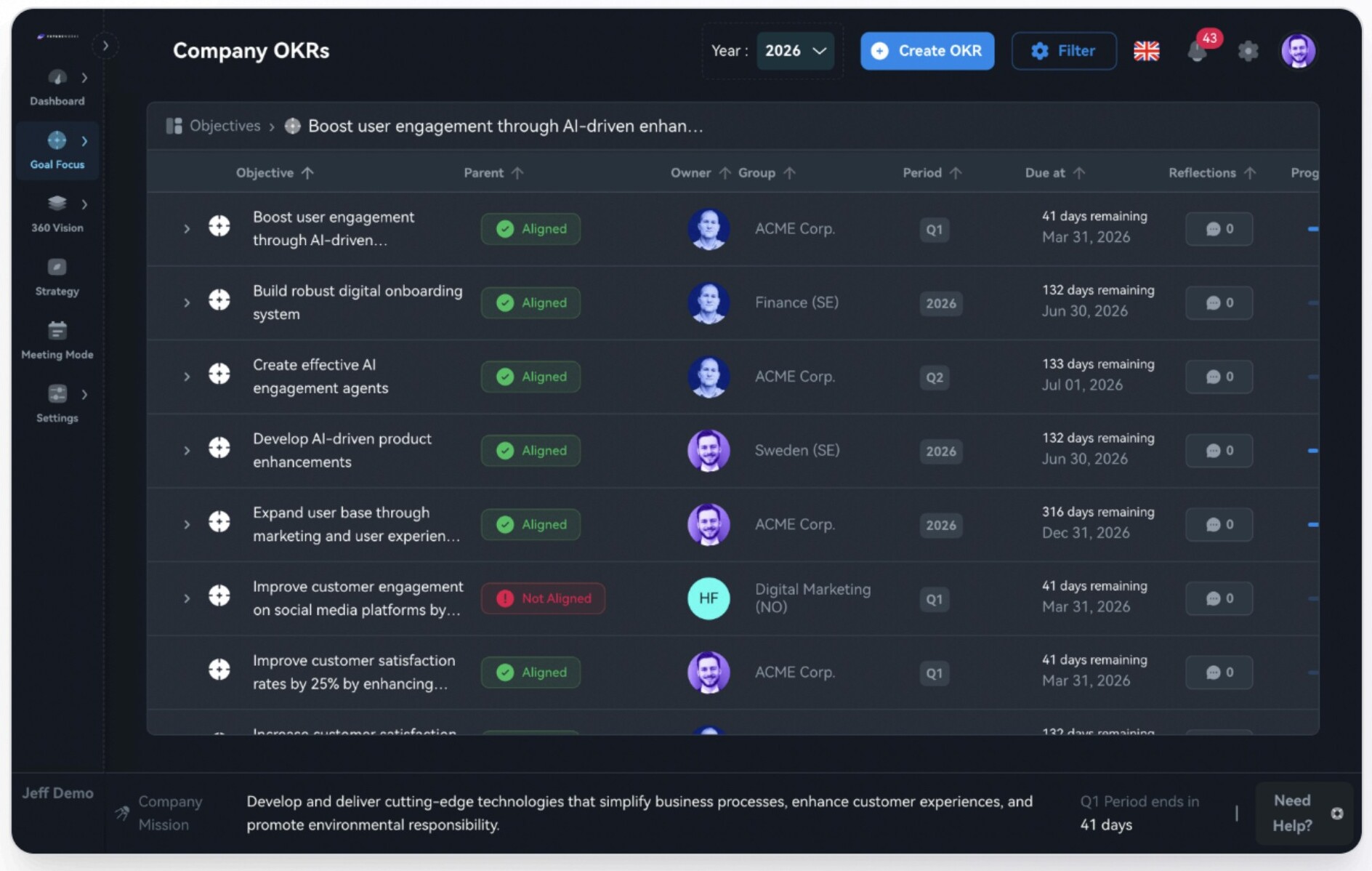
Weekdone's check-in model works at team level. It starts to lose coherence when you need a single, consistent view of how a company-wide objective is progressing across multiple departments, each with their own contributing key results. Futureworks is built for exactly that, multi-level alignment that stays clear and actionable as complexity grows.
2. Enterprise infrastructure that does not require workarounds
As organisations grow, so do their requirements around permissions, security, identity management, and governance. Weekdone was not designed with these in mind. Futureworks was, with advanced role-based permissions, Nordic security standards, and an architecture that supports large, multi-team rollouts without the manual configuration work that Weekdone eventually demands.
3. Coaching that makes the rollout stick
The most common reason OKR programmes fail is not the software, it is that the habits never took hold beyond the initial enthusiasts. Futureworks provides hands-on OKR coaching from local experts who have run these programmes in Nordic enterprises and government organisations. Weekdone offers no equivalent.
When the rollout gets hard, you are on your own.
Choose Weekdone if you want:
1. A fast, low-friction start for a small team
If you are running a pilot with one team or department and need something operational within a day or two, Weekdone's simplicity is a genuine advantage. There is minimal setup, a low learning curve, and enough structure to get a basic OKR rhythm going quickly.
2. A budget-friendly option for early OKR experimentation
For organisations not yet ready to commit to an enterprise platform, Weekdone's pricing makes it an accessible way to test whether OKRs gain traction internally before investing in a full rollout.
3. Weekly reporting as the primary use case
Weekdone's roots are in weekly status updates and planning. If your primary need is a structured way to collect and share team progress each week, rather than a full strategy execution system, it covers that use case adequately.
Which OKR platform meets your needs?
Use the table below to match your priorities to the right solution.
| Business Need | Futureworks | Weekdone |
|---|---|---|
| Enterprise-scale OKR management | Built for it | Not designed for this |
| Multi-level alignment visibility | Advanced, org-wide | Team level only |
| Nordic public-sector readiness | Proven implementations | No references |
| Hands-on OKR coaching | Included or available | Not offered |
| Weekly execution habits | Embedded across the whole org | Strong at small team level |
| AI-assisted strategy execution | AI Context Engine | Not available |
| Advanced permissions and security | Enterprise-grade | Basic |
| Fast setup for a small team | Available | Strong fit |
| Low-cost entry for a department pilot | Possible | Well suited |
Final verdict
Weekdone is a reasonable starting point. It lowers the barrier to trying OKRs, and for small teams it does enough to be useful. There is no shame in having started there.
But there is a ceiling, and most Nordic enterprises hit it sooner than they expect. The moment OKRs need to span more than one or two teams, the moment leadership needs strategic visibility rather than team summaries, or the moment a rollout requires real change management support, Weekdone runs out of road.
Futureworks is what organisations move to when they are serious about making OKRs work at scale. Built for Nordic complexity, supported by local expertise, and designed to carry strategy from the boardroom to the front line, week after week, not just at the start of the quarter.
Ready to see Futureworks in action?
Discover how Nordic teams are turning strategy into results, week by week. Get in touch to see Futureworks live.
Ready to put OKRs into practice?
See how Futureworks helps teams align, track, and execute every week.