The Missing Link in OKRs: How to Run Effective Check-ins

Many organizations implement OKRs with strong intentions, clear objectives, measurable key results, and leadership alignment. Yet execution still falls short. Progress stalls, priorities drift, and OKRs quietly fade into the background.
The issue is rarely the quality of the OKRs themselves.
The real problem is the missing operating rhythm: effective, consistent check-ins.
Without structured check-ins, OKRs remain static documents. With them, they become a living system that drives execution.
Why Check-ins Are the Missing Link
OKRs are not a quarterly exercise, they are a weekly discipline.
Check-ins serve three essential purposes:
- Maintain focus: Re-anchor teams on what matters most
- Drive accountability: Make progress visible and owned
- Enable course correction: Address risks before they become problems
Without this cadence, even the best-defined OKRs lose momentum.
Make OKRs Part of Existing Meetings (Not Another Meeting)
One of the most common mistakes is treating OKR check-ins as an additional meeting.
That approach fails quickly.
Leaders are already managing full calendars, and adding "one more meeting" creates resistance. Instead, OKRs must be embedded into existing weekly or bi-weekly leadership and team meetings.
This shift is critical:
- OKRs become part of how the team operates, not an extra task
- Discussions stay grounded in strategic priorities
- Meetings become more focused and outcome-driven
A good rule:
If a meeting discusses priorities, performance, or progress, it should be anchored in OKRs.
The Discipline of Effective Check-ins
Effective OKR check-ins are:
- Short (typically 15–30 minutes)
- Focused (only on what matters)
- Prepared (no real-time thinking from scratch)
- Consistent (same cadence, same structure)
They are not status meetings. They are execution conversations.
Roles and Responsibilities
Clarity on roles is essential to keep check-ins efficient.
Meeting Owner (Leader or Team Lead)
- Facilitates the meeting
- Keeps time and focus
- Challenges unclear updates
- Ensures decisions are made
OKR Owners (Participants)
- Come prepared with updates
- Report on progress, not activities
- Highlight risks and blockers
- Propose actions where needed
Who Should Attend
- Only those directly responsible for the OKRs discussed
- Cross-functional stakeholders when relevant
Avoid over-inviting. The goal is relevance, not inclusivity for its own sake.
Too many participants dilute focus and slow decision-making.
Preparation: The Non-Negotiable
An effective check-in starts before the meeting.
All participants must:
- Update their key results in advance
- Identify risks or blockers
- Be ready to answer: Are we on track? If not, why?
If preparation is missing, the meeting becomes inefficient, and quickly loses value.
Suggested Cadence
- Weekly: For fast-moving teams or critical OKRs
- Bi-weekly: For more stable environments
Consistency matters more than frequency. Choose a rhythm and stick to it.
Example Agenda (Inspired by Futureworks Meeting Mode)
Below is a practical, leadership-friendly structure designed to keep meetings short, focused, and effective.
Duration: 20–30 minutes Owner: Team Lead / OKR Owner Participants: Only directly relevant stakeholders
1. Opening & Focus (2 minutes)
- Reconfirm the objective(s) in focus
- Align on priorities for this check-in
2. Key Result Progress Review (10–15 minutes)
For each key result:
- Current status (on track / at risk / off track)
- Progress since last check-in
- Key insight (what changed or learned)
Focus on:
- Movement, not description
- Outcomes, not activities
3. Risks & Blockers (5–8 minutes)
- What is at risk?
- What is blocking progress?
- Where is support needed?
This is the most critical part of the meeting.
Surface issues early, this is where execution improves.
4. Decisions & Actions (5 minutes)
- What actions are required before next check-in?
- Who owns each action?
- Are priorities still correct?
Keep it concrete and accountable.
5. Close (1–2 minutes)
- Confirm next steps
- Reaffirm focus until next check-in
What Good Check-ins Feel Like
When done well, OKR check-ins:
- Are fast and energizing, not draining
- Create clarity, not confusion
- Surface real issues, not polished updates
- Drive decisions, not just discussion
They become a natural part of execution, not a forced process.
Common Pitfalls to Avoid
1. Turning Check-ins into Status Reporting Fix: Focus on progress, risks, and decisions, not activities.
2. Lack of Preparation Fix: Require updates before the meeting. No preparation = no value.
3. Too Many Participants Fix: Only invite those directly involved.
4. No Follow-Up Fix: Always end with clear actions and ownership.
5. Inconsistent Cadence Fix: Make check-ins a fixed part of the operating rhythm.
Final Thought
OKRs do not fail because of poor strategy.
They fail because they are not actively managed.
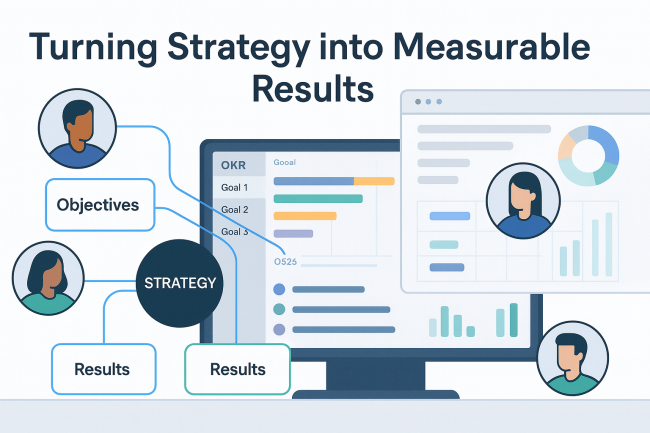
Check-ins are where strategy meets execution, week after week.
If leadership teams embed OKRs into their meeting rhythm, keep discussions focused, and maintain discipline, OKRs stop being a framework…
…and start becoming how the organization actually works.
Redo att omsätta OKR i praktiken?
Se hur Futureworks hjälper team att samordna, följa upp och genomföra varje vecka.