AI vs. the Human Brain: How Leaders Stay Disciplined With OKR Follow-Up
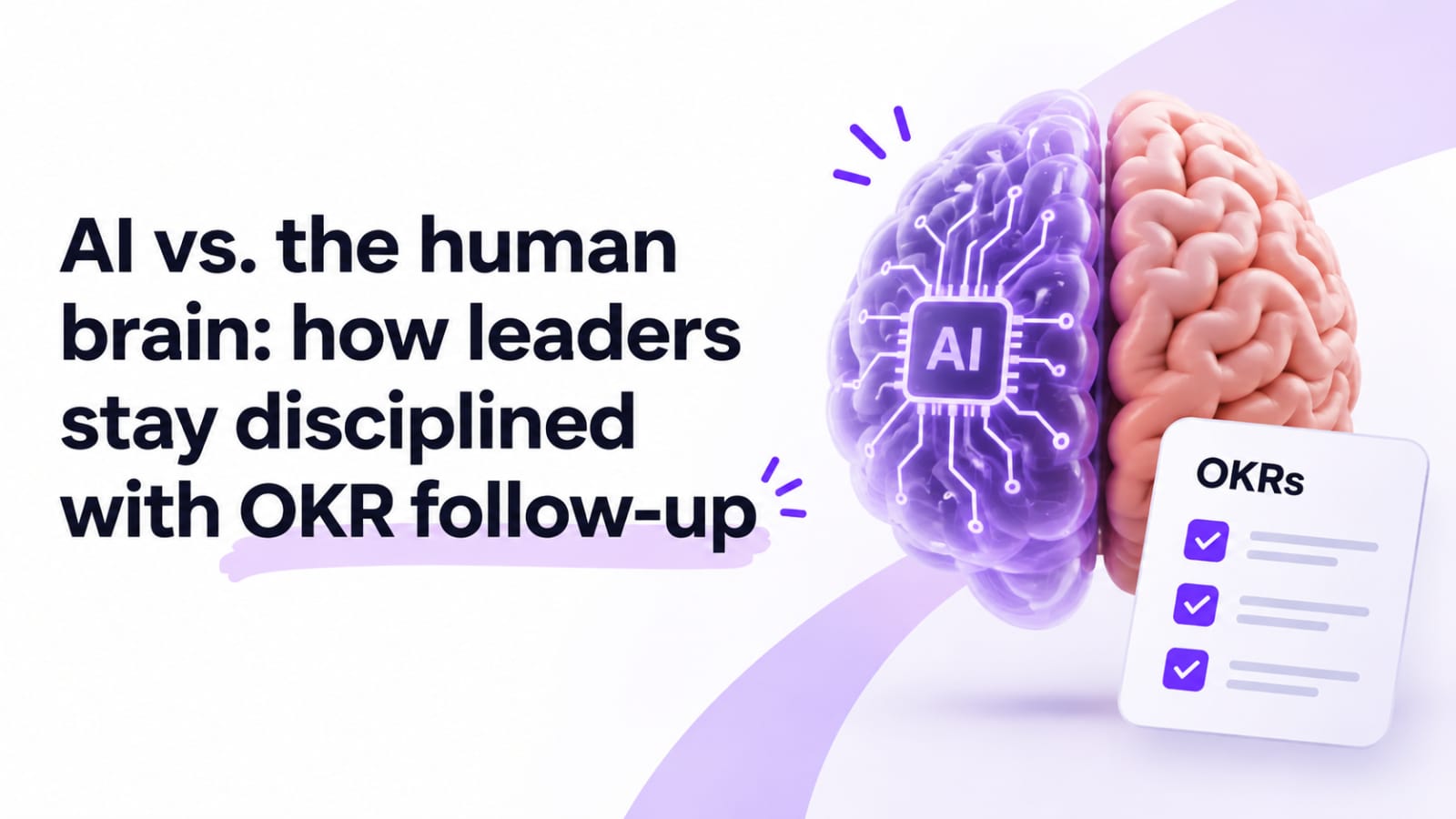
Every leadership team we meet in 2026 has the same question on the table: how much of our job should we hand to AI? It's a fair question. AI can summarise a quarter's worth of updates in seconds, spot a stalled key result before anyone admits it, and draft the agenda for Monday's meeting.
But here's the uncomfortable truth. Most strategies don't fail because leaders lack information. They fail because nobody follows up. Teams set ambitious OKRs in January, review them in March, and discover in April that half of them quietly died in February.
AI won't fix that on its own. Follow-up is a habit, and habits are built by people in a fixed rhythm. This article covers where AI genuinely earns its seat at the leadership table, where the human brain still beats any model, and how to build OKR follow-up discipline with a structured weekly meeting in Futureworks.
The short answer: Use AI for speed, pattern-spotting and preparation. Keep humans in charge of judgment, context, trust and commitment. Then lock both into a weekly OKR meeting where every objective gets a status and a next step.
How AI can help leaders (and where it already does)
AI is already part of how leaders decide, for faster analysis, faster meeting prep, and a faster first draft of a decision. The question for most leadership teams isn't whether to use AI anymore. It's what to use it for.
In strategy execution and OKR work, AI is at its best in five jobs:
- Preparing the meeting. Summarise last week's updates, comments and reflections so the team walks in informed instead of reading slides together.
- Spotting patterns early. Flag key results whose progress has flatlined or objectives with no recent updates.
- Reducing admin. Draft status notes, follow-up actions and meeting minutes so leaders spend time on decisions, not documentation.
- Improving OKR quality. Challenge vague key results ("launch X") and suggest measurable outcomes ("increase X from 42% to 60%").
- Scaling visibility. Roll up progress across teams, countries and business units so a CEO can see the whole picture in minutes.
In short: AI shortens the distance between data and a conversation. It doesn't have the conversation for you.
When the human brain is better than AI
AI gives you answers. Leadership is deciding which answers matter. Leaning on AI too heavily has a cost: leaders who let a model's conclusion override their own read of a situation, or who stop discussing decisions with their team because the AI already "decided," lose something a dashboard can't give back. That's a warning sign, not a productivity win.
The gaps that matter most in leadership are rarely about access to information. They're about judgment, trust, and turning information into a decision everyone actually commits to.
The human brain still wins in five places that matter most for OKRs:
- Context. AI sees that a key result is at 37%. You know the main customer delayed signing because of a reorganisation, and that it will land next month.
- Judgment and trade-offs. Deciding to drop an objective, move people or accept a lower score for a bigger long-term win is a values call, not a calculation.
- Reading the room. A confidence score of 55% can mean "we're on it" or "I'm afraid to say it's dead." Only a person in the conversation hears the difference.
- Accountability and commitment. A model can suggest a next step. Only a person can say "I own this, and I'll have it done by Friday" and mean it.
- Purpose and motivation. People don't get out of bed for a dashboard. They do it for a leader who explains why the work matters.
The winning model isn't AI or human. It's AI for preparation and pattern-spotting, humans for meaning and decisions.
Why OKRs fail: the follow-up gap
OKRs rarely fail at the setting stage. They fail in the weeks after, when daily operations crowd out strategic priorities. Teams that skip a consistent weekly check-in rhythm are far more likely to abandon their OKRs altogether, and teams that run weekly OKR check-ins consistently complete more of what they set out to do than teams that rely on end-of-quarter reviews alone.
The follow-up gap usually shows up in three ways:
- The "we'll look at it next month" drift. Reviews get pushed, and nobody notices a key result has stalled until it's too late to recover.
- Status theatre. Updates say "on track" while confidence quietly drops and no one asks why.
- Talk without commitments. Meetings end with good discussion but no owner, no deadline and no next step.
None of these are technology problems. They're discipline problems. And discipline is easiest when the structure does the heavy lifting.
How to follow up OKRs with the Futureworks Meeting Mode
Futureworks' Meeting Mode turns OKR follow-up into a fixed, time-boxed routine. Instead of a status meeting that drifts, every point on the agenda has a purpose and a timer, and your live OKR data sits right inside the meeting.
A meeting agenda built for execution
A typical weekly leadership meeting in Futureworks runs through seven points in about 40 minutes:
| Agenda point | Time | What happens |
|---|---|---|
| Good news | 1 min | Start with a win. It sets the tone and builds momentum. |
| Follow-ups | 5 min | Check last week's commitments. Done, or why not? |
| OKR status | 10 min | Review every objective's progress, confidence and status. |
| KPIs | 8 min | Check the health metrics that keep the business running. |
| Discussions and decisions | 10 min | Spend time where judgment is needed and make the call. |
| Initiatives | 7 min | Align the work that drives the key results. |
| Weekly priorities | 1 min | Each owner states their top priority for the week. |
The built-in timer shows the active point and the time left, so the meeting keeps its pace and ends on time. That rhythm is what builds discipline: the same structure, the same day, every week.
The OKR status point: where AI-style signals meet human judgment
The OKR status point brings every objective for the period into one view. For each objective, you see the owner, group, due date, number of reflections, progress, confidence and status. You can filter by period, by status (Critical, Off-Track, On-Track, Achieved, Risk) and by alignment, and "Show deviations" pulls the objectives that need attention to the top.
This is exactly where the AI-versus-human split comes alive. The data flags the signals. The leaders in the room interpret them.
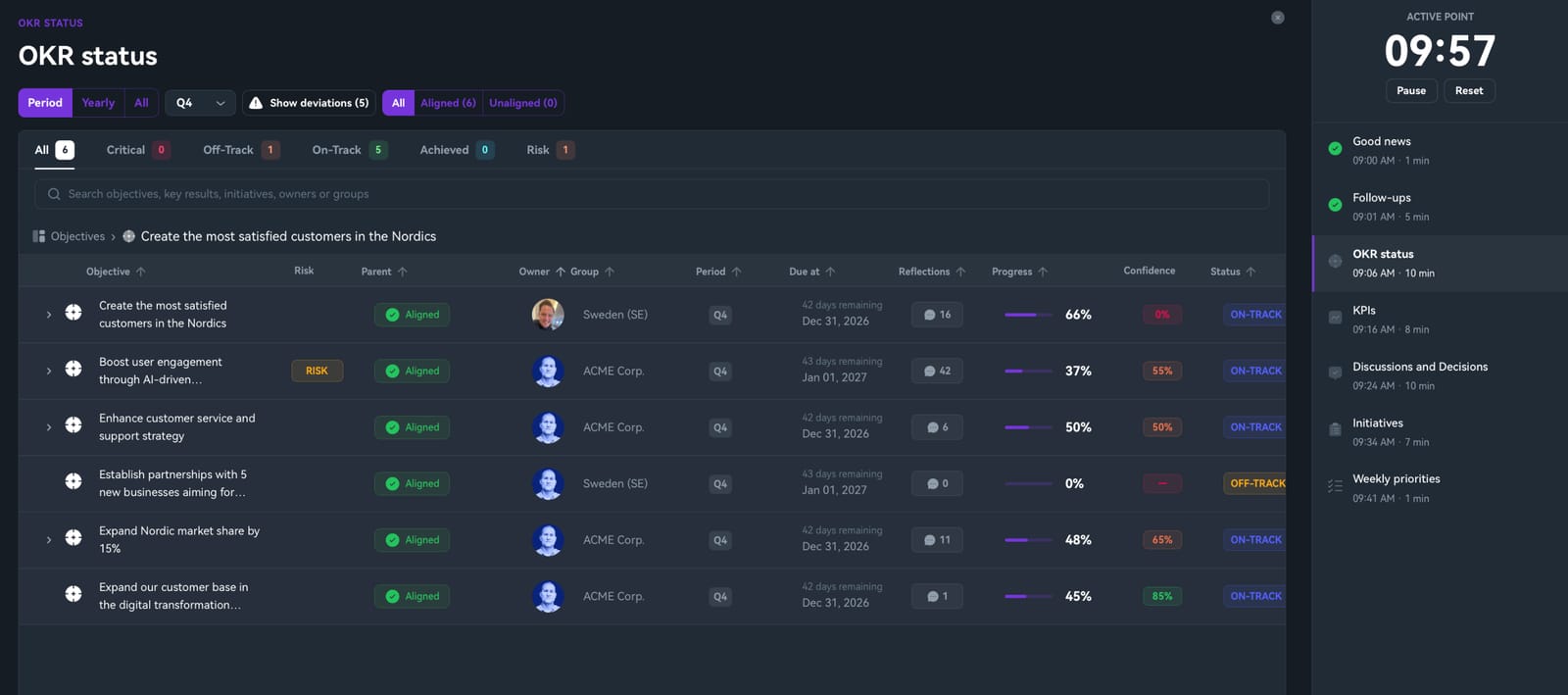
- "Establish partnerships with 5 new businesses" is at 0% progress, has no reflections and is marked Off-Track. The system can surface that. Only the team can decide whether to rescue it, re-scope it or drop it.
- "Boost user engagement through AI-driven…" is flagged as a risk at 37% progress and 55% confidence. That deserves a few minutes of honest discussion, not a nod.
- "Create the most satisfied customers in the Nordics" shows 66% progress but 0% confidence. Numbers alone can't explain that mismatch. A good question from a leader can: "What do you know that the progress bar doesn't?"
That last example is the whole argument of this article in one row. Data and AI tell you where to look. Human judgment tells you what it means and what to do next.
A practical playbook for disciplined OKR follow-up
Use this checklist to build the habit in your leadership team. It takes about four weeks before the rhythm feels natural.
- Fix the day and time. Same slot every week, protected in every leader's calendar. Consistency beats intensity.
- Update before the meeting, not in it. Key result owners record progress, confidence and blockers at least 24 hours in advance, so the meeting is for decisions, not data entry.
- Let AI do the prep. Use AI to summarise reflections, highlight deviations and draft the discussion points. Read the summary before you arrive.
- Start with deviations. Use "Show deviations" and the Off-Track and Risk filters first. On-track objectives need a glance, not a debate.
- Ask about confidence, not just progress. Progress tells you where you are. Confidence tells you where you'll end up. A gap between them is your best discussion starter.
- Decide, then assign. Every discussion ends with a decision, an owner and a deadline, captured in Follow-ups for next week.
- Respect the timer. A meeting that ends on time is a meeting people keep coming to.
- Close with priorities. One sentence per person: "My top priority this week is…" It turns strategy into Monday morning.
Frequently asked questions
How can AI help leaders?
AI helps leaders prepare faster, spot patterns earlier and spend less time on admin. In OKR work, it can summarise updates, flag stalled key results, suggest better-formulated key results and roll up progress across teams.
When is human judgment better than AI?
Human judgment is better when a decision depends on context, values, trade-offs, trust or motivation. Deciding whether to drop an objective, reading why a team's confidence is falling, and getting real commitment from an owner are all human jobs.
How often should leaders follow up on OKRs?
Weekly. A focused weekly check-in takes 15 to 30 minutes, or around 40 minutes as part of a full leadership meeting, and consistently beats a routine built only around quarter-end reviews.
What should an OKR follow-up meeting agenda include?
A strong agenda covers good news, follow-ups from last week, OKR status, KPIs, discussions and decisions, initiatives and weekly priorities. Each point should be time-boxed so the meeting stays focused.
What is the difference between progress and confidence in OKRs?
Progress shows how far a key result has moved. Confidence shows how likely the owner believes it is to be achieved by the deadline. A big gap between the two is often the most important signal in the meeting.
Can AI replace OKR meetings?
No. AI can prepare the meeting and make it shorter, but decisions, accountability and alignment happen between people. The meeting is where data becomes commitment.
The bottom line: let AI prepare, let leaders decide
AI will keep getting better at finding signals in your data. That makes the human part of leadership more important, not less. The leaders who win in 2027 won't be the ones with the most AI. They'll be the ones who combine AI-powered preparation with the discipline to show up every week, ask the hard questions and leave with clear commitments.
Futureworks gives you both: live OKR data with deviations and confidence in one view, and Meeting Mode to turn follow-up into a rhythm your team can actually keep.
Ready to make OKR follow-up a habit? Book a demo of Futureworks and see Meeting Mode in action, or download our free OKR Guide to get your team started. For a deeper walkthrough of running this kind of meeting, our ebook From Meetings to Momentum goes further into the mechanics.
Ready to put OKRs into practice?
See how Futureworks helps teams align, track, and execute every week.