OKRs Built for the Org Chart You Actually Have
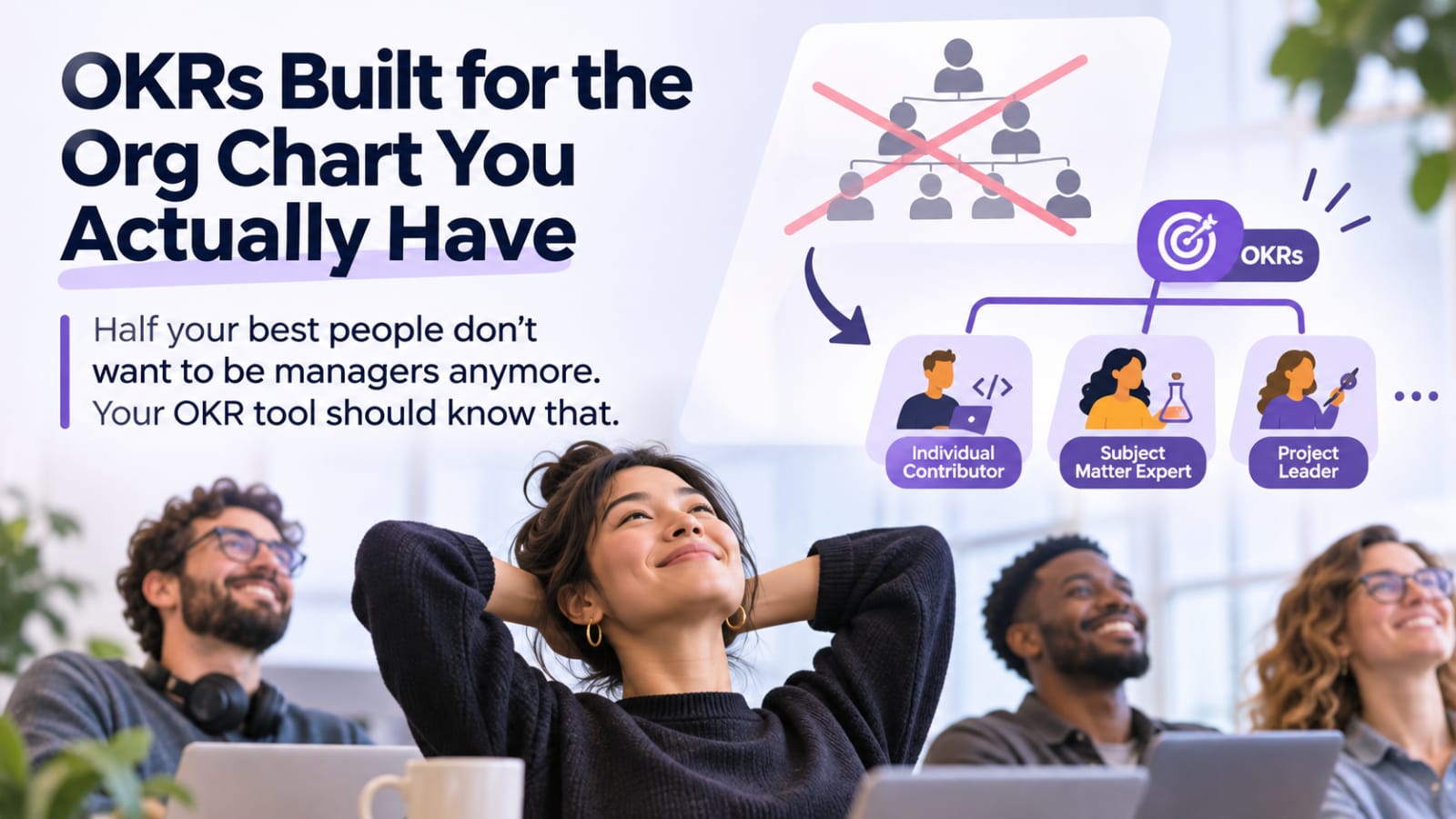
Ask around your org and you'll probably find at least one person who turned down the promotion everyone assumed they'd take. Maybe it's your strongest engineer, or the account lead everyone trusts when a deal gets complicated. They didn't leave. They didn't get passed over. They just said no to becoming someone's manager, and kept doing the work they're actually good at. (Honestly, can you blame them?)
That's not a retention problem. It's a design problem for whatever software your company uses to set and track goals. Most OKR tools were built around one quiet assumption: every Key Result has a manager attached to it, someone whose title comes with the authority to chase it down. When the person doing the real work isn't that person, and increasingly, they aren't, the tool doesn't bend. It just stops reflecting reality.
It's Not Burnout. It's a Different Kind of Ambition.
HR and culture press have a name for what's happening: "conscious unbossing," "job hugging," "quiet ambition" — take your pick, they're describing the same shift. People aren't checking out of work. They're opting out of managing other people, and it's not just junior employees avoiding the climb. Gallup's 2026 workplace data shows manager engagement fell from 27% to 22% in a single year, the steepest one-year drop Gallup has ever recorded, against a backdrop of global engagement sitting at its lowest point since 2020.
One former CMO put it plainly in a Fortune op-ed this year: "I used to be valued for how many people reported to me. Now I'm valued for how good I am at the work itself." That's not someone giving up. That's someone redefining what counts as moving forward.
The easy read is to treat this as a problem to manage around — a succession headache, a pipeline gap. The more useful read: fewer people chasing the manager title isn't a shortage of ambition. It's ambition that finally has somewhere else to go. Good news, if your systems can keep up with it.
Most OKR tools were built for an organizational chart that's disappearing
Here's the quiet assumption baked into almost every goal-setting platform on the market: a Key Result gets assigned to a role, the role reports up through a manager, and the manager is the one accountable for chasing the number. Reasonable enough if your org chart actually still works that way.
Increasingly, it doesn't. A senior individual contributor owns a Key Result because they're the only one who actually understands the problem. A flat pod ships a quarter's worth of work with no single "owner" in the traditional sense, just a few people who split it by what they're each best at. A lead rotates every cycle because the team decided that's how they want to run it.
None of that is dysfunction. It's just what alignment looks like when fewer people want the manager seat. But when your OKR tool only knows how to assign ownership to a job title, someone ends up forcing square pegs into round holes every quarter, naming a "manager of record" who isn't managing anything, just so the software has somewhere to put the accountability.
Ownership that follows the work, not the title
This is the part of Futureworks built specifically for that mismatch. Every goal, Key Result, and initiative in Futureworks has a single named owner, so accountability never gets vague, but that owner doesn't need to have direct reports, and they don't need to be anyone's manager. It can be a senior individual contributor who's closest to the work, a subject matter expert, or whoever the team agreed should carry it this cycle.
In practice, that means:
- A Key Result's owner is a person, not a job title. The platform doesn't require that person to sit above anyone else on an org chart, or to have the word "manager" in their title.
- Leadership sees progress directly, through 360 Vision's goal tree, the same way as any other Key Result, without needing a manager to roll it up by hand. That matters more, not less, as management layers get thinner.
- A goal, Key Result, or initiative can link to another team's goal it depends on, so cross-team work stays visible even when it doesn't flow through a management chain. It's a support link, not a transfer of ownership: the dependency is visible, but accountability stays exactly where it already was.
It's the same principle Futureworks has always built around — complete alignment from strategy to daily action — applied to a workforce that's organizing itself differently than it did five years ago.
Three questions worth asking before next quarter
You don't need new software to start fixing this. Before your next OKR cycle, ask three questions about every Key Result on the board:
- Who actually touches this work day to day, and is that the name attached to it? If the answer is "their manager," check whether that's true or just tidy.
- Would this Key Result survive a re-organization? If ownership only makes sense because of where someone sits on today's chart, it's fragile by design.
- If the person doing the work doesn't want to be a manager, does your process still let them own the outcome? If the honest answer is no, that's the gap — not the person.
None of this requires everyone to get a new title. It requires a goal-setting process, and the tool underneath it, that doesn't need one.
Build OKRs for the organization you have, not the one on the chart
The shift away from management-as-the-default-path isn't going away, and it isn't a crisis to manage around. It's a chance to build alignment that actually matches how your best people want to work. Which, if you ask them, is usually "let me own this and get out of my way."
Futureworks is built for exactly that: an owner is whoever's actually accountable for the outcome, not whoever holds the title. If you're rethinking how goal ownership works on your team, you can learn more at futureworks.no.
Frequently asked questions
What is "conscious unbossing"?
The trend of capable employees — not just Gen Z — deliberately turning down management roles to stay hands-on in their craft, choosing depth of expertise over headcount and title.
How do you assign OKR ownership without a traditional manager?
Assign each Key Result to whoever is actually doing the work rather than defaulting to their manager, and track accountability by that named owner rather than by where they sit on the org chart.
Why do most OKR tools assume a management layer?
Most goal-setting platforms were designed around a traditional hierarchy where a manager owns and reports on each team's Key Results — an assumption that breaks down as fewer people want that role.
Does Futureworks require OKR owners to be managers?
No. Every goal, Key Result, and initiative in Futureworks has a single named owner, but that owner doesn't need to have direct reports. It can be a senior individual contributor who's closest to the work, with leadership still getting direct visibility into progress without a manager relaying it.
Ready to put OKRs into practice?
See how Futureworks helps teams align, track, and execute every week.