Why Your Strategy Looks Great on Paper but Fails in Practice

Most companies don't struggle to come up with a strategy. The real challenge begins when the planning is over and everyone goes back to work.
It's Friday afternoon. The leadership team has just wrapped up a two-day strategy workshop.
There have been good discussions, a few disagreements, and some important decisions about where the company needs to go. You've looked at the market, talked about opportunities and challenges, and agreed on what should matter most over the coming years.
For once, it feels like everyone is on the same page.
The strategy is documented, the presentation looks good, and people leave the room with a sense of direction. There's genuine enthusiasm about what the company can achieve.
Then Monday comes.
A customer needs something urgently. A project is running behind schedule. Someone needs approval for an unexpected expense. The sales team has identified an opportunity that wasn't part of the plan, and a manager is struggling to find enough people to deliver on existing commitments.
By Wednesday, most people are back to doing what they were doing before the workshop.
Not because they've forgotten the strategy, or because they disagree with it. It's simply that the day-to-day reality of running a business has a way of taking over.
Three months later, the leadership team gets together to review progress. Some initiatives are moving forward, others have barely started, and a few have taken on a life of their own. Everyone has been busy, but it's surprisingly difficult to explain what has actually changed as a result of the strategy.
The strategy itself still makes sense.
So what happened?
The problem usually isn't the strategy
When companies struggle to deliver on their strategic ambitions, the natural reaction is often to question the strategy itself.
Perhaps the objectives weren't clear enough. Maybe the market has changed. Or perhaps the leadership team needs to revisit its priorities.
Sometimes that's true. Strategies can be based on assumptions that turn out to be wrong, and circumstances do change.
But quite often, the problem is something else entirely.
The organization has a reasonable idea of where it wants to go. What it lacks is a practical way of connecting that direction to the decisions people make every day.
This is the gap between strategy development and strategy execution.
Strategy development is about deciding what the organization wants to achieve and where it will focus its efforts. Strategy execution is about making those choices part of how the business actually operates.
That sounds straightforward, but it involves a lot more than assigning projects and tracking deadlines.
It requires people across the organization to understand what matters, how their work contributes, and what they should prioritize when different demands compete for their attention.
And perhaps most importantly, it requires leaders to keep having those conversations long after the strategy workshop has ended.
When everyone agrees, but nobody means quite the same thing
Imagine a company that has decided to make customer experience one of its most important strategic priorities.
It's a sensible ambition. The leadership team agrees that improving the customer experience will help the company strengthen relationships, increase retention, and support future growth.
The strategy is presented to employees, and the message is well received.
But what happens next?
The sales department decides to focus on responding to inquiries faster. Customer support wants to reduce waiting times. Product development starts working on usability improvements, while the finance team looks for ways to simplify billing.
All of these initiatives could improve the customer experience.
The problem is that the departments may be working from different interpretations of what the company is actually trying to achieve.
Perhaps the biggest issue isn't response times or billing at all. Perhaps customers are leaving because they struggle to get value from the product during their first few months.
If that's the case, several departments could deliver impressive results against their own targets without making much difference to the company's most important challenge.
This is one reason why communicating a strategy isn't the same as creating alignment.
People may understand the overall ambition without understanding what it means for their own priorities.
And that gap matters.
A strategy becomes useful when it helps people make decisions. When a manager has to choose between two initiatives, the strategy should provide some guidance. When a team is deciding where to spend its time, the strategy should make that choice easier.
If it doesn't, it risks becoming something people agree with in principle but rarely use in practice.
The solution isn't necessarily more communication from the top. Often, it's about involving teams in translating the strategy into something meaningful for their part of the business.
What are we actually trying to improve? What would success look like? How can our team contribute? And what might we need to do differently?
These conversations take time, but they're essential. Without them, even a well-communicated strategy can lead to very different interpretations across an organization.
The uncomfortable truth about priorities
There's another challenge that tends to appear in almost every strategy process.
Most companies want to do too much.
Growth is important. So is profitability. Customer satisfaction matters, but so does innovation. The company needs to become more efficient, attract good people, improve internal processes, and invest in new technology.
Nobody wants to argue against any of these ambitions.
So they all become priorities.
The problem is that calling something a priority doesn't create more time or resources to work on it.
Consider a company that has identified improving profitability as a key strategic objective. At the same time, it's expanding into a new market, introducing a CRM system, reorganizing its sales department, developing new products, and trying to improve employee engagement.
Every initiative may be justified on its own.
But together, they create an enormous amount of work, much of it competing for the same people, budgets, and management attention.
The result is often an organization where everyone is busy, but very little receives the sustained attention needed to create meaningful change.
And when difficult choices have to be made, people naturally focus on what's most urgent.
The customer waiting for an answer gets attention. The project with a deadline gets resources. The problem that lands on the CEO's desk gets solved.
Meanwhile, the strategic initiatives that don't demand immediate attention are quietly pushed further down the list.
This is why prioritization is one of the most difficult parts of strategy execution.
It's relatively easy to agree on what the company should do. It's much harder to agree on what the company won't do, at least not right now.
A useful strategy should help leaders make those choices.
It should create enough clarity that managers feel comfortable saying no to activities that don't support the most important objectives, even when those activities seem valuable.
We've explored this in our article on setting realistic OKRs for the final quarter, where one of the central ideas is that a clear understanding of what not to prioritize can be just as valuable as the objectives themselves.
Because ultimately, a strategy that doesn't help an organization make choices isn't doing much of its job.
The distance between the boardroom and everyday work
One of the more interesting things about strategy execution is how differently strategy and everyday work are often managed.
Strategy tends to live in presentations, annual plans, and leadership discussions.
Everyday work happens somewhere else entirely.
It happens in customer meetings, project management tools, emails, team discussions, and the countless small decisions people make throughout the week.
For many employees, these two worlds rarely meet.
They know the company has a strategy. They may even remember the main priorities. But when they sit down on Monday morning to decide what needs to get done, those priorities aren't necessarily part of the conversation.
Instead, the focus is on tasks, deadlines, and immediate responsibilities.
There's nothing inherently wrong with that. Businesses need operational work to function.
The challenge appears when the organization has no clear way of connecting that work to the outcomes it wants to achieve.
A team can complete every project on its list and still make limited progress towards the company's strategic ambitions.
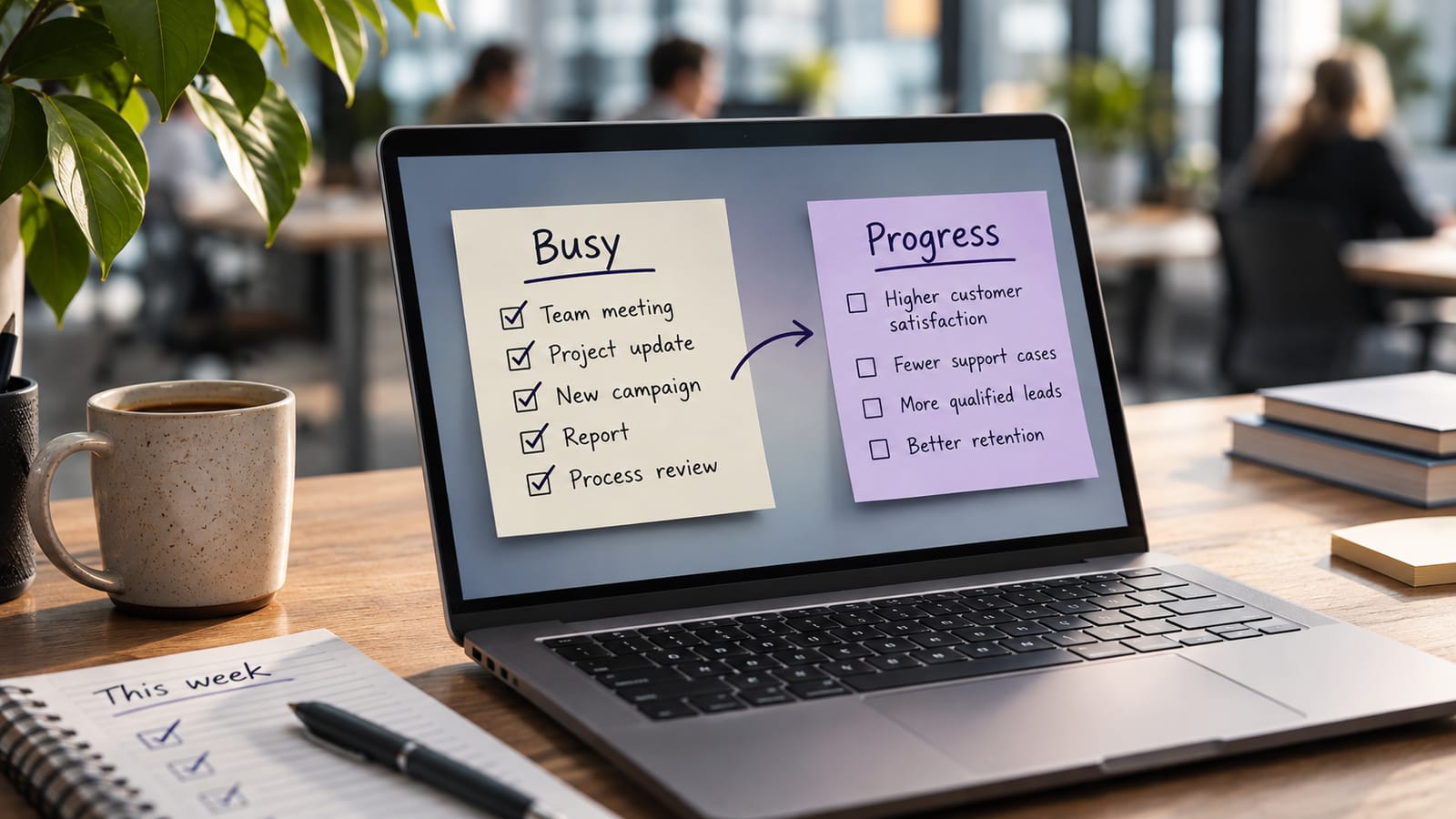
This distinction between activity and progress is easy to overlook.
Imagine that a company wants to improve customer retention. One department launches a new onboarding program, another introduces additional customer meetings, and a third develops a set of educational resources.
Six months later, all three initiatives have been delivered.
From a project management perspective, everything looks successful.
But customer retention hasn't improved.
Was the work worthwhile?
Perhaps. The initiatives may have created value in other ways. But if the objective was to reduce customer churn, the organization needs to understand why the expected improvement hasn't happened.
This is where it becomes important to distinguish between what we do and what we achieve.
Launching a new onboarding program is an activity. Reducing the time it takes customers to become successful with a product is an outcome.
Implementing a new sales process is an activity. Improving conversion rates is an outcome.
Both are important, but they tell us different things.
When organizations focus too heavily on activities, it's possible to report excellent progress while the underlying business results remain unchanged.
A better approach is to start with the outcome and work backwards.
What are we trying to change? How will we know whether it's improving? And which activities are most likely to help us get there?
These questions bring strategy much closer to the everyday decisions teams need to make.
Making strategy part of the way people work
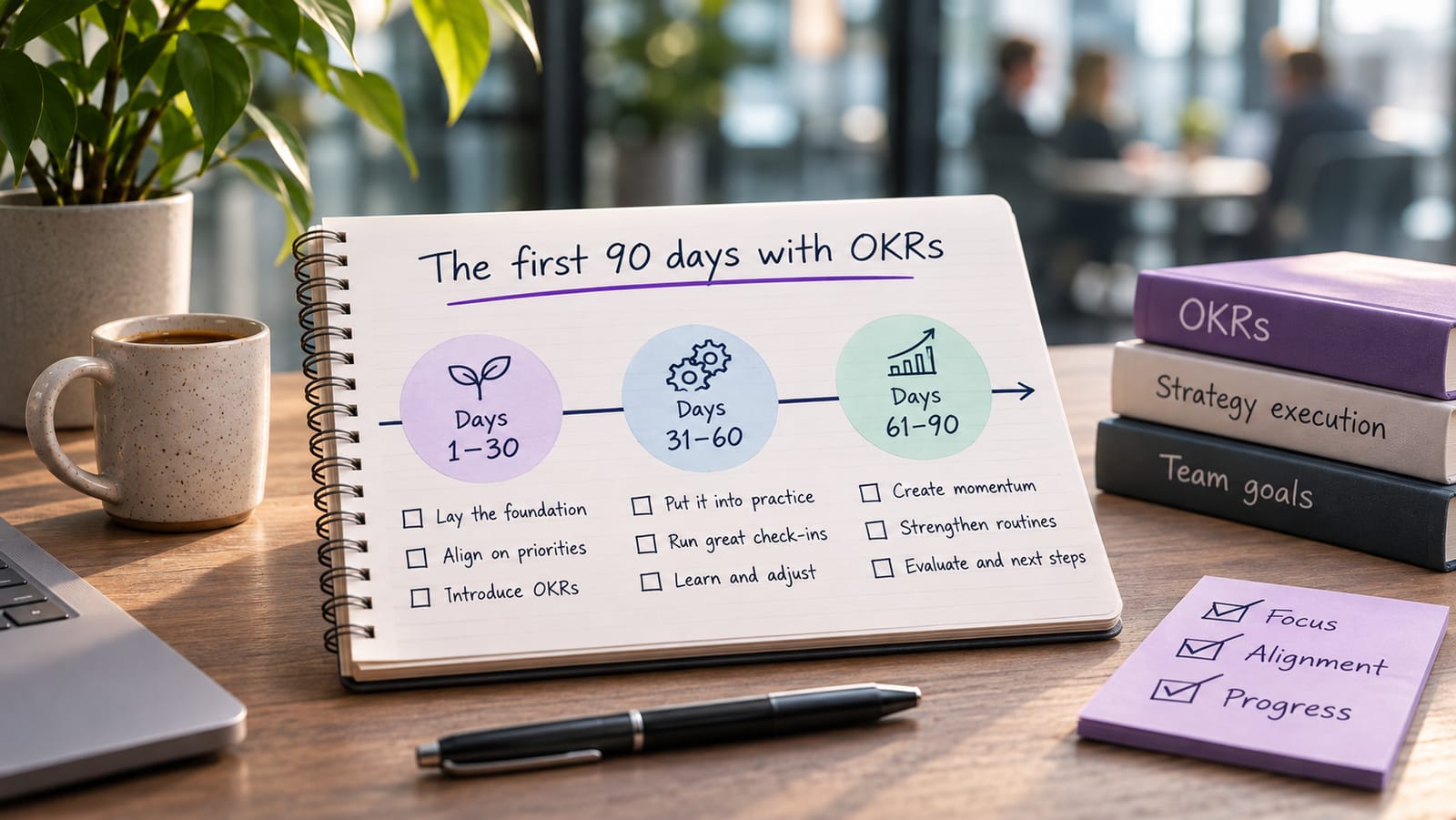
This is also where Objectives and Key Results, usually referred to as OKRs, can be helpful.
The idea behind OKRs is relatively simple. You define what you want to achieve and identify measurable results that will tell you whether you're making progress.
For example, a company might have a strategic ambition to improve customer retention.
Rather than leaving that as a broad statement, a team could define an objective around helping customers get more value from the product.
The Key Results might focus on reducing customer churn, improving product adoption, and shortening the time it takes new customers to become active users.
The numbers themselves will depend on the business. What's important is that the organization has a clearer understanding of what success looks like.
That changes the conversation.
Instead of asking whether the onboarding project has been completed, a manager can ask whether onboarding is becoming more effective.
Instead of discussing how many customer meetings have taken place, the team can look at whether those meetings are contributing to stronger customer relationships.
The focus moves from completing activities to understanding results.
But there's something important to recognize here.
OKRs aren't a shortcut to good strategy execution.
Simply introducing a framework won't solve unclear priorities, weak leadership routines, or poor collaboration between departments.
In fact, if the organization doesn't change how it works, OKRs can easily become another administrative exercise.
Teams spend time writing objectives, updating numbers, and preparing reports, while the decisions that really matter continue to happen elsewhere.
The value comes when objectives become part of the conversations people are already having.
We've written more about this in OKR as part of modern goal management and strategic leadership.
The important point is that a framework should support better management practices, not replace them.
Why the conversations matter more than the dashboards
Think about the last management meeting you attended.
How much time was spent reviewing what had happened?
And how much time was spent discussing what needed to happen next?
In many organizations, management meetings are largely built around reporting.
One department presents its numbers. Another explains the status of its projects. Someone shares an update on a major initiative, and another manager walks through the challenges their team is facing.
All useful information.
But by the time everyone has finished presenting, there's often very little time left for discussion.
The meeting ends, people return to their work, and many of the same challenges appear on the agenda the following month.
It's not necessarily because the meetings are badly organized.
It's because reporting and managing progress are two different activities.
A status report tells you what has happened. A useful management conversation helps you decide what to do about it.
If a strategic objective is progressing as expected, there may be little reason to spend ten minutes discussing it.
If another objective is falling behind, that's where the conversation becomes interesting.
What's causing the problem? Have our assumptions changed? Is there a dependency we haven't addressed? Do we need to adjust our approach?
And perhaps most importantly, what are we going to do differently?
These conversations are often where strategy execution actually happens.
Not when someone updates a dashboard, but when a team identifies a problem, makes a decision, and agrees on what happens next.
This is one of the reasons we've put so much emphasis on meeting routines at Futureworks.
Our Meeting Mode is designed to help teams bring objectives, progress, and priorities into their regular meetings, so the conversation can focus on what needs attention rather than simply reviewing information.
We've discussed this further in The Meeting Is Where Your OKRs Actually Happen.
The underlying idea is straightforward: strategy shouldn't be something you take out of a drawer every quarter. It should influence the conversations you're already having.
When departments succeed but the company doesn't
Another challenge becomes particularly visible as organizations grow.
Different departments develop their own goals, budgets, and ways of measuring success.
Sales is measured on revenue. Operations focuses on efficiency. Customer support tracks response times. Product development has its own roadmap and delivery targets.
Individually, these measures can make perfect sense.
But they don't always lead to the best outcome for the company as a whole.
Imagine a business where the sales department is rewarded for increasing revenue.
To win more customers, the team starts offering highly customized solutions.
Sales increases. Targets are met. Everyone is pleased with the results.
But those customized solutions create additional complexity for product development, increase delivery costs, and put more pressure on customer support.
One department has succeeded, while the company may have become less profitable.
This is a classic example of why strategic alignment matters.
It isn't enough for every department to have clear goals. Those goals also need to support the same overall direction.
That requires transparency across teams and a willingness to discuss dependencies.
If improving customer retention is a company priority, for example, it probably shouldn't belong exclusively to customer success.
Sales influences which customers are brought into the business. Product development influences the value they receive. Support influences their experience when something goes wrong.
The outcome depends on several teams working together.
When those teams understand their shared responsibility, it's easier to make decisions that benefit the organization rather than optimizing one department at the expense of another.
Of course, that also requires clear ownership.
Someone needs to be responsible for ensuring that progress is followed up, obstacles are addressed, and decisions are made.
Shared objectives shouldn't mean unclear accountability.
What organizations can learn from real experience
These challenges aren't limited to a particular industry or company size.
They appear in startups, established businesses, and large public organizations, although the circumstances can be quite different.
On the Futureworks website, several customers have shared experiences that highlight the importance of making objectives more visible and creating a clearer structure for following up on progress.
At the Norwegian Digitalisation Agency, Digdir, Andreas Rafaelsen has described how Futureworks helped make objectives more transparent and measurable. His published testimonial also highlights the value of combining the platform with practical support.
StormGeo has shared experiences related to clearer priorities, visibility into progress, and collaboration across functions. These are particularly relevant challenges for organizations where different teams need to coordinate their efforts around shared strategic objectives.
SpareBank 1 SMN has also highlighted the importance of creating a consistent structure for translating strategy into action across teams and organizational units.
These are customer experiences rather than independently verified performance measurements, and every organization's circumstances are different.
Still, they point towards something worth paying attention to.
Improving strategy execution isn't always about making dramatic changes.
Sometimes it's about creating a clearer connection between what the organization wants to achieve, what teams are working on, and how progress is discussed.
And making that connection part of everyday management.
So, where should a leadership team start?
If your company recognizes some of these challenges, the answer isn't necessarily to start over with a new strategy.
Before doing that, it may be worth looking at what happens to the strategy after it's been agreed upon.
Start with the priorities.
Can the leadership team clearly explain the few outcomes that matter most over the coming months? And would the rest of the organization give roughly the same answer?
If not, that's probably a good place to begin.
Then look at how those priorities are translated into team objectives.
Do managers understand what their departments are expected to contribute? Are the objectives specific enough to guide decisions? Are there conflicts between what different teams are trying to achieve?
It's also worth looking closely at how progress is measured.
Are you mainly tracking projects and activities, or can you see whether the organization is moving towards the outcomes it wants?
And finally, consider the conversations taking place in management and team meetings.
Is strategy something you discuss when preparing for a quarterly review, or is it part of how you decide what to focus on each week?
There's no single meeting structure or management framework that works for every organization.
A smaller company may need relatively simple routines, while a larger organization will require more coordination and transparency.
But the principle is much the same.
Strategic priorities need to be clear enough to guide everyday decisions. Progress needs to be visible. And people need regular opportunities to discuss what's working, what's not, and what should happen next.
Over time, these habits can make a significant difference to how an organization operates.
Where software can help, and where it can't
As a company that develops software for working with OKRs and strategy execution, we naturally believe technology has a role to play.
But it's worth being clear about what that role is.
Software won't create a good strategy.
It won't resolve disagreements within a leadership team or automatically make people collaborate more effectively.
And it certainly won't replace the difficult decisions involved in choosing what to prioritize.
Those are leadership responsibilities.
What software can do is make it easier to maintain the routines that support good strategy execution.
It can help people understand how objectives connect across the organization, make progress visible, and provide a shared starting point for discussions about priorities and results.
That's the thinking behind Futureworks.
We've developed the platform to help organizations connect their strategic direction with team objectives and everyday follow-up.
With 360 Vision, organizations can see how objectives relate to each other across different levels. Meeting Mode is designed to support regular conversations about progress, priorities, and obstacles.
The intention isn't to introduce more administration.
It's to make the strategy easier to work with.
Because when people can see what matters, understand how their work contributes, and discuss progress regularly, strategy becomes something more useful than a document.
It becomes part of how the organization operates.
The real test begins on Monday morning
It's easy to feel optimistic at the end of a successful strategy workshop.
You've had the important conversations. You've agreed on a direction. The plan looks convincing.
But the real test isn't what happens in that room.
It's what happens afterward.
When a manager has to choose between two competing priorities.
When a team discovers that an initiative isn't delivering the expected results.
When departments need to work together to solve a problem.
Or when an unexpected opportunity forces the organization to reconsider where it should spend its time.
These are the moments when strategy either influences decisions or gets pushed aside.
The companies that execute their strategies well aren't necessarily the ones with the most sophisticated plans.
They're the ones that manage to keep the connection between long-term ambitions and everyday work alive.
They make priorities clear enough that people can act on them. They create ownership without unnecessary bureaucracy. They pay attention to outcomes rather than just activities. And they make time for honest conversations about progress.
Perhaps most importantly, they recognize that strategy execution isn't something that happens after the strategy has been developed.
It's an ongoing part of leading the business.
And that may be the most useful way to think about it.
A strategy isn't successful because everyone agreed with it in a workshop.
It's successful when it starts changing the decisions people make on an ordinary Monday morning.
At Futureworks, we work with organizations that want to make that connection between strategy and everyday execution stronger.
If you're interested in how OKRs, clearer priorities, and better follow-up routines can support that work, you can learn more at futureworks.no.
Frequently asked questions
Why do good strategies fail during implementation?
Good strategies often fail because organizations struggle to translate their strategic ambitions into clear priorities, responsibilities, and everyday decisions. Even when the strategy itself is sound, competing demands, unclear ownership, poor alignment, and insufficient follow-up can prevent it from delivering the expected results.
What is strategy execution?
Strategy execution is the process of turning an organization's strategic direction into coordinated actions and measurable results. It involves making priorities clear, connecting team objectives to company goals, allocating resources, reviewing progress, and adjusting decisions when circumstances change.
How can leaders improve strategy execution?
Leaders can improve strategy execution by focusing on fewer priorities, involving teams in defining their contributions, measuring meaningful outcomes, and making strategic progress part of regular management conversations. Clear ownership and collaboration between departments are also important.
How do OKRs support strategy execution?
OKRs, or Objectives and Key Results, help organizations connect strategic ambitions to specific objectives and measurable results. When used as part of regular management routines, they can improve alignment, make progress more visible, and help teams make better decisions about their priorities.
How often should organizations review their strategy?
Organizations should distinguish between reviewing their overall strategic direction and following up on execution. While long-term strategic choices may remain stable for extended periods, progress towards objectives should be discussed regularly. Weekly team check-ins, monthly management discussions, and quarterly reviews can provide a useful starting point.
Can strategy execution software improve business performance?
Strategy execution software can support better alignment, transparency, and follow-up, but it can't replace clear priorities or effective leadership. Its greatest value comes when it helps organizations maintain the routines and conversations needed to turn strategic plans into measurable progress.
Ready to put OKRs into practice?
See how Futureworks helps teams align, track, and execute every week.