OKR Software for 2027: How to Choose the Right Platform for Strategic Execution
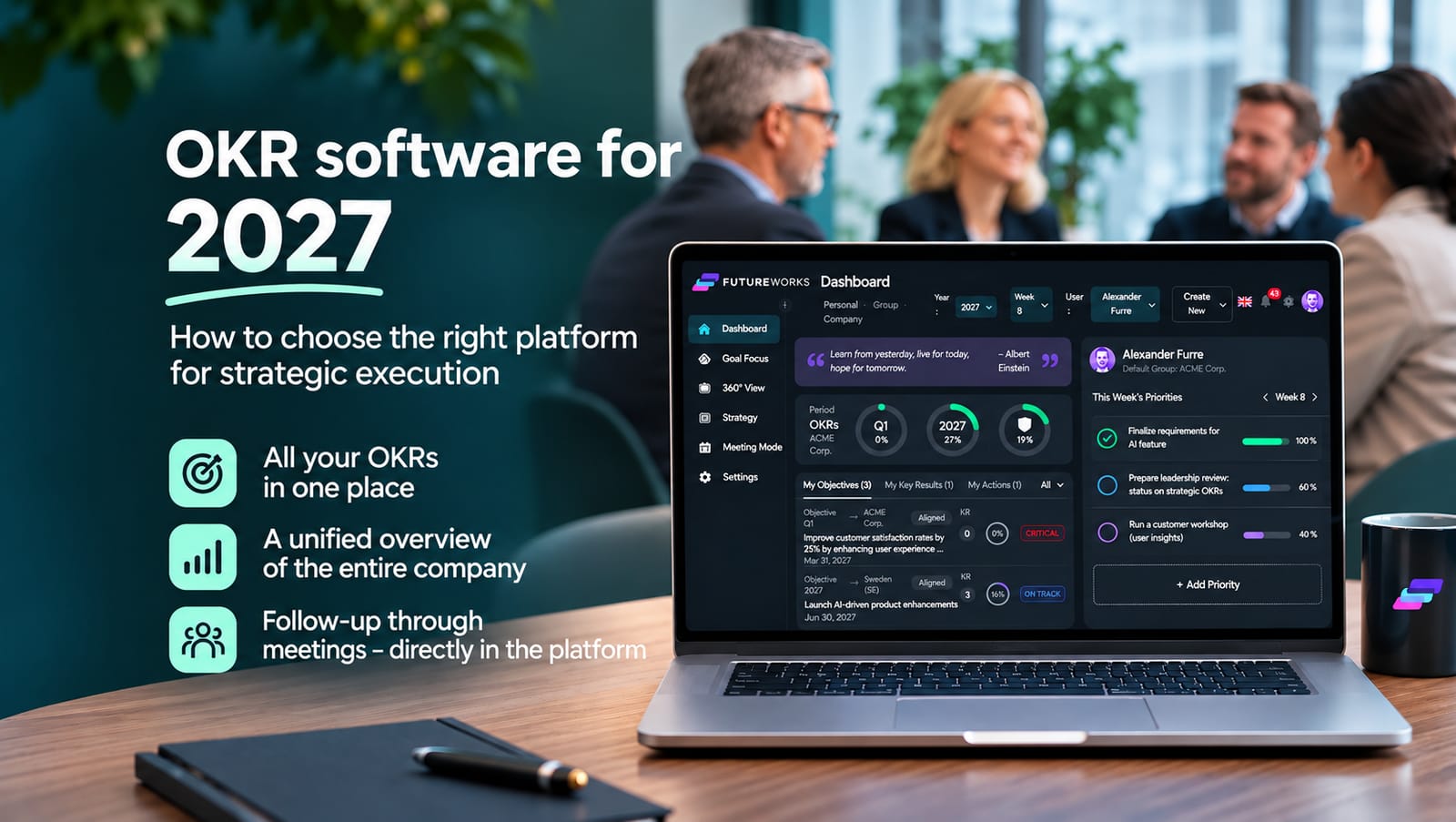
Is your organization choosing OKR software for 2027? For companies with multiple departments, leadership teams, and strategic initiatives, the choice is about far more than digitizing goals. It's about building an organization that prioritizes correctly, moves in the same direction, and actually executes its strategy. Here's what you, as CEO, strategy director, or member of the leadership team, should look for before you choose a platform.
2027 starts before January
The strategy may already be set. The budget is being finalized, and the leadership team has discussed which initiatives will define the year ahead. Ambitions are clear, and expectations are high.
But how well is the organization actually positioned to execute?
Does every department know which strategic priorities apply? Is it clear how the different teams should contribute? Does the leadership team have a consolidated view of progress? And is there an established structure for following up on goals, surfacing challenges, and making the necessary decisions along the way?
For many organizations, this is exactly where the challenge lies.
The strategy lives in PowerPoint. The goals live in Excel. Departments keep their own documents. Status updates are shared by email, and decisions are recorded in meeting notes that are rarely linked back to the strategic goals.
Each of these tools may work fine on its own. Together, though, they don't necessarily give leadership the overview and execution power the organization needs.
If you're considering OKR software for 2027, it's worth starting with the right question:
Not just how you'll log and track goals, but how you'll build a system for strategic execution across the whole organization.
1. The strategy is clear in the boardroom – but not necessarily in the organization
One of the biggest challenges for senior leaders is making sure the strategy actually shapes what the organization does every single week.
Agreeing on three or four strategic priorities in the leadership team is one thing. Making sure hundreds of employees, spread across different departments and teams, prioritize in line with them is something else entirely.
The larger the organization grows, the more demanding this task becomes.
Different parts of the business interpret the strategy differently. Departments establish their own priorities, and local goals can end up getting more attention than the company's overall ambitions.
The result can be an organization with high activity but limited collective progress.
OKR – Objectives and Key Results – provides a framework for translating strategic ambitions into clear goals and measurable results. But the methodology alone doesn't solve the problem.
You also need a platform that makes the connection between the company's overall goals and each department's contribution visible.
With Futureworks, the organization can bring its OKRs together in one place, giving leadership and the organization a shared view of what the company needs to achieve, and how different departments and teams contribute.
That turns strategy into something the organization can work with continuously, rather than something that's mainly presented at strategy days and all-hands meetings.
2. Leadership lacks a consolidated view of strategic progress
How long does it take to get an up-to-date picture of how the business is performing against its most important strategic goals?
Can the CEO or strategy director get that overview directly? Or does it require someone to collect information from department heads, update spreadsheets, and put together a new presentation?
In many organizations, strategic reporting is still a manual process.
Departments report in different ways, at different frequencies, and with varying levels of detail. By the time the information finally reaches leadership, it may already be out of date.
That creates several problems:
- Leadership spends time gathering information instead of making decisions.
- Strategic deviations are discovered later than necessary.
- It becomes difficult to compare progress across departments.
- Dependencies between different teams become less visible.
- Discussions revolve around what the status actually is, rather than what the organization should do about it.
Good OKR software should give leadership access to a consolidated, up-to-date overview, provided the organization has solid follow-up routines in place.
In Futureworks, the company's OKRs are gathered in a single platform. Leadership can get an overview of the company as a whole, while still being able to drill into individual departments and teams.
That gives a better foundation for identifying where the organization is making good progress, where attention is needed, and where leadership should step in to remove obstacles.
The goal isn't more reporting. The goal is better decisions.
3. Too many priorities weaken execution
Most senior leaders know the challenge: the organization has more important initiatives than it has the capacity to execute.
New projects come in. The market shifts. Customers raise new demands. Technology opens new possibilities. Meanwhile, day-to-day operations still need to be handled.
It's rarely a lack of ambition that's the problem. It's the lack of clear choices.
When everything is important, it becomes difficult for departments and teams to know what should actually be prioritized.
One of the most important values of OKR, then, isn't just defining what the business should achieve, but forcing the discussion about what it should not prioritize right now.
For the CEO, CFO, and COO, this is also a question of resource allocation. Is the organization's time, expertise, and investment going toward the areas that create the greatest strategic value?
Good OKR software should make priorities visible across the organization. When goals and expected results are gathered in one place, it becomes easier to spot overlapping initiatives, discuss conflicting priorities, and assess whether the organization has taken on too much.
Futureworks gives the leadership team and departments a shared space to work through these priorities.
The platform doesn't replace the strategic choices leadership has to make. What it does is make those choices easier to surface, communicate, and follow up on.
4. Departments perform well individually – but not necessarily together
In organizations with several hundred employees, strategic results are rarely the product of a single department's efforts.
A commercial push might depend on product development, technology, marketing, sales, and customer service. An efficiency ambition might need contributions from finance, HR, IT, and operations alike.
Yet goals and follow-up are often organized within each individual department.
That can lead to departments succeeding at their own local goals without the organization necessarily achieving the overall result.
Sales hits its activity targets. Product ships the planned features. Marketing runs its campaigns. But the strategic effect doesn't materialize.
For leadership, the question isn't just whether each department is delivering, but whether the departments, together, are contributing to the results the business actually needs.
Good OKR software has to support this holistic view.
By bringing the company's, departments', and teams' OKRs together in Futureworks, the organization gets a shared starting point for understanding how different parts of the business contribute to the strategy.
It can also make it easier to spot the need for collaboration and coordination earlier.
For larger organizations, this matters especially. The value of OKR isn't just better goals within each team, but better interplay between the teams.
5. Strategic goals aren't followed up systematically enough
Many organizations are good at setting goals. Fewer are equally good at following them up throughout the year.
Significant time goes into strategy processes, quarterly planning, and drafting OKRs. But once day-to-day work takes over, operational tasks take priority.
The goals sit untouched. Updates become sporadic. The leadership team only discusses the strategy again when it's time for the next quarterly review.
By then, valuable time may already have been lost.
OKR works best when it's part of a continuous leadership process. That means the organization regularly needs to assess progress, discuss obstacles, and decide what adjustments are necessary.
It's not enough to have a system where employees log goals and update status.
You need a structure that connects the goals to the actual leadership dialogue.
This is an important part of what Futureworks does. The platform doesn't just bring the organization's OKRs together, it also makes it possible to run and document follow-up meetings in the same solution.
That lets the organization build a more cohesive way of working, where goals, progress, discussions, and decisions all connect.
Strategic follow-up becomes an integrated part of how the business is led, not a separate reporting activity.
6. Leadership and follow-up meetings aren't well enough connected to the strategy
How much of the time in your leadership meetings goes toward the company's most important strategic priorities?
And how easy is it to find what was discussed and decided the last time a strategic goal was on the agenda?
In many organizations, there's a significant gap between the systems used to define goals and the systems used to run meetings.
The goals live in one place. The agenda lives somewhere else. Notes are stored in separate documents, and follow-up on decisions happens over email or other tools.
The consequence is that important context gets fragmented.
When the leadership team meets again, time goes into reconstructing earlier discussions, understanding the status, and clarifying what was actually decided.
With Futureworks, follow-up meetings can be run directly from the organization's goals and documented in the same platform.
That makes a more focused meeting structure possible, one where the leadership team can concentrate on questions like:
- How are we doing on our most important strategic goals?
- What has changed since the last meeting?
- Where is the organization hitting obstacles?
- What decisions do we need to make?
- What needs to be followed up before the next meeting?
When meetings are documented in the same solution as the goals, it becomes easier to maintain continuity in the follow-up.
This matters for the senior leadership team, department heads, and operational teams alike.
In other words, good OKR software shouldn't just support strategic planning. It should also support the meetings and leadership processes where the strategy actually gets executed.
7. There's too much distance between activity and strategic impact
A common pitfall when implementing OKR is that the organization formulates goals that, in practice, describe tasks and activities.
Run a project. Launch a solution. Hold a workshop. Set up a new process.
These can be important activities, but they don't necessarily say anything about the impact the business is achieving.
For leadership, it's essential to understand the difference between what the organization does and what results it creates.
A good Key Result describes a measurable change that shows the business is moving in the right direction.
It might be about profitability, customer loyalty, productivity, quality, growth, or shorter lead times, for example.
When the organization establishes a shared OKR structure in Futureworks, leaders and teams get a common starting point for discussing which results they should actually be aiming for.
Combined with regular follow-up meetings, this can help shift the leadership conversation from activity reporting to strategic impact.
That's an important distinction for organizations that want to get more out of their strategic investments.
What should you require from OKR software in 2027?
If you're now evaluating different OKR tools, we recommend starting from how you want to lead the organization, not just which features the various vendors offer.
Here are seven key evaluation criteria.
1. All OKRs in one place
The platform should make it possible to bring the company's strategic goals and OKRs together in a single shared solution.
You should be able to reduce the need for separate spreadsheets, presentations, and manual compilations.
2. Visibility at the company, department, and team level
Leadership needs the full picture, while department heads and teams need an overview of their own areas of responsibility.
The tool should support both needs without forcing the organization to run parallel systems.
3. Visible strategic priorities
It should be clear what the organization is prioritizing, and how the different parts of the business contribute to the overall ambitions.
This matters especially in organizations with complex structures and many strategic initiatives.
4. Continuous follow-up on progress
The platform should make it easy to follow up on goals throughout the quarter and the year, not just during formal reporting cycles.
Good follow-up needs to be a natural part of everyday work.
5. Meetings and documentation in the same solution
Consider how the platform supports leadership meetings, OKR follow-up, and strategic discussions.
When meetings and goals are handled in the same solution, you can reduce the fragmentation that happens when strategic information is scattered across different systems.
6. Usability and organizational adoption
Even a feature-rich OKR tool has limited value if leaders and employees don't actually use it.
Consider how easy it is to get started, update goals, find relevant information, and use the platform within your existing leadership processes.
Also look into access control, information security, and any integration needs that matter for your organization.
7. Availability of implementation support
Some organizations already have strong OKR capability and are mainly looking for a platform.
Others need help establishing the methodology, writing good goals, developing a workable meeting structure, and securing buy-in from the leadership team.
A good vendor should understand the difference and be able to meet the organization where it is.
Should you implement OKR yourselves, or get professional support?
Choosing OKR software is one decision. How you implement OKR across the organization is another.
It's important to keep these separate.
Option 1: You implement OKR on your own
For organizations that already have experience with OKR, a clear strategy, and established leadership processes, it may make sense to own the implementation yourselves.
You might have a strategy director, a strategy office, or internal resources who can drive the process.
In that case, the purchase decision is mainly about getting a platform that supports your way of working, gives you better visibility, and reduces the need for manual coordination.
Futureworks can be the shared digital foundation for that way of working.
Option 2: You want support to implement OKR
For other organizations, the tool itself isn't the biggest challenge.
It's building a shared understanding of OKR, securing good strategic priorities, and developing a leadership culture where goals are followed up systematically.
This is where implementation support can be valuable.
Areas where support often helps include:
- Getting OKR embedded in the senior leadership team.
- Translating strategy into clear priorities and goals.
- Writing good Objectives and Key Results.
- Establishing OKR at the company, department, and team level.
- Developing an effective meeting and follow-up structure.
- Building capability among leaders and internal champions.
The goal should be for the organization to become capable of owning and developing the approach itself over time.
You don't necessarily have to choose between full implementation support and doing everything on your own. For many organizations, a combination makes sense, using external support where the need is greatest.
How to set the organization up for 2027
If the ambition is to actively use OKR from January, you should start the work before year-end.
That doesn't necessarily mean every department and team needs finished OKRs before the new year. But the most important organizational and strategic decisions should be in place.
| Period | Recommended focus |
|---|---|
| Before year-end | Clarify ambitions, strategic priorities, platform choice, and ownership of the implementation. |
| January | Establish the company's OKRs, involve the leadership teams, and define each department's contribution. |
| February | Put regular follow-up meetings and solid routines for updating progress in place. |
| March | Evaluate the first quarter, identify areas for improvement, and adjust the approach before Q2. |
For larger organizations, a gradual rollout may make more sense than trying to introduce everything at once.
Start with the leadership team and a handful of departments. Establish a way of working that holds up, build experience, and then expand to the rest of the organization.
What matters most is getting started with a clear direction and a deliberate approach to how OKR will be used as a leadership tool.
What does it cost to keep doing things the way you do now?
When choosing OKR software, it's natural to weigh license costs, implementation, and resource use.
But it's also worth considering the cost of your current way of working.
How much leadership time goes into manual reporting? How many hours go into compiling presentations and status updates? How often are strategic deviations caught too late? How much capacity goes toward initiatives that don't support the organization's most important priorities?
For an organization with several hundred employees, even modest improvements in coordination, prioritization, and decision-making can carry significant value.
The business case for OKR software shouldn't be limited to saved administration time.
It should also account for the potential for better resource allocation, earlier identification of challenges, more effective leadership meetings, and stronger strategic execution.
These are values that matter to the entire leadership team.
Why choose Futureworks as your OKR software for 2027?
Futureworks is a platform for organizations that want to work more structured and holistic with strategy, OKR, and execution.
By bringing the organization's OKRs together in one place, leadership gets a shared overview of the company and its various departments and teams.
At the same time, follow-up meetings can be run and documented in the same platform, so strategic follow-up stays closely connected to how the business is actually led.
That gives you a shared foundation for:
- Clearer strategic priorities.
- Better visibility across the organization.
- More coordinated effort between departments and teams.
- Systematic follow-up on goals and results.
- More focused leadership and follow-up meetings.
- Continuity in the strategic leadership dialogue.
Whether you already have OKR experience and want to implement the platform yourselves, or you want support building a solid way of working, the starting point is the same:
OKR shouldn't be just another administrative task. It should be a tool for better leadership and stronger strategic execution.
Ready to choose your OKR software for 2027?
If you're considering OKR software in the coming weeks or months, now is a good time to think through how you want to work with strategy and execution in 2027.
How should leadership get the overview it needs? How should departments and teams work toward shared priorities? And how will you make sure strategic goals actually get followed up in leadership meetings throughout the year?
With Futureworks, you can bring these processes together in one shared platform.
Book a no-obligation walkthrough of Futureworks.
We'll look together at how the platform can support your strategic ambitions, organizational structure, and leadership processes, whether you want to implement OKR yourselves or get support along the way.
2027 isn't just about setting the right goals. It's about setting the organization up to reach them.
Ready to put OKRs into practice?
See how Futureworks helps teams align, track, and execute every week.