OKR as Part of Modern Goal Management and Strategic Leadership
It's rarely ambition that's missing from a strategy. It describes where the business is heading, which markets it wants to win, which customers it wants to create value for, and what needs to change. The hard part comes afterwards: How does the strategy turn into what the organisation actually prioritises this week? How do employees know what matters most? And how does the leadership team see whether the strategy is creating momentum, before the year is over?
That's where goal management comes in, and it's where OKR (Objectives and Key Results) has become an important tool for a growing number of organisations. Used well, OKR is about far more than setting goals. It's a way of connecting strategy, priorities, execution and learning. To understand why it works, though, we need to start with what good goal management actually is.
What is goal management?
Put simply, goal management means leading an organisation by deciding which results you want to achieve, tracking progress, and using what you see to prioritise and make decisions. But there's a big difference between having goals and actually managing by them.
Most organisations have goals in abundance: budgets, KPIs, strategic focus areas, project goals, sales targets, action plans and individual goals. The problem is rarely a lack of goals. It's more often that there are too many of them, that they don't connect, or that they don't actually influence how time and resources are used.
Good goal management answers six questions:
- Where are we going? Strategy and direction.
- What matters most right now? A small number of priorities the strategy can be translated into.
- How do we know if we're succeeding? Concrete, measurable results.
- What do we need to do to get there? Projects and initiatives connected to the goals.
- Are we on track? Progress that's followed up regularly.
- What do we do when reality changes? Priorities and actions that can be adjusted along the way.
That last question might be the most important one. Goal management isn't a way of documenting what you intended to do. It's an active management tool meant to help leaders and employees make better decisions while the work is happening.
What is OKR?
OKR stands for Objectives and Key Results. The method helps organisations decide what their most important priorities are, which results they need to achieve, and how progress should be measured.
An OKR has two parts. The Objective answers what we want to achieve, while Key Results answer how we know we got there. In practice, a third part belongs with it: initiatives, meaning what we do to influence the results. The Objective sets the direction, the Key Results describe the results we want to create, and the initiatives are the work we believe will get us there.
At Futureworks, we therefore see OKR both as a framework for goal setting and as a framework for strategy execution: strategic priorities turned into measurable progress across teams.
A simple example
Say a company wants to improve the customer experience. A typical but weak goal is "improve customer service." The problem is that no one really knows what "improve" means. An OKR can instead look like this:
Objective: Create a customer experience that makes customers actively want to stay with us.
Key Results:
- Increase customer satisfaction from 78% to 88%
- Reduce average response time from 10 to 3 hours
- Reduce churn from 8% to 5%
The team can then choose initiatives, for example a new onboarding flow, a better help centre, a revised support process, training, and automating certain customer inquiries.
Notice that the initiatives aren't the goals. They're hypotheses about what might produce the results. The team could carry out all five and still not end up with happier customers, and that's exactly why it's the results that get measured. As we often say: "It's not the activity of 'cleaning' we're after, it's the outcome of 'clean.'"
Why OKR has earned a place in modern goal management
Traditional goal management has tended to follow the annual cycle. Strategy is set, the budget is approved, goals are distributed, and then the year begins. But reality doesn't follow the annual plan. Customer needs change, competitors move, technology evolves, projects take longer than expected, and new opportunities appear.
An organisation therefore needs both a long-term direction and the ability to adapt in the short term. That's where OKR plays a natural role. Strategy typically has a horizon of three to five years, while OKR is used to decide which results the organisation should prioritise over a shorter period. That creates a chain:
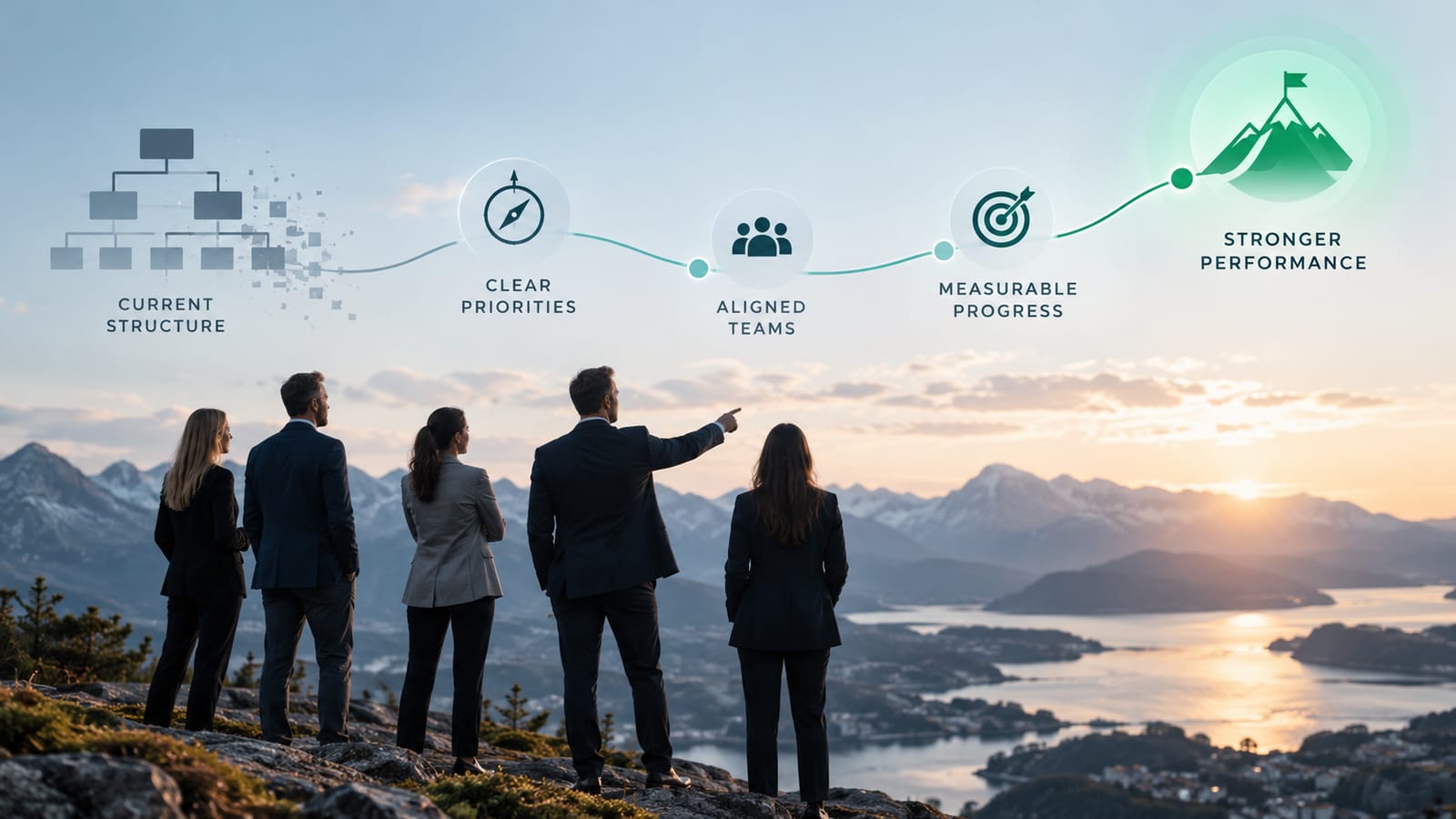
Strategy → OKR → initiatives → execution → results → learning
Strategy doesn't just live in a document, then. It gets translated into priorities people can actually work on.
OKR doesn't replace strategy
A common misunderstanding is that OKR can replace strategy. It can't. Strategy tells you where the business is heading and which choices it's making, while OKR helps the organisation create momentum on the most important strategic priorities. If the strategy is unclear, the OKRs often end up unclear too.
That's why it's rarely a good idea to start an OKR workshop by asking "which OKRs should we have?" A better starting point is: What's the most important thing we need to succeed at right now to move the strategy forward? That turns OKR into a tool for strategy execution, rather than a separate goal-setting process running alongside it.
What's the difference between OKR and KPI?
This is probably the most common question we get from organisations getting started with OKR. In short, KPI and OKR don't compete with each other, they solve different problems.
A KPI (Key Performance Indicator) is an indicator that tracks an important part of the business, such as revenue, customer satisfaction, churn, sick leave, response time, profitability, delivery time, or uptime. KPIs tell you how the business is performing. OKR is used when you want to create a specific change or improvement. Put simply: KPIs measure performance, OKRs drive change.
| KPI | OKR | |
|---|---|---|
| Purpose | Monitor performance | Create change |
| Time horizon | Ongoing | Time-bound |
| Question | How are we doing? | What do we need to improve? |
| Focus | Operations and health | Strategic progress |
| Character | Continuous | Prioritised and temporary |
Most organisations need both.
How they work together in practice
Imagine a SaaS company tracking the KPI customer churn. It's sitting at 8%, while leadership wants it under 5%. The KPI shows the company has a problem, but it doesn't solve it. Here, the organisation can set an OKR:
Objective: Create a customer experience that makes it easy to succeed with the product.
Key Results:
- Reduce churn from 8% to 5%
- Increase product adoption from 62% to 80%
- Increase the share of customers completing onboarding from 55% to 85%
Now it's clear which change needs to happen. The team chooses initiatives it believes will move the results, and once the period is over, you can see whether they actually did. The relationship looks like this: the KPI reveals a problem, the OKR prioritises the improvement, the initiatives try to create the change, and the KPI ultimately shows whether the business actually got better.
Why KPIs alone aren't enough
A good KPI dashboard gives leadership solid visibility. But visibility isn't the same as execution. If the dashboard shows customer satisfaction at 72%, leadership can see the number, discuss it, and report on it. But if no one decides what needs to change, who owns the improvement, and what needs to be reprioritised, nothing may happen at all. It's a classic trap in goal management: the organisation gets good at measuring the past, but not necessarily at steering the future. That's the gap OKR can fill.
And why OKR alone isn't enough either
The opposite happens too. An organisation can write good OKRs and still get little out of them, because OKR doesn't execute the strategy on its own. Someone has to prioritise resources, do the work, follow up, and make decisions when progress stalls.
OKR should therefore be seen as part of a larger management system: strategy → OKR → priorities and initiatives → execution → KPI, where OKR is connected to strategy, portfolio and projects, teams, and KPIs. It's that whole picture that makes OKR interesting for strategic leadership.
What does OKR have to do with strategic leadership?
Strategic leadership isn't just about developing a strategy, it's about getting the organisation to act in line with it. That requires clear direction, prioritisation, resource allocation, coordination, decisions, follow-up and learning, and OKR can become the connective tissue between them.
With a small number of clear Objectives, it becomes easier to talk about what actually matters most. Measurable Key Results make it easier to discuss progress on an objective basis. When initiatives are linked to the OKRs, you can see where resources are going, and when progress is followed up regularly, leadership can react earlier. That's how goal management moves from being a reporting exercise to becoming a management process.
From annual goals to a fixed management rhythm
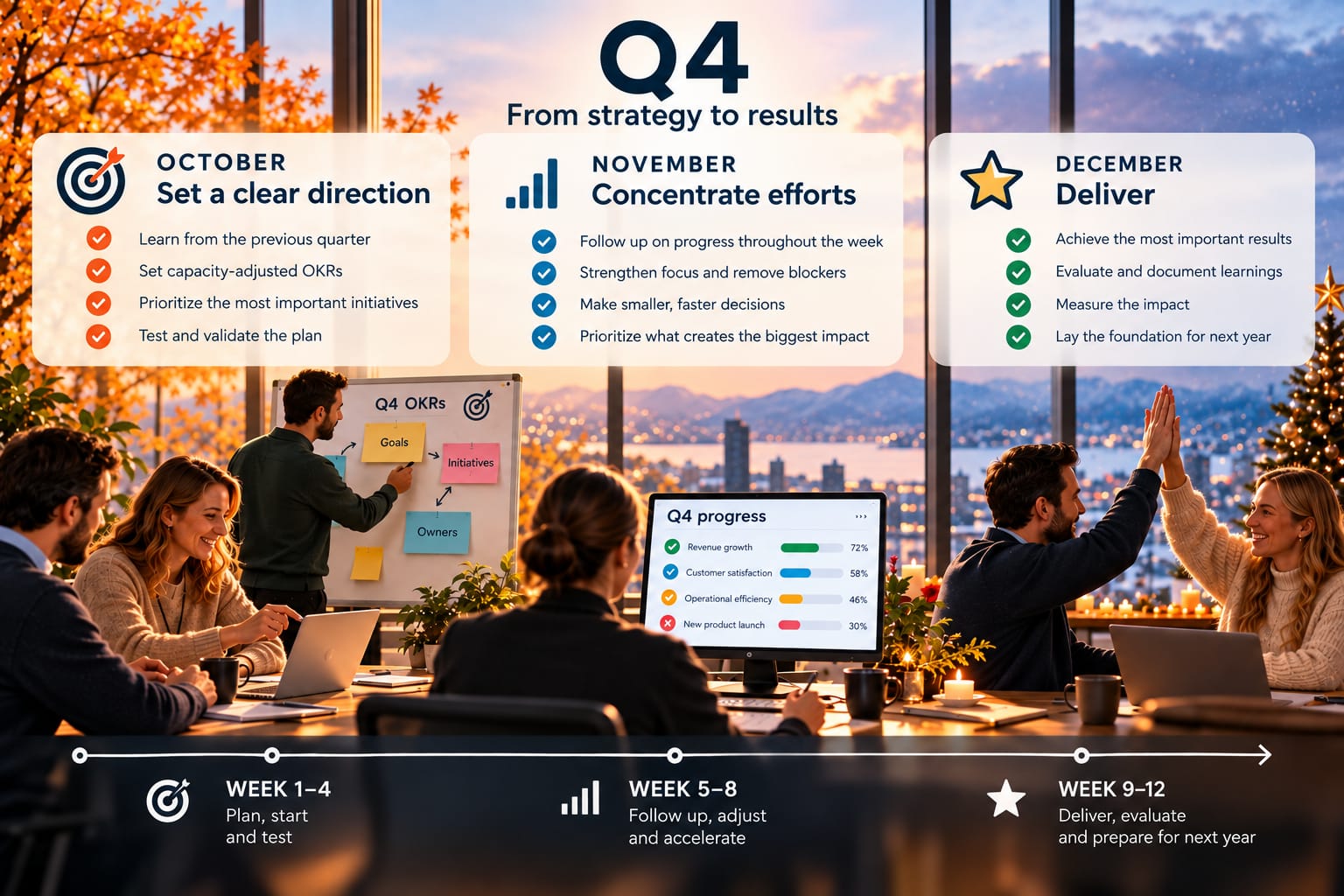
This is perhaps where the biggest difference lies between a good and a bad OKR implementation. OKR shouldn't be something an organisation does four times a year, it should shape the conversations between those points.
We've all seen it happen: the OKRs get set in the first week of the quarter, everyone goes back to their everyday work, and three months later the system gets reopened just to note that "we reached 43%." That creates little value. The value comes when OKR is used along the way, in a fixed rhythm, ideally weekly, where the team asks itself:
- What's changed since last time?
- Are we on track toward the Key Results?
- What's standing in the way of progress?
- Are our initiatives working?
- What do we need to prioritise differently, and what decisions need to be made?
That's what turns OKR into a management tool instead of a reporting tool. A focus on results and a clear execution rhythm are what turn strategic plans into actual progress.
OKR makes priorities visible
Strategy is as much about what you choose not to do as what you choose to do. The same goes for OKR. A department with 12 Objectives, 38 Key Results and 74 initiatives probably hasn't prioritised, it has documented everything it would like to do.
Good goal management requires scarcity. A small number of goals forces the question of what matters most right now. That discussion can be uncomfortable, but that's exactly why it's valuable. When everything is a priority, nothing is.
From activity to impact
OKR also challenges the organisation to distinguish between output and outcome. Output is what we deliver, for example launching a new customer portal. Outcome is the impact it creates, for example the share of customers who solve their own problem without contacting customer service increasing from 35% to 60%.
The team controls the first. The second is what the business is actually after. That changes the conversation in leadership too: instead of just asking whether the project was delivered, you ask whether it created the impact you expected. That leads to better learning, and over time, better use of resources.
What good goal management with OKR looks like
When OKR works, several things happen at once. Strategy becomes easier to understand, because employees can see which priorities apply right now. It becomes clear what the organisation has chosen to focus on, and what it has chosen not to. Progress becomes measurable, so the discussion shifts from gut feeling to concrete results.
Teams also see how their goals support other teams and the business as a whole. Problems become visible earlier, while there's still time to do something about them. And leadership gets a better basis for decisions, because OKR meetings are about what needs to change to succeed, not just about status. That's how OKR can become much more than a goal-setting method: an operating structure for strategic leadership.
The most common OKR mistakes
OKR is easy to understand, but that doesn't mean it's easy to implement. A few mistakes come up again and again:
- Too many OKRs. When everything becomes an OKR, the method loses the most important thing it has to offer: focus.
- Key Results that describe activities. "Run five workshops" says what you'll do, but not what impact the workshops are supposed to have.
- OKRs that turn into individual to-do lists. OKR works best when it describes important results the team or organisation needs to create, not every task belonging to each individual.
- OKRs with no connection to strategy. If no one can explain why an Objective matters to the strategy, it's worth asking whether it should be an OKR at all.
- No follow-up. This might be the biggest mistake of all: goals get set with enthusiasm and forgotten once everyday work takes over.
- Progress that turns into pure reporting. A good check-in doesn't stop at "what's the status?" It leads to the question "what do we do now?"
The OKR meeting: where goal management actually happens
A dashboard doesn't execute anything, people do. That's why the meetings around OKR matter at least as much as the goals themselves. A good OKR meeting doesn't need to be long. The point is a fixed rhythm where the team looks at what matters most. A simple agenda can look like this:
- Where do we stand on the most important Key Results?
- Where is progress slower than expected?
- Why?
- Which initiatives are working, and which aren't?
- What decisions need to be made?
- Who owns the next step?
That turns the meeting into more than a status review. It becomes part of the engine that drives execution itself.
From goal setting to strategy execution
So, what is OKR? The short answer is that OKR stands for Objectives and Key Results and is a method for setting goals with measurable key results. But that answer only describes the structure. The real value lies in what the structure makes possible: a clear line from strategy to everyday work.
- Strategy: Where are we going?
- OKR: What's most important to achieve right now?
- Key Results: How do we know we're making progress?
- Initiatives: What do we do to influence the results?
- Execution: How do we follow up and adjust along the way?
- KPIs: Is the business actually getting better because of the changes?
This is goal management as an ongoing process, not as an annual document.
OKR isn't the goal, better execution is
It's easy to get hung up on the methodology. How many Objectives should we have? How many Key Results? Should we score from 0 to 1, or in percent? Quarterly or annually? These are all relevant questions, but they come second. The most important question is whether goal management is helping the organisation make better decisions and execute its strategy better. If the answer is no, it matters little how "correct" the OKR structure is. OKR is a tool, not a goal in itself.
Strategic leadership requires more than a good strategy
Most organisations spend a lot of time developing strategy, and that's natural. But strategy only creates value once it influences what people actually do. That requires leadership to connect direction, prioritisation, goals, resources, execution and learning, and that's where goal management becomes strategic leadership.
KPIs show how the business is performing. OKRs point to which changes matter most. Initiatives make the priorities concrete, and regular follow-up makes it possible to learn and adjust. Strategy gives the whole thing direction. When these pieces work together, strategy becomes something more than a presentation the leadership team looks at once a year. It becomes part of how the business works, every week.
Maybe that's the best way to understand OKR: it's not about setting more goals, it's about focusing on the few results that matter most, and building a rhythm that makes it more likely you'll actually reach them.
Frequently asked questions about OKR and goal management
What does OKR mean?
OKR stands for Objectives and Key Results. The Objective describes what the organisation wants to achieve, while the Key Results make the result concrete and measurable.
What is goal management?
Goal management is a leadership approach where the organisation decides which results it wants to achieve, tracks progress, and actively uses that information in priorities, decisions and resource allocation.
What's the difference between OKR and KPI?
A KPI typically tracks an important part of the business's ongoing performance or health. OKR is used to prioritise and drive a specific change or improvement. The two work best together, not as alternatives.
Is OKR the same as strategy?
No. Strategy sets the direction and the high-level choices. OKR helps translate the strategy into short-term, measurable priorities and progress.
How often should OKR be followed up?
The most important thing is a fixed rhythm. For many teams, a short weekly check-in works well, while others need a different frequency. The point is that the OKRs are actively used to spot obstacles, prioritise, and make decisions, not just reviewed once the period is over.
How many OKRs should an organisation have?
Few enough that they're actually priorities. We recommend a limited number of Objectives, rather than turning every goal the business has into an OKR.
Can you use OKR without KPI?
Yes, but the organisation loses an important part of the picture. OKR shows which changes you're prioritising, while KPIs show the business's ongoing health and impact. The strongest management model uses both.
Is OKR only for tech companies?
No. The principle of connecting strategy to prioritised, measurable results and regular follow-up applies across every industry. How OKR is implemented, however, should be adapted to the organisation's size, structure, management model and needs.
Want to see how Futureworks connects strategy, OKR and KPIs in a single platform? Get in touch for a no-obligation walkthrough.
Ready to put OKRs into practice?
See how Futureworks helps teams align, track, and execute every week.