Organizational Adjustments That Deliver: How OKRs Help Leaders Turn Structural Change into Better Performance
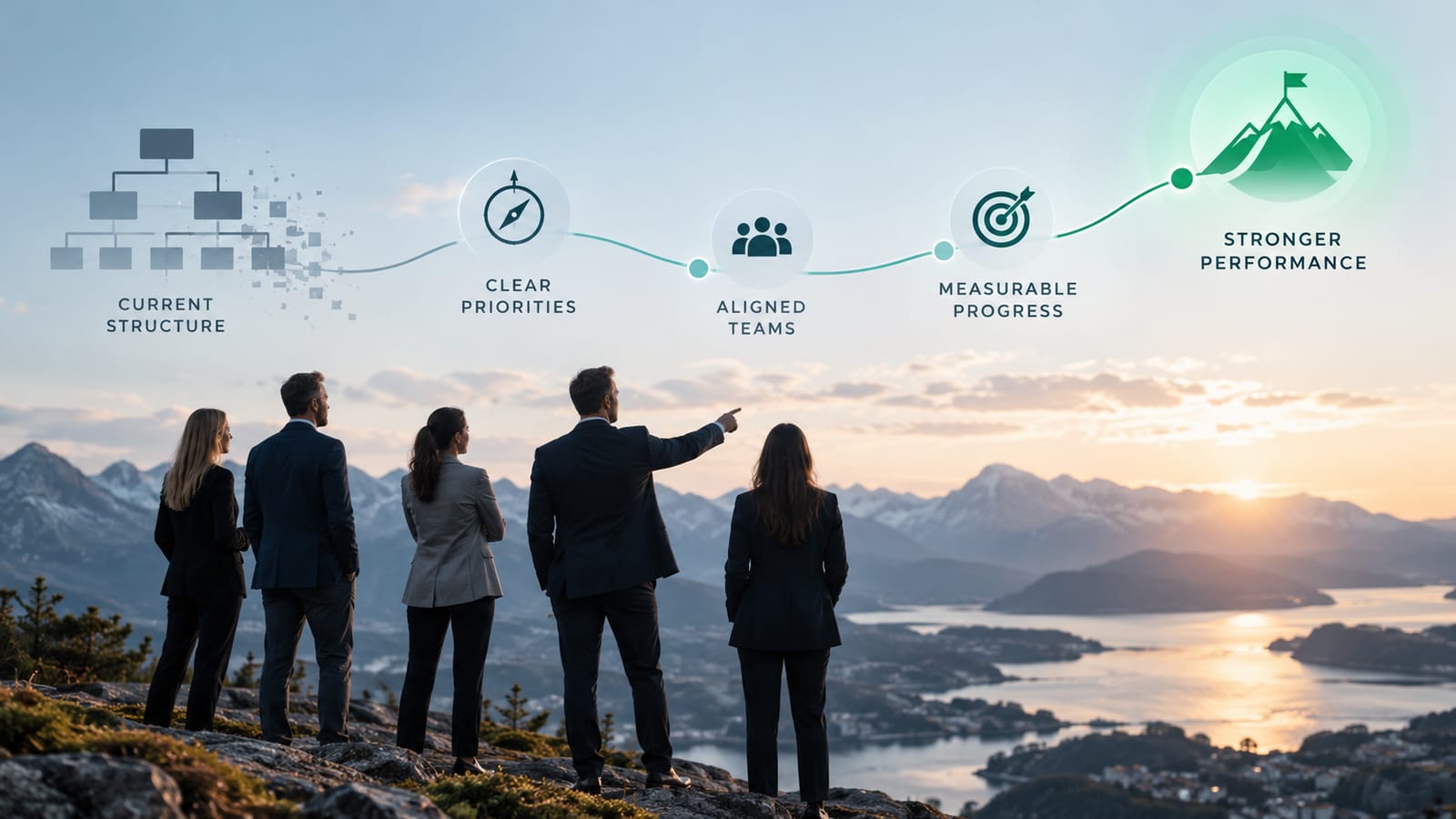
Why successful organizational change requires more than a new structure — and how Objectives and Key Results (OKRs) can help Nordic leadership teams align people, priorities and execution.
Organizational adjustments are a natural part of running a growing business. Markets change, strategies evolve, customer expectations shift, and companies need to adapt.
Yet many organizational adjustments fail to deliver the improvements they were designed to achieve.
A company introduces a new organizational structure, appoints new leaders, merges departments or establishes cross-functional teams. The organizational chart looks better. Responsibilities have been redistributed. Leadership announces a new beginning.
Six months later, however, many of the same challenges remain.
Decisions still take too long. Departments continue to operate in silos. Strategic initiatives compete for resources. Employees struggle to understand what has actually changed beyond their reporting lines.
For leaders of larger Nordic organizations, the challenge is rarely a lack of willingness to change. More often, it is the difficulty of translating structural adjustments into meaningful changes in how people work together.
This is where Objectives and Key Results (OKRs) can play an important role.
Not as another management framework to implement alongside the reorganization, but as a practical way to connect organizational adjustments with strategic priorities, measurable outcomes and shared accountability.
The organizational chart is not the organization
When leadership teams discuss organizational adjustments, the conversation often starts with structure.
Should we centralize or decentralize? Should business units have greater autonomy? Do we need fewer management layers? Should product development and technology report to the same executive?
These are legitimate questions, particularly in companies with more than 200 employees, where organizational complexity can become a barrier to effective execution.
But structure is only one part of organizational performance.
An organization is also defined by how decisions are made, how teams collaborate, how priorities are established and how leaders allocate resources.
Changing reporting lines without changing these underlying mechanisms rarely produces lasting results.
Consider a Nordic technology company experiencing slow product development. Leadership decides to reorganize around cross-functional product teams.
The intention is sensible: improve collaboration, reduce dependencies and accelerate delivery.
But if performance continues to be evaluated primarily within individual functions, budgets remain locked inside departments, and leadership priorities are unclear, the new teams may simply inherit the problems of the previous structure.
The structure has changed. The operating model has not.
This distinction is critical.
Organizational adjustments should begin with a clear understanding of the outcomes the business needs to achieve, rather than an assumption that a new structure will automatically create them.
Start with outcomes, not organizational boxes
One of the most valuable contributions of OKRs during organizational change is that they force leadership teams to answer a deceptively simple question:
What should become measurably better as a result of this adjustment?
Too often, organizations describe the activities involved in a reorganization rather than the results they expect.
Examples include:
- Establish a new operating model.
- Merge two departments.
- Introduce cross-functional teams.
- Reduce management layers.
- Clarify roles and responsibilities.
These may all be necessary activities, but none demonstrates whether the organization is performing better.
OKRs encourage a different conversation.
Instead of treating the implementation of a new structure as the objective, leaders can define the business outcomes the structural adjustment is intended to enable.
Example: From organizational restructuring to measurable impact
Imagine a Nordic company with 800 employees operating across several markets. Leadership wants to improve its ability to respond to customer needs.
The proposed organizational adjustment involves moving from functionally organized departments toward more customer-oriented, cross-functional teams.
A relevant OKR might look like this:
Objective: Create a more responsive organization that delivers customer value faster.
Key Results:
- Reduce average time from approved customer requirement to production release from 120 to 75 days.
- Increase the percentage of customer requests resolved without cross-department escalation from 45% to 75%.
- Improve customer satisfaction for affected services from 78% to 85%.
- Reduce average decision lead time for prioritized customer initiatives from 20 to 10 working days.
These are illustrative targets, not universal benchmarks. The right Key Results depend on the company's baseline, strategy and operating environment.
The important distinction is that the OKR measures whether the organization is becoming more effective, rather than whether the restructuring project has been completed.
It also gives leadership a basis for evaluating whether the new organizational design is working.
Five common pitfalls in organizational adjustments
Even well-intentioned organizational changes can create unintended consequences. The following challenges are particularly relevant for larger companies, where changes in one area frequently affect several others.
1. Changing the structure without aligning strategic priorities
A new organizational structure does not automatically create strategic alignment.
In fact, reorganizations can temporarily increase confusion as teams attempt to understand new responsibilities, relationships and expectations.
Without clear priorities, departments may interpret the purpose of the adjustment differently.
Sales might focus on growth, operations on efficiency, and technology on platform modernization. All three may be pursuing legitimate goals, but their priorities can compete.
How OKRs help: Establish a small number of company-level Objectives before translating them into team-level priorities.
These Objectives should clarify what matters most across organizational boundaries.
For example, improving customer retention may require coordinated contributions from sales, customer service, product development and operations.
Rather than assigning separate, disconnected targets, OKRs can make these dependencies visible and encourage teams to agree on how they will contribute.
The goal is alignment, not simply cascading identical objectives through every management layer.
2. Underestimating the human impact of change
Nordic leadership traditions often emphasize trust, participation and relatively flat hierarchies.
These characteristics can be strengths during organizational change, but they do not eliminate uncertainty.
Employees still want to understand how adjustments will affect their responsibilities, influence, career opportunities and everyday work.
When these questions remain unanswered, even a strategically sound reorganization can lose momentum.
A common leadership mistake is to communicate the new structure extensively while spending too little time explaining why the change is necessary and what success should look like.
How OKRs help: Use clear, outcome-oriented Objectives to explain the purpose of the change and involve teams in defining how they can contribute.
Employees are more likely to engage when they understand the business challenge and have meaningful influence over the solutions.
OKRs can provide that connection between strategic intent and local ownership.
However, OKRs should never be used as a substitute for proper employee involvement, consultation or the established labor relations processes that apply in Nordic countries.
3. Creating new silos while trying to remove old ones
Many reorganizations aim to improve cross-functional collaboration.
Ironically, they sometimes create new boundaries instead.
A company might move from functional departments to business units, only to discover that each business unit begins optimizing its own performance at the expense of shared company priorities.
Another organization may establish product teams but leave critical decision rights and resources under functional control.
The result is a more complicated matrix rather than better collaboration.
How OKRs help: Identify outcomes that require cooperation across organizational boundaries.
Where several teams genuinely share responsibility for an outcome, establish shared OKRs with explicit ownership and agreed contributions.
For instance, reducing customer onboarding time may require coordinated improvements in sales, compliance, technology and customer operations.
The shared outcome makes collaboration a management priority rather than an informal expectation.
That said, not every Objective should be shared. Excessive shared ownership can make accountability unclear. One accountable owner and clearly defined contributors often work better than assigning responsibility to everyone.
4. Treating organizational change as a one-time project
Many organizations approach restructuring with a traditional project mindset.
There is a planning phase, an implementation date, new reporting lines and a formal announcement that the change has been completed.
But organizational performance rarely improves overnight.
New teams need to establish working relationships. Leaders must adjust decision-making practices. Processes and incentives may need to change.
Without a mechanism for evaluating progress, organizations can struggle to distinguish between temporary transition challenges and fundamental design problems.
How OKRs help: Establish a regular rhythm of reviewing measurable outcomes.
Quarterly OKR cycles, supported by shorter progress check-ins, give leaders opportunities to evaluate whether the intended improvements are materializing.
The discussion should go beyond whether activities have been completed.
Are decisions becoming faster? Are customer outcomes improving? Have dependencies decreased? Are teams able to execute more effectively?
If not, leadership should be willing to adjust the operating model rather than defend the original design.
5. Failing to change leadership behavior
Perhaps the most underestimated risk in organizational adjustments is that leaders continue behaving as they did before the change.
An organization may introduce autonomous teams while senior leaders continue approving operational decisions.
Leadership may communicate a commitment to collaboration while rewarding individual departmental performance.
Or the executive team may announce three strategic priorities while continuing to launch initiatives that compete for the same resources.
Employees quickly recognize these contradictions.
How OKRs help: Make leadership accountability visible.
The executive team should actively own and review company-level OKRs, resolve cross-functional conflicts and make resource allocation decisions based on agreed priorities.
This also means being willing to stop initiatives that no longer support the strategy.
OKRs cannot compensate for inconsistent leadership behavior. They can, however, make the inconsistency more visible and create a structured opportunity to address it.
Using OKRs before, during and after organizational adjustments
The greatest value of OKRs comes when they are integrated into the change process rather than introduced as an additional reporting requirement.
For larger organizations, a practical approach can be divided into three phases.
Phase 1: Before the adjustment — establish strategic clarity
Before deciding how the organization should be structured, leadership should establish what the organization needs to accomplish.
Start by identifying the business challenges driving the adjustment.
Are customers experiencing slow delivery? Is innovation taking too long? Are operating costs increasing? Is accountability unclear? Is growth constrained by coordination across functions?
Translate the most important challenges into a limited number of measurable strategic outcomes.
At this stage, leadership should also establish baselines. Without an understanding of current performance, it becomes difficult to evaluate whether an organizational adjustment has delivered value.
The central question is:
What must improve, and how will we know?
Once the desired outcomes are clear, leaders can assess which organizational changes are actually necessary.
Sometimes the answer is a significant restructuring.
In other cases, better decision rights, clearer priorities, improved resource allocation or stronger cross-functional collaboration may deliver much of the intended benefit without changing the formal structure.
This is an important distinction. Reorganizations are disruptive and should not become the default response to every performance challenge.
Phase 2: During the adjustment — align teams around shared outcomes
During implementation, OKRs can provide continuity while responsibilities and working relationships change.
Company-level Objectives should remain sufficiently stable to provide strategic direction.
Teams can then define their contributions within the new operating model.
For example, if the strategic Objective is to improve customer responsiveness, different teams may contribute through shorter development cycles, faster support resolution or simpler approval processes.
The focus should be on how the teams collectively influence the desired outcome.
Leaders should also establish clear decision rights.
Who can make which decisions? Where are dependencies managed? Who resolves conflicts between priorities?
These questions cannot be answered by OKRs alone. They require deliberate organizational design.
However, OKR discussions can expose gaps in accountability and highlight where structural arrangements are preventing progress.
Phase 3: After the adjustment — measure, learn and adapt
Once the new structure is in place, leadership must resist the temptation to declare victory too early.
The real test is whether performance improves.
A quarterly review cycle can help leadership distinguish between implementation progress and business impact.
Useful questions include:
- Which outcomes have improved since the adjustment?
- Where are teams still experiencing unnecessary dependencies?
- Have decision-making processes become faster and clearer?
- Are employees able to connect their priorities to the company strategy?
- Which assumptions about the new operating model have proven incorrect?
The purpose is not to continually reorganize.
It is to create an operating model that can be refined through evidence and learning rather than relying solely on leadership assumptions.
A practical leadership example: When OKRs reveal that structure is not the problem
Consider a Nordic industrial company with approximately 1,500 employees across manufacturing, engineering, sales and service.
The executive team believes that the organization has become too slow and bureaucratic.
A proposal emerges to remove one management layer and give regional business units greater autonomy.
Before proceeding, the leadership team establishes an OKR focused on improving operational responsiveness.
Objective: Enable faster decisions and execution closer to our customers.
Key Results:
- Reduce average approval time for customer-specific solutions from 15 to 7 working days.
- Increase the proportion of operational decisions made at the appropriate local level from 50% to 80%.
- Reduce the number of escalations requiring executive intervention by 40%.
During the initial review, the team discovers that many delays are not caused by management layers.
Instead, decision rights are poorly defined, several functions use conflicting priorities, and managers are reluctant to act without senior approval.
Rather than immediately launching a major restructuring, leadership clarifies decision authority, simplifies approval processes and aligns priorities across functions.
These adjustments are tested and measured through the OKRs.
If they deliver the required improvements, the company may avoid a disruptive reorganization. If significant structural barriers remain, leadership has stronger evidence for deciding what to change.
This hypothetical example illustrates an important principle:
The best organizational adjustment is not necessarily the largest one. It is the one that removes the constraints preventing the business from achieving its objectives.
What Nordic leaders should consider
For Nordic companies, organizational adjustments take place within a leadership and workplace context that deserves particular attention.
Trust, employee participation, transparency and collaboration are important characteristics of many Nordic organizations.
These characteristics can support effective OKR implementation, particularly when teams are given meaningful ownership of outcomes.
But there are also potential tensions.
Consensus-oriented decision-making can sometimes delay difficult prioritization decisions. High levels of autonomy can lead to fragmented execution if company-wide priorities are unclear. And an emphasis on participation can become counterproductive if leaders avoid making decisions for which they are accountable.
The answer is not to abandon these leadership principles.
It is to combine them with clearer strategic direction, measurable outcomes and explicit accountability.
For organizations with several hundred or several thousand employees, this becomes particularly important because alignment cannot depend on informal communication alone.
A disciplined OKR approach can help leadership maintain common direction while preserving autonomy in how teams achieve their goals.
It is also important to recognize that organizational changes may involve formal consultation, collective agreements and country-specific employment obligations. OKRs should support transparent communication and execution, not bypass these responsibilities.
A leadership checklist before your next organizational adjustment
Before approving a major organizational change, the executive team should be able to answer seven questions:
- Strategic purpose: Which business outcomes are we trying to improve?
- Evidence: What indicates that the current organization is preventing these outcomes?
- Alternatives: Could we achieve the same results through changes in decision rights, processes or priorities?
- Accountability: Who will own the outcomes, and who has authority to make the necessary decisions?
- Alignment: How will different teams coordinate their contributions?
- Measurement: Which Key Results will tell us whether the adjustment is working?
- Learning: When will we evaluate progress, and what are we prepared to change if our assumptions prove wrong?
If these questions cannot be answered, the organization may not yet be ready to implement the proposed adjustment.
Final thoughts: Organize for outcomes, not appearances
Organizational adjustments are sometimes necessary to remain competitive, improve performance or execute a new strategy.
But a new structure is not a business outcome.
For leaders of larger Nordic organizations, the real opportunity is to shift the conversation from how the organization should look to what the organization needs to achieve.
OKRs provide a practical framework for making that shift.
They help leadership teams clarify strategic priorities, align cross-functional efforts, establish measurable expectations and learn whether organizational adjustments are delivering their intended value.
Used well, OKRs also challenge leaders to examine their own behavior, decisions and priorities throughout the change process.
The most successful organizational adjustments are not defined by how many departments are merged, how many reporting lines are changed or how quickly the new structure is announced.
They are defined by whether the organization becomes better at delivering value.
Start with the outcomes. Design the organization to support them. Use OKRs to determine whether the changes are working.
That is how organizational adjustments become meaningful business improvements rather than another exercise in moving boxes on an organizational chart.
Want to see how Futureworks can support your organization through structural change? Get in touch for a no-obligation walkthrough.
Ready to put OKRs into practice?
See how Futureworks helps teams align, track, and execute every week.