Turn Goals Into Learning: Introducing Review Period in Futureworks

Setting good goals is only half the job.
The real value comes when you stop, look back at what happened, and ask: What did we achieve? What did we learn? And what should we do differently next time?
That is exactly what Review Period in Futureworks is designed to help you do.
Available from Goal Focus, Review Period gives teams a dedicated way to review a completed goal period, reflect on results, and turn those insights into better decisions for the next cycle.
Why review your goals?
It is easy to move directly from one goal period to the next.
The quarter ends. New priorities appear. New OKRs are created. Everyone gets busy again.
But when we skip the review, we also skip one of the most valuable parts of goal management: learning from execution.
A goal tells you where you wanted to go. Progress updates tell you how you were doing along the way. A review helps you understand the full story.
Did we achieve what we set out to achieve? Why did some goals succeed while others struggled? Were our Key Results ambitious enough, or perhaps too ambitious? What changed during the period? And what should we carry forward into the next cycle?
Review Period creates a natural moment for that reflection.
Instead of treating goals as something that simply expires at the end of a quarter, you can use them as a source of organizational learning.
What is Review Period?
Review Period is a function in Goal Focus that lets you review goals from a selected period after the execution cycle is complete.
Think of it as the closing chapter of your goal cycle.
During the period, your attention is primarily forward-looking: What are we trying to achieve? Are we making progress? Where do we need to adjust?
During the review, the perspective changes. You are looking back to understand performance, outcomes, and lessons learned before deciding what comes next.
This creates a simple rhythm:
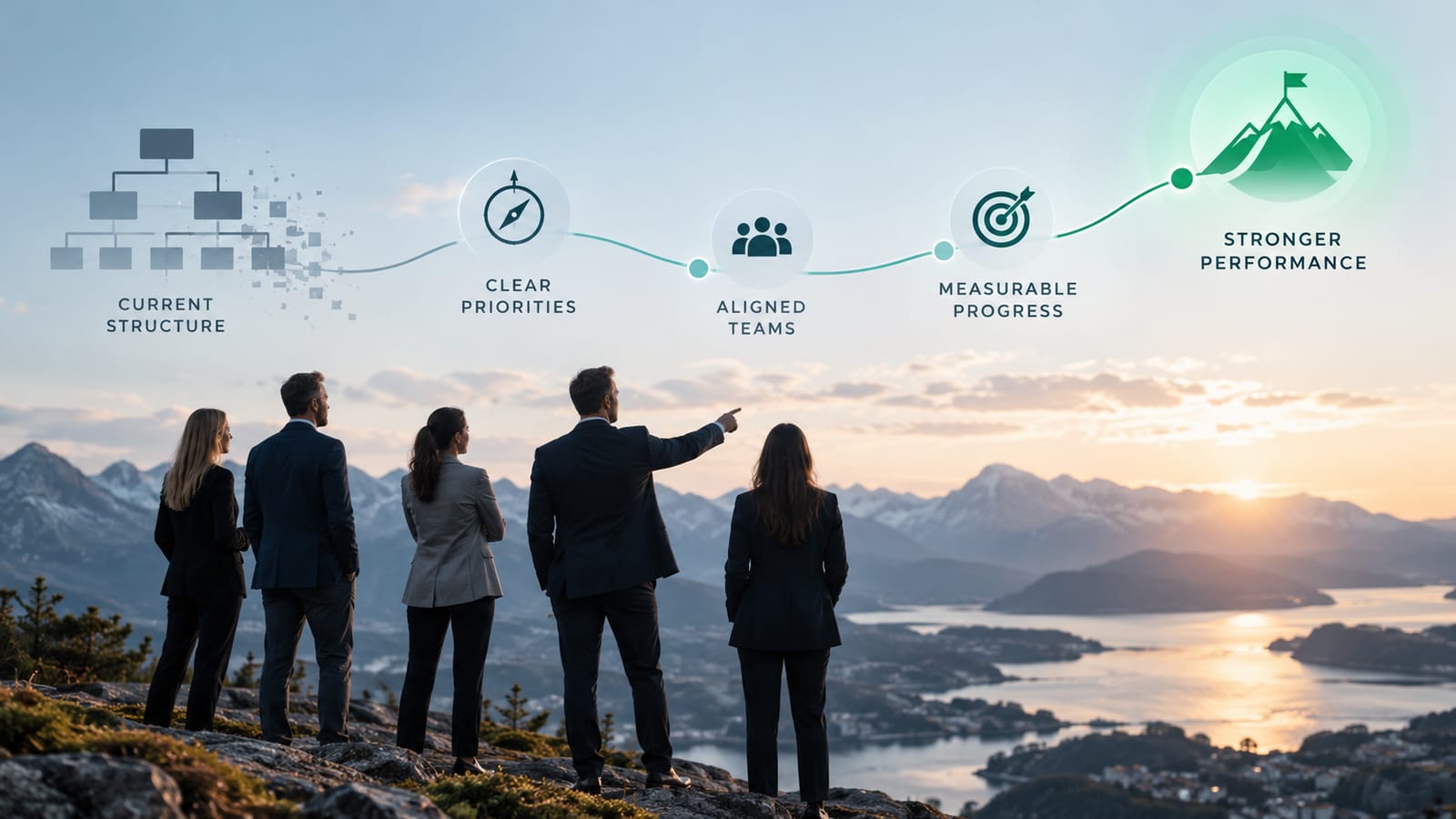
Set goals → Execute and follow up → Review → Learn → Set better goals
Over time, that rhythm can make a significant difference. Teams become better at setting realistic but ambitious goals, identifying obstacles earlier, and understanding which initiatives actually contribute to strategic progress.
How to use Review Period in Futureworks
Review Period is accessed through Goal Focus, where your objectives and their progress are already visible.
Start by opening Goal Focus and selecting the period you want to review. From there, use the Review Period function to shift from following current execution to evaluating the completed period.
The review should not simply be a discussion about whether every number reached 100%. Use the goals and results in Futureworks as the starting point for a conversation.
For each important goal, consider questions such as:
- What did we achieve? Look at the final results and the progress made during the period.
- What contributed to the result? Identify the initiatives, decisions, collaboration, or changes that made a difference.
- What got in the way? Discuss dependencies, changing priorities, assumptions, resource constraints, or other obstacles.
- What did we learn? Capture insights that should influence how you work or set goals in the future.
- What happens next? Decide whether the goal is complete, whether some of the work should continue, or whether the learning should influence the next set of goals.
The purpose is not to create a lengthy reporting exercise. It is to create a focused conversation that turns the data already captured in Futureworks into useful insight.
When should you use Review Period?
The natural time is at the end of each goal cycle and before, or as part of, setting goals for the next one.
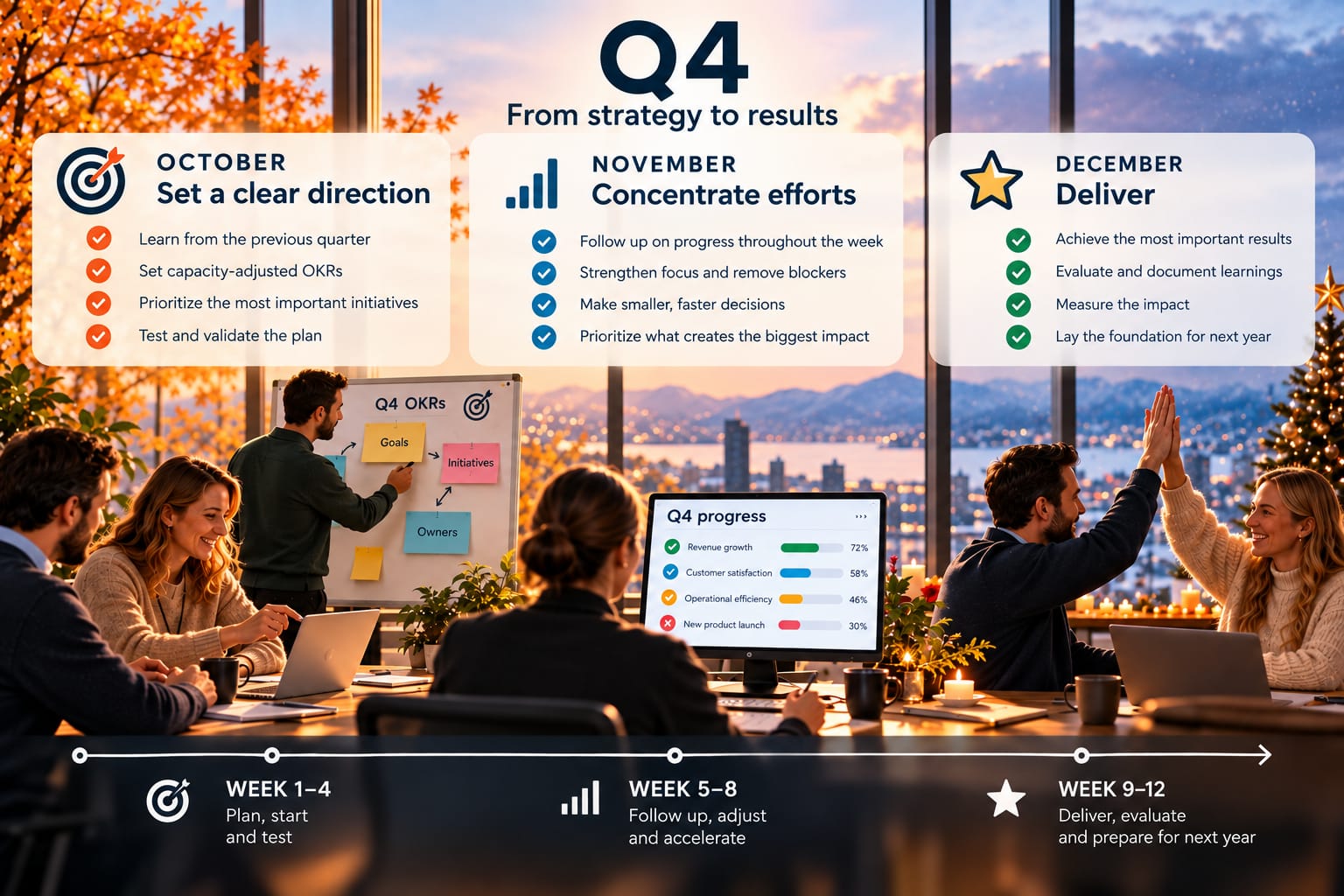
For organizations working with quarterly OKRs, for example, Review Period becomes part of the quarterly rhythm.
Finish the quarter, review the outcomes, identify the lessons, and then use those lessons when creating the next quarter's goals.
You can use Review Period at different levels of the organization as well. A team can review its own objectives before planning the next cycle, while leaders can use reviews across teams to identify broader patterns, dependencies, and opportunities for improvement.
The important thing is consistency.
A review is useful once. A regular review practice is much more powerful because it creates a feedback loop between strategy, execution, learning, and the next round of priorities.
How to run your quarterly goal review in Futureworks
A good quarterly review does not need to become a long workshop or reporting exercise. The goal is to create a structured conversation around the results and turn what you learn into better priorities for the next quarter.
Here is a simple way to run it.
Step 1: Make sure your goals are up to date
Before the review, ask goal owners to update their goals and Key Results with the latest progress.
Having accurate final numbers gives everyone a common starting point and means you can spend the review discussing why you got the results, not debating whether the data is correct.
Step 2: Open Review Period from Goal Focus
Go to Goal Focus, select the period you want to evaluate, and open Review Period.
This gives you a shared view of the goals for the period and creates the foundation for the review conversation.
Step 3: Review the outcomes
Work through the most important goals and Key Results.
Start with what actually happened. Which goals were achieved? Where did you make significant progress? Where did results fall short of expectations?
Try not to spend too much time simply reading out numbers. The numbers are the starting point for the discussion, not the discussion itself.
Step 4: Discuss the "why"
This is where much of the value of the review is created.
For each important result, ask: Why did we get this result?
Look at both successes and misses. What worked particularly well? What slowed you down? Did priorities change? Were there dependencies you underestimated? Did you discover that one of your original assumptions was wrong?
The aim is to understand the factors behind the result.
Step 5: Identify the learning
Now turn observations into lessons.
What would you repeat next quarter? What would you do differently? Did you learn something about your customers, your market, your team, or the way you execute?
Try to make the learning specific enough to influence a future decision.
"Communication could have been better" is difficult to act on.
"We need to involve the sales team before finalizing product launch targets" is much more useful.
Step 6: Decide what carries forward
Not every unfinished goal should automatically become a goal for the next quarter.
Ask whether the goal is still strategically important.
Some goals should continue. Some may need to be reframed based on what you learned. Others may no longer be relevant and should be closed.
This is an important moment to avoid simply carrying yesterday's priorities into tomorrow's plan.
Step 7: Use the review to shape the next quarter
Finally, take the insights from the review into your next goal-setting process.
What deserves greater focus? What should change? Which lessons should affect the way you define your next Objectives and Key Results?
This is where Review Period becomes more than a retrospective.
The output of a good review is better input for the next quarter.
A simple quarterly rhythm could therefore look like this:
Update → Review → Learn → Prioritize → Set the next goals
Repeat that cycle consistently, and goal management becomes more than tracking progress. It becomes a continuous process for improving how your organization executes its strategy.
Review is about learning, not grading
One principle is especially important when reviewing goals: the review should not become a hunt for green numbers.
Ambitious goals do not always end at 100%.
A goal that reached 70% may have produced an important breakthrough. A goal that reached 100% may, in hindsight, have been too easy. And a goal that made little measurable progress may still have revealed an assumption that the organization needed to challenge.
That is why the conversation behind the result matters.
The question is not simply: "Did we hit the target?"
It is also: "What does this result teach us?"
When teams feel comfortable discussing both successes and misses, goal reviews become a tool for improvement rather than an exercise in explaining performance.
From goal tracking to continuous improvement
Futureworks is designed to connect strategy, goals, priorities, and the ongoing rhythm of execution. Review Period completes an important part of that loop.
Goals should not disappear when their deadline passes.
They should leave something behind: better understanding, better decisions, and better goals for the next period.
By making Review Period part of your regular goal-setting rhythm, you turn every cycle into an opportunity to improve, not only what your organization achieves, but how it achieves it.
So before you rush into your next set of goals, spend a little time looking back.
Review the period. Capture the learning. Then use it to make the next one better.
Want to see Review Period in action? Get in touch and we'll show you how it fits into your own goal-setting rhythm.
Ready to put OKRs into practice?
See how Futureworks helps teams align, track, and execute every week.