The First 90 Days With OKRs: What to Expect and What to Avoid
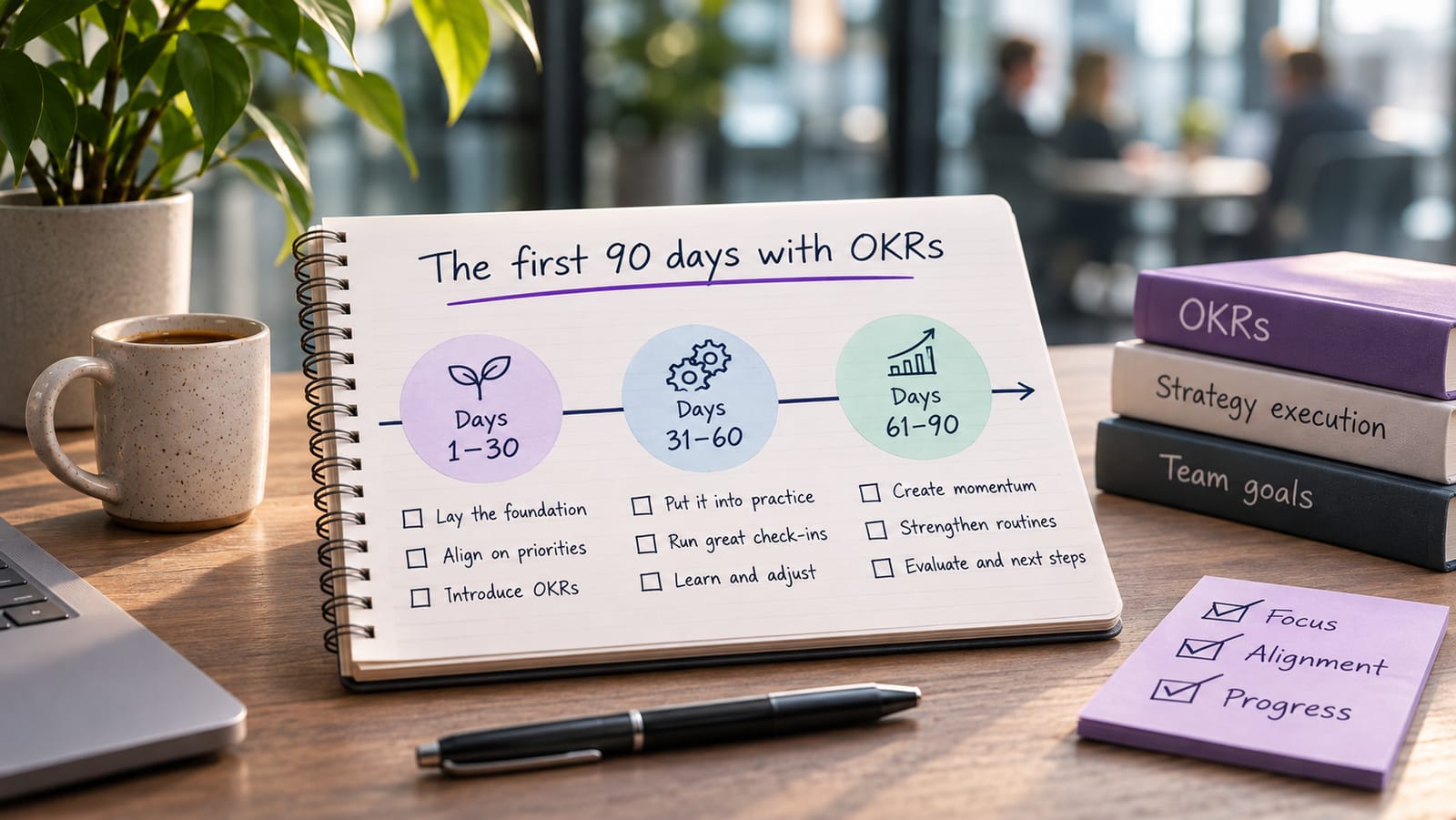
Introducing OKRs can help your organization create clearer priorities, improve alignment, and make progress more visible. But the first three months rarely go exactly as planned. Here's what to expect, what to avoid, and how to give your team a good start.
There's usually a moment when a leadership team realizes that the way it manages goals isn't quite working.
Perhaps the company has grown, and it's become harder to keep everyone moving in the same direction. Maybe departments are doing good work individually, but their efforts don't always add up to the results the company needs. Or perhaps the strategy is clear at the leadership level, yet somehow gets lost in everyday work.
Someone suggests introducing OKRs.
The idea sounds promising. Objectives and Key Results provide a way to connect strategic priorities with measurable outcomes. Teams get a clearer understanding of what matters, and leaders can follow progress without waiting for the next quarterly review.
A few articles are shared. Someone presents the framework in a management meeting. The leadership team agrees that it's worth trying.
Then comes the question that often proves more difficult than expected.
Where do we actually start?
Should every department set OKRs immediately? How many objectives should we have? Who should own them? How often should we meet? And how do we make sure this doesn't become another management initiative that starts with enthusiasm and quietly disappears after a few months?
These are sensible questions.
The first 90 days with OKRs are less about getting everything right and more about learning how to work with objectives in a way that makes sense for your organization.
And that requires a little patience.
What should you realistically expect from your first 90 days with OKRs?
Let's begin with something that's easy to overlook when reading about OKRs.
Your first quarter probably won't be perfect.
Some objectives will be too broad. Some Key Results will be difficult to measure. Teams may confuse projects with outcomes, and a few people will wonder why the organization needs another way of setting goals.
That's normal.
Introducing OKRs isn't simply a matter of learning a framework. You're asking people to change how they think about priorities, how they discuss progress, and sometimes how they work together.
Those habits take time to develop.
The goal of the first 90 days shouldn't be to have a flawless set of OKRs across the entire organization.
A more realistic ambition is to establish a small number of meaningful objectives, create a consistent follow-up routine, and help people become comfortable discussing progress openly.
If you can achieve that, you've created a foundation worth building on.
The following roadmap is one practical way to approach your first quarter. It isn't a universal formula, and the timing may need to change depending on your organization's size, maturity, and existing management routines.
But it gives you a place to start.
Weeks 1–2: Before you write a single OKR
Imagine a company with 80 employees.
The leadership team has decided to introduce OKRs because it wants to improve strategic alignment and make it easier to follow up on company priorities.
The temptation is to announce the new framework, organize a workshop, and ask every department to come back with its objectives.
But there's a problem.
If the leadership team hasn't agreed on what the company needs to achieve, asking everyone else to define OKRs will simply create a collection of disconnected goals.
The first two weeks are better spent getting clear on the purpose of the initiative.
Why are you introducing OKRs?
It sounds like an obvious question, but the answers can vary considerably.
One leader may want better reporting. Another may want more accountability. A third may be concerned that teams aren't collaborating effectively.
These are related challenges, but they're not identical.
It's important to agree on what you actually want to improve.
Perhaps the most useful question to ask is:
What should be different about the way we work six months from now?
If the answer is simply that everyone should have OKRs, you probably need to dig a little deeper.
A more meaningful answer might be that managers should have a shared understanding of company priorities, teams should be able to explain how their work contributes, and leadership meetings should focus more on progress and decisions.
That's something worth working towards.
During these first weeks, the leadership team should also identify the few strategic priorities that matter most for the coming quarter.
Try not to turn every ongoing responsibility into an objective.
The business still needs to operate. Customers need support, employees need managing, and routine work needs to happen.
OKRs are particularly useful for focusing attention on meaningful improvements or changes, rather than documenting everything the organization already does.
By the end of week two, aim to have a clear reason for introducing OKRs, leadership support, and a small number of strategic priorities.
You don't need a complete implementation plan for the entire company.
You need enough clarity to take the next step.
Weeks 3–4: Writing your first OKRs
This is where things start to become more concrete.
The leadership team has agreed on its priorities, and now it's time to translate them into Objectives and Key Results.
An Objective describes what you want to achieve. It should provide direction and be meaningful enough that people understand why it matters.
Key Results describe how you'll know whether you're making progress.
The distinction is simple in theory.
In practice, it's one of the first things organizations struggle with.
Imagine the company wants to improve customer retention.
Its first attempt might look like this:
Objective: Improve customer retention.
Key Results:
- Launch a new onboarding program.
- Organize customer workshops.
- Update the help center.
At first glance, this seems reasonable.
But there's a problem.
These Key Results describe activities, not results.
The company could complete all three and still lose the same number of customers.
A more useful version might be:
Objective: Help customers get lasting value from our product.
Key Results:
- Reduce quarterly customer churn from 8% to 5%.
- Increase onboarding completion from 60% to 85%.
- Increase the proportion of active customers using key features from 55% to 75%.
These numbers are illustrative, not recommended benchmarks.
Now the team has a clearer understanding of what success looks like.
The onboarding program, customer workshops, and help center improvements might still be important. But they become initiatives that support the objective rather than the definition of success.
This shift from activities to outcomes is one of the most valuable things teams can learn from working with OKRs.
And it's worth spending time on.
During weeks three and four, focus on writing a manageable number of objectives.
For a first quarter, one or two meaningful objectives per participating team may be enough. Each objective might have two to four Key Results, depending on what you're trying to achieve.
These aren't strict rules. The point is to keep the first cycle manageable.
You should also establish a baseline for each measurable Key Result wherever possible.
If you want to improve customer satisfaction, what is the current score? If you want to reduce onboarding time, how long does it take today?
Without a baseline, it's difficult to know whether progress is meaningful or whether a target is realistic.
And if you don't have reliable data yet, don't invent a number just to complete the OKR.
Sometimes your first step needs to be establishing a useful way of measuring the outcome.
Week 5: Bringing the teams into the conversation
One of the easiest ways to make OKRs feel like another reporting requirement is to introduce them entirely from the top.
The leadership team defines the company objectives, distributes them to departments, and asks managers to create supporting goals.
Everyone completes the exercise.
But the people responsible for doing the work may have had very little influence on what they're being asked to achieve.
This can create problems.
Managers and employees often have information that isn't visible at the leadership level. They know where customers struggle, which processes create unnecessary work, and what obstacles are likely to prevent progress.
If those perspectives aren't included, the organization risks setting objectives that look sensible in a presentation but are difficult to execute.
Week five is a good time to bring participating teams into the conversation.
Explain the company priorities and why they matter.
Then ask teams to think about where they can make the greatest contribution.
A customer success team might identify onboarding as the biggest opportunity to improve retention. A product team might see recurring usability problems that need attention. Sales might recognize that certain customer segments are more likely to succeed with the product than others.
These insights can help shape better objectives.
The aim isn't for every team to create a separate set of goals just because the framework requires it.
It's to identify where meaningful contributions can be made.
And sometimes the best decision is for two teams to share an objective rather than create separate ones.
That can be particularly valuable when the outcome depends on collaboration across departments.
Week 6: The first check-in, and the first awkward conversation
By week six, the first OKRs are in place.
People have started working towards them, and it's time to review progress.
This is often when the difference between setting OKRs and actually using them becomes clear.
Imagine a team that has committed to reducing customer onboarding time.
At the first check-in, the manager asks how things are going.
The team explains that the new onboarding materials are almost finished and several internal meetings have taken place.
Good progress, it seems.
But when the manager asks whether onboarding time has actually improved, nobody knows.
The team has been tracking the work, but not the outcome.
This is a useful discovery.
Not because anyone has done something wrong, but because it reveals what the team needs to change.
A good OKR check-in should be a conversation about progress rather than a presentation of completed activities.
The team should look at the Key Results, discuss what has changed, and identify anything that needs attention.
If progress is slower than expected, the conversation should focus on understanding why.
Perhaps the original assumptions were wrong. Perhaps another department needs to contribute. Or perhaps the team simply needs more time before the results become visible.
The important thing is to make these conversations normal.
People should feel comfortable saying that an initiative isn't working or that they're uncertain about the best way forward.
If every check-in becomes an exercise in explaining why targets haven't been met, teams will quickly learn to set safer objectives and avoid difficult conversations.
That's the opposite of what you want.
Weeks 7–8: When the initial enthusiasm starts to fade
There's often a point in any new management initiative when the excitement wears off.
The workshops are finished. The objectives have been written. People understand the basic terminology.
And now everyone has to fit the new routines into an already busy working week.
This is where many OKR implementations begin to struggle.
Managers postpone check-ins because other meetings feel more urgent. Teams forget to update progress. Objectives start to feel disconnected from the work people are actually doing.
Before long, OKRs become something that gets attention only when someone asks for an update.
If that happens, resist the temptation to solve the problem by introducing more reporting.
Instead, look at how OKRs fit into your existing routines.
Do you really need a separate OKR meeting?
Or could you use part of the weekly team meeting to discuss objectives, progress, and obstacles?
For many teams, the second option is more sustainable.
The aim is to make OKRs part of how work is managed, not an additional layer of administration.
A useful weekly check-in might take 15–30 minutes for a small team with a limited number of objectives.
The team reviews the Key Results, discusses where progress is happening, and agrees on what needs attention before the next meeting.
Some weeks, there may be little to discuss.
Other weeks, an unexpected obstacle may require a longer conversation.
That's fine.
The value comes from maintaining a regular rhythm and using the information to make decisions.
At Futureworks, this is one of the reasons we've developed Meeting Mode. It's designed to bring objectives and progress into the meetings teams are already having, making it easier to discuss what matters without turning follow-up into a separate reporting exercise.
The principle is simple: OKRs become useful when they influence conversations and decisions, not just when they're documented.
Weeks 9–10: Looking beyond your own department
By this point, teams should be becoming more comfortable with their objectives.
They may also begin to notice something that wasn't obvious at the beginning.
Progress often depends on people outside their own team.
A marketing department wants to generate more qualified leads, but needs sales to provide feedback on lead quality.
A customer success team wants to improve onboarding, but depends on product development to address recurring usability issues.
An operations department wants to reduce processing time, but needs finance to simplify an approval process.
These dependencies aren't necessarily problems.
They're a normal part of how organizations work.
But they can become obstacles when teams don't have visibility into each other's priorities.
Weeks nine and ten are a good time to look at how objectives connect across the organization.
Are different teams working towards compatible outcomes?
Are there conflicting priorities?
Does one department need support from another to make progress?
And are there decisions that need to be made at the leadership level?
These conversations can be particularly valuable for companies that introduced OKRs to improve strategic alignment.
It's one thing for each team to have clear objectives.
It's another for those objectives to contribute to a shared direction.
The purpose isn't to create a complicated hierarchy of goals where every Key Result has to connect neatly to something above it.
It's to make important relationships visible and help people collaborate more effectively.
Weeks 11–12: Preparing for your first quarterly review
As the quarter approaches its end, teams will naturally start looking at whether they've achieved their Key Results.
Some will be on track.
Others may be behind.
And a few objectives may turn out to have been poorly defined from the beginning.
That's not necessarily a bad result for a first quarter.
Remember, you're still learning how to use the framework.
The most valuable part of the review isn't simply assigning a score to each objective.
It's understanding what happened.
Did the team make meaningful progress? Which initiatives contributed most? What assumptions turned out to be wrong? Were the targets realistic? Did the team have the resources and support it needed?
And perhaps most importantly, what should change next quarter?
A good quarterly review should create space for honest reflection.
If a Key Result wasn't achieved, that doesn't automatically mean the team failed.
Perhaps the objective was deliberately ambitious. Perhaps market conditions changed. Or perhaps the team discovered that the original approach wasn't effective.
Those are different situations, and they should lead to different conversations.
At the same time, it's important not to use the learning mindset as an excuse to avoid accountability.
If progress was slow because objectives were ignored, responsibilities were unclear, or decisions were repeatedly postponed, those issues need to be addressed.
The purpose of the review is to learn enough to make the next quarter better.
Not to produce a perfect-looking scorecard.
Week 13: Deciding what comes next
By the end of the first 90 days, your organization should have a much better understanding of what working with OKRs actually involves.
You'll know which parts of the framework people find useful, where the process creates friction, and which management routines need more attention.
This is a good moment to decide how to approach the next quarter.
Perhaps the pilot worked well, and you're ready to involve more teams.
Perhaps the objectives were too numerous, and the next cycle should be simpler.
Or perhaps you discovered that managers need more support in writing meaningful Key Results and leading effective check-ins.
All of these are useful outcomes.
The important thing is not to treat the first quarter as a final examination.
Think of it as the beginning of a learning process.
You don't need to expand OKRs across the entire organization simply because three months have passed.
It's often better to strengthen the routines that are working before introducing them more broadly.
A small, successful implementation is more valuable than a company-wide rollout that people experience as unnecessary administration.
The mistakes that can make OKRs harder than they need to be
Looking back at the first 90 days, several common mistakes tend to explain why organizations struggle.
One is trying to introduce too much, too quickly.
When every department is asked to create multiple objectives immediately, the organization can end up spending more time managing the framework than using it.
Another is confusing OKRs with ordinary task management.
If Key Results are simply lists of projects to complete, teams may become better at reporting activities without developing a clearer understanding of outcomes.
A third is treating OKRs as a performance evaluation system.
When employees believe that missing an ambitious Key Result will negatively affect their individual performance assessment, they're likely to become more cautious about what they commit to.
This can undermine the openness and learning that make OKRs valuable.
There's also the temptation to make the framework more complicated than necessary.
Organizations introduce elaborate scoring methods, approval processes, reporting templates, and rules about how objectives should be connected.
Before long, managers spend more time discussing how to use OKRs than discussing the business problems they're supposed to help solve.
Finally, some organizations underestimate the importance of leadership involvement.
If the leadership team introduces OKRs but continues to manage the business through unrelated priorities and reporting processes, employees will quickly notice.
People pay attention to what leaders actually discuss and follow up on.
If strategic objectives rarely appear in leadership conversations, it's difficult to expect them to remain important elsewhere.
None of these mistakes is unusual.
But being aware of them can make the first quarter considerably easier.
What should your OKR meetings actually look like?
One of the most practical questions companies ask when introducing OKRs is how often they should meet.
There isn't one correct answer.
A small team working on fast-moving objectives may benefit from weekly check-ins, while another team may find that biweekly discussions provide enough structure.
What's important is that the rhythm matches the work and gives people opportunities to act on what they learn.
For a first quarter, a simple structure could look like this.
Weekly team check-ins focus on progress towards Key Results, obstacles, and immediate priorities. The aim is to identify where attention is needed, not to review every task.
Monthly management reviews look across teams and departments. These discussions are particularly useful for identifying dependencies, conflicting priorities, and decisions that need leadership involvement.
A quarterly review provides space to evaluate the results, discuss what worked, and agree on what should change in the next cycle.
You may already have meetings that can serve these purposes.
If so, use them.
The aim isn't to fill the calendar with OKR meetings.
It's to make the conversations you're already having more useful.
We've explored this idea in our article The Meeting Is Where Your OKRs Actually Happen, which looks at why regular discussions are such an important part of successful OKR work.
How do you know if the first quarter has been successful?
It's tempting to judge the first quarter by looking at how many Key Results were achieved.
But for an organization that's just getting started, that doesn't tell the whole story.
Suppose one team achieves every Key Result but rarely discusses its objectives during the quarter.
Another team achieves only some of its targets but develops a strong routine for reviewing progress, identifying obstacles, and making better decisions.
Which team has had the more successful introduction to OKRs?
The answer isn't necessarily obvious.
For the first quarter, it's worth looking at both results and the habits you're developing.
Do people understand the objectives?
Can teams explain how their work contributes to company priorities?
Are Key Results being used to guide decisions?
Do managers have better conversations about progress?
Are obstacles being identified earlier?
And is the organization learning something useful about how to set and follow up on goals?
These are signs that OKRs are beginning to become part of the way the organization works.
You may not see dramatic business improvements after 90 days.
Some outcomes take longer to develop, and some Key Results won't respond immediately to the initiatives you've introduced.
That's why realistic expectations matter.
The first quarter is about establishing clarity, consistency, and a shared way of working.
The benefits can build over time.
Where OKR software can help during the first 90 days
When companies first introduce OKRs, many begin with spreadsheets or shared documents.
For a small pilot, that may be enough.
The challenge often comes when more teams become involved.
Objectives are stored in different places. Progress updates become difficult to find. Managers spend time preparing status reports, and it becomes harder to see how one team's work connects to another's.
This is where dedicated OKR software can become useful.
At Futureworks, we've developed a platform designed to help organizations connect strategic objectives with team priorities and regular follow-up.
The intention is to make OKRs easier to work with, not to introduce another layer of complexity.
With 360 Vision, teams and leaders can see how objectives relate across the organization. Meeting Mode supports regular discussions about progress, priorities, and obstacles.
That can be particularly valuable during the first 90 days, when the organization is still developing its routines.
But it's important to be realistic about what software can and can't do.
A tool won't write meaningful objectives for you. It won't resolve disagreements about priorities or replace leadership involvement.
Those things still require people to make decisions and work together.
What software can do is provide a shared structure that makes the process easier to maintain as the organization grows.
Your first 90 days don't need to be perfect
If there's one thing worth remembering when introducing OKRs, it's that the first quarter is a starting point.
You don't need to get every objective right.
You don't need a complicated scoring system.
And you certainly don't need every employee to become an OKR expert before the framework can be useful.
What you need is a clear reason for introducing OKRs, a manageable number of meaningful objectives, and a willingness to keep learning.
Start with the priorities that matter most.
Involve the people who will be responsible for making progress.
Make the results visible.
And create room for regular, honest conversations about what's working and what isn't.
Some things will go better than expected.
Others won't.
That's part of the process.
The organizations that get lasting value from OKRs aren't necessarily the ones that introduce the framework most quickly.
They're the ones that find a way to make it useful in everyday work.
Because the goal isn't to become good at managing OKRs.
It's to become better at turning the things that matter into meaningful progress.
At Futureworks, we help organizations get started with OKRs and develop practical routines for connecting strategy, team objectives, and everyday execution.
If you're considering introducing OKRs, you can learn more about our approach at futureworks.no.
Frequently asked questions about implementing OKRs
How long does it take to implement OKRs?
An organization can establish its first OKR cycle within a few weeks, but developing effective routines usually takes longer. The first 90 days are a useful period for testing objectives, establishing meeting routines, and learning how the framework fits the organization. Broader adoption and maturity often require several cycles.
Should every department start using OKRs at the same time?
Not necessarily. Many organizations benefit from beginning with a leadership team, a small group of departments, or a pilot team. This provides an opportunity to learn what works before expanding the framework across the organization.
How many OKRs should a team have?
For a first cycle, one or two meaningful Objectives per participating team may be enough. Each Objective might have two to four measurable Key Results. These are practical starting points rather than fixed rules. The most important thing is to avoid creating so many objectives that the team loses focus.
How often should teams review their OKRs?
Weekly or biweekly check-ins are common starting points. The frequency should depend on how quickly progress can be measured and how often decisions are needed. The purpose of the meeting is to understand progress, identify obstacles, and agree on next steps.
What is the biggest mistake companies make when introducing OKRs?
One of the most common mistakes is treating OKRs as a reporting exercise rather than a way to manage priorities and outcomes. When teams focus mainly on updating numbers or completing activities, they can miss the opportunity to use OKRs for better decisions and collaboration.
Should OKRs be linked to employee performance evaluations?
It's generally wise to be cautious about directly linking ambitious OKR achievement scores to individual compensation or performance ratings. Doing so can encourage employees to set safer targets and make honest discussions about progress more difficult. OKRs are often more useful as a framework for alignment, learning, and execution.
Do you need OKR software to get started?
No. Small teams can begin with spreadsheets or shared documents. Dedicated OKR software can become useful when more teams are involved and the organization needs better visibility, alignment, and consistent follow-up.
What should success look like after the first 90 days?
A successful first quarter should leave the organization with clearer priorities, a manageable set of objectives, regular progress discussions, and a better understanding of how to use OKRs. Achieving every Key Result isn't necessarily the most important measure during an initial implementation.
Ready to put OKRs into practice?
See how Futureworks helps teams align, track, and execute every week.