The Meeting Is Where Your OKRs Actually Happen
Every OKR dies the same way. Not in a dramatic moment, not because the goal was wrong. It dies quietly, in the gap between the workshop where it was set and the next time anyone actually looked at it.
You know the workshop. Coffee, whiteboards, a genuinely good conversation about what matters most this quarter. Everyone leaves energised. Three weeks later, someone opens the system to prep for a meeting and realises nobody has touched the numbers since. The objective is still there. So is the enthusiasm, technically. What's missing is the thing that was supposed to carry it forward: a meeting that actually did its job.
Meetings are where execution either happens or doesn't
Strategy gets set in a workshop. It gets executed, or quietly abandoned, in whatever happens every week after. That's not a knock on workshops, it's just where the real pressure sits. A weekly or biweekly meeting is the only recurring moment where a team collectively looks at what's moving, what's stuck, and what needs to change. If that moment is weak, sporadic, or turns into a status recital nobody's really listening to, the OKRs don't have a chance, no matter how well they were written.
Regular, focused meetings are what keep teams aligned, turn discussion into decisions, and keep priorities actually moving instead of just being revisited. The word doing the work in that sentence is regular. A brilliant meeting once a quarter doesn't compensate for silence in between. A short, slightly imperfect meeting every week beats it every time.
What actually goes wrong
Most OKR meetings don't fail because the team doesn't care. They fail because of a handful of very ordinary problems:
- The agenda is a blank page. Someone has to build it from scratch every time, so half the time it doesn't happen at all.
- The numbers are stale. Someone exported a screenshot the night before, and by the time the meeting happens it's already out of date.
- Decisions get made and then evaporate. Something gets agreed on in the room, and a week later nobody remembers who was supposed to act on it.
- Minutes either don't exist or take longer to write than the meeting itself. So nobody writes them, and the team's memory of what happened lives entirely in people's heads.
None of these are big, dramatic failures. They're small frictions. But they add up to the same result: meetings people stop trusting, and eventually stop showing up to with any real intention.
Why we rebuilt Meetings around this
We didn't design the new Meetings feature in Futureworks by asking "what would a meeting tool look like." We asked what was actually getting in the way of the meetings that make OKRs work, based on feedback and years of sitting in these meetings alongside customers. A few things came up over and over. (You can see the full breakdown of what's new on our product updates page.)
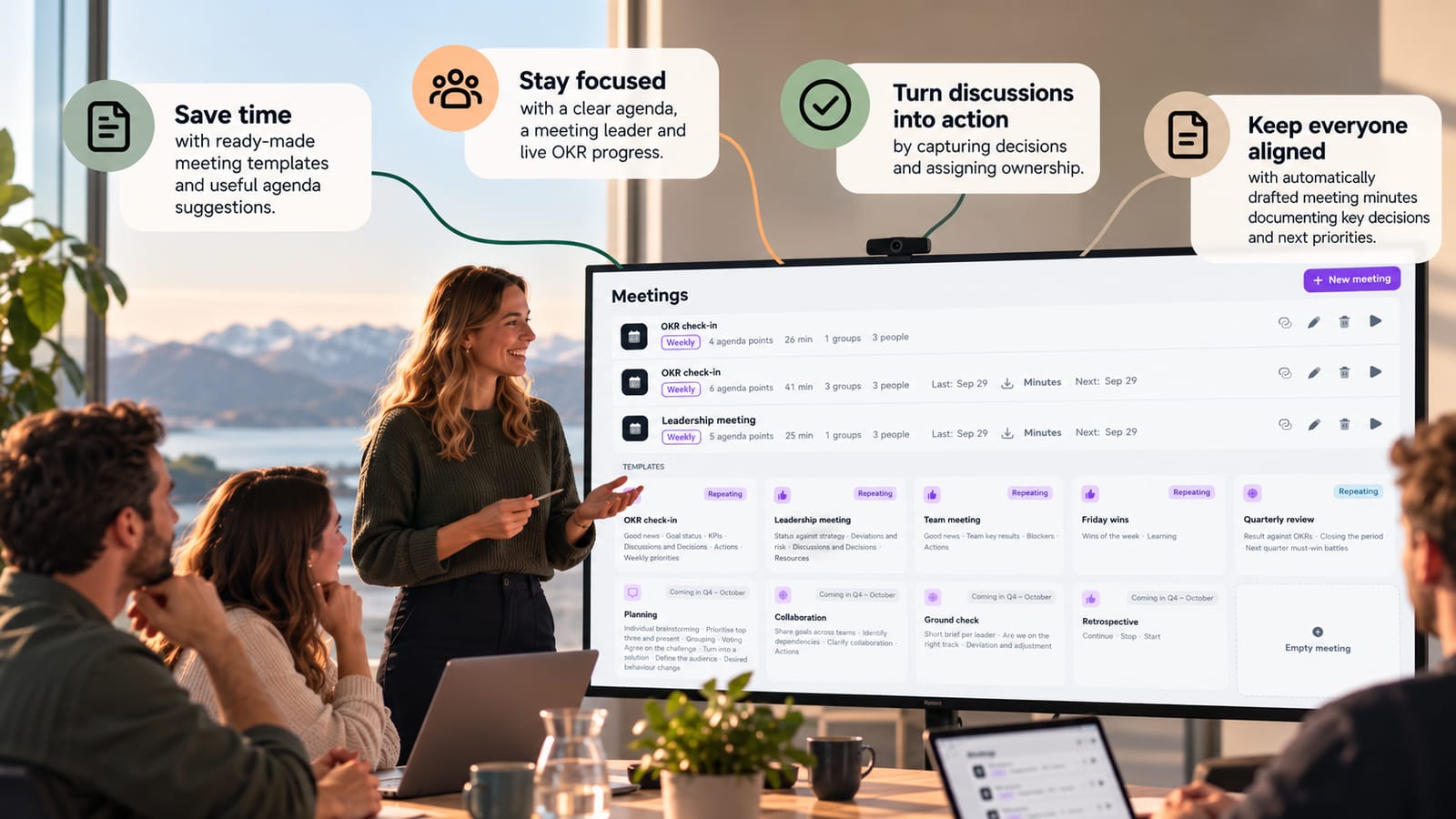
Save time with ready-made templates and agenda suggestions. Nobody should have to build the same recurring agenda from scratch every single week. Start from a template, or build your own once and reuse it.
Stay focused with a clear agenda, a meeting leader, and live OKR progress. The numbers on screen are the real numbers, not a snapshot from the night before. Nobody's discussing a stale export while someone quietly wonders if it's still accurate.
Turn discussion into action by capturing decisions and assigning ownership. When something gets decided in the room, it doesn't stay a sentence someone remembers saying. It becomes an owned initiative, on the spot, with a deadline attached, so it doesn't evaporate the moment the call ends.
Keep everyone aligned with meeting minutes that draft themselves. By the time the meeting ends, the minutes already exist: who was there, what was decided and why, and what everyone's priority is until next time. The person running the meeting reviews it, adjusts anything that needs adjusting, and sends it out, instead of writing it from scratch that evening.
The goal underneath all of it is simple: less meeting admin, better follow-up, and more actual momentum toward the OKRs, instead of another hour spent reconstructing where things stand.
A meeting worth showing up to
None of this makes meetings magically enjoyable. Nobody's OKR review is going to be the highlight of their Tuesday. But there's a real difference between a meeting where people are half-present, scrolling through a document someone rushed together an hour before, and one where the numbers are live, the agenda took thirty seconds to open, and everyone leaves knowing exactly what was decided and who owns it.
That difference is what turns OKRs from a document written in good faith once a quarter into something a team actually runs on, week after week. Not because the goals got better. Because the room where they get discussed finally works the way it should.
Want to see the new Meetings module in action? Get in touch and we'll show you how it fits into your own OKR rhythm.
Ready to put OKRs into practice?
See how Futureworks helps teams align, track, and execute every week.