The Final Quarter: How to Set OKRs You Can Actually Execute
It's October 1st, and in a lot of leadership teams, the same thing is happening this week. The Q3 numbers get presented, new OKRs get set, and the goals for the year's final quarter look suspiciously like the goals from the last one. The only thing that's changed is the deadline.
That's a risky way to start Q4. This is the quarter where the annual plan needs to land, next year's budget needs to be locked in, and projects need to close out, all while customers expect exactly as much as before. December is rarely a full working month for anyone. Yet October through December often gets planned as if the organisation has three months of full capacity ahead of it. Ambitious OKRs get set, and in January everyone realises they didn't get through it all.
The problem is rarely the ambition level. The problem is that the goals get set based on the calendar, not based on what the organisation can actually execute.
A better starting point for Q4 planning, then, isn't "what can we fit in?" but "which results need to be in place before the year is over?" In our experience, that requires three things. The previous quarter needs to be used as a data source, not just as history. Strategy needs to be translated into a small number of real priorities. And weekly follow-up needs to be used to make decisions, not to report status. Only then does OKR function as a tool for strategy execution, rather than just a list of goals.
What did you actually learn in Q3?
When a new quarter starts, it's natural to look forward. But how good next quarter's objectives and key results turn out to be depends heavily on how well you understand the last one.
A Key Result that landed at 72 percent doesn't say much on its own. What's interesting is why it landed there. Maybe the goal was unrealistic, or you got started too late. Maybe capacity got eaten up by operations or another priority. It's also possible the hypothesis behind the goal was wrong, or the measurement method didn't hold up. Quite often, you find a dependency on another team that no one actually owned, or that a lot of the effort went into activities that never influenced the result. Answers like that are worth more than the score itself.
An example from sales
Take a sales team that had this Key Result in Q3: increase the conversion rate from qualified opportunity to customer from 24 to 32 percent. At quarter end, they're at 27.
The simple conclusion is that the goal wasn't reached. But say the team discovered along the way that conversion varies dramatically between customer segments: 38 percent in one, 14 in another. Then the quarter has given you something far more useful than a red field on a dashboard. It's given you strategic insight.
The right Q4 goal might not be to push overall conversion up to 32 percent. A better Objective could be to concentrate sales effort on the segments where you create the most value and have the highest probability of winning, with Key Results that measure segment mix, conversion, and deal value.
This is exactly what the OKR quarterly cycle is for. Q3 is supposed to make Q4 smarter. If the learning from the previous quarter doesn't change a single priority in the next one, it's worth asking how much the organisation is actually learning.
From reflection to decision
Most people have sat through a retrospective that ended with sensible conclusions. "We need to get better at prioritising." "Sales needs to get involved earlier." "We had too many projects running." All of that might be true, but it changes nothing until it shapes a concrete decision.
A simple discipline is to end the Q3 evaluation with three questions. What should we keep doing because it worked? What should we stop doing because it cost more than it delivered? And what do we need to change in Q4, whether that's assumptions, ways of working, or priorities? It's that last question that counts. Learning that doesn't lead to change is just documentation.
Q4 is shorter than you think
On paper, Q4 runs from October 1st to December 31st. In practice, the execution window is significantly shorter for most people. November gets eaten up by budgeting and next year's strategy process. December fills up with wrap-ups, annual reporting, and the holidays. In many industries, this is also peak season. Operations keep running as usual, and customers don't take a break just because you've set new OKRs.
That's why Q4 goals should be capacity-adjusted, and surprisingly few organisations do that systematically. The question isn't how much you want to achieve. The question is which strategic results matter most, and how much capacity you realistically have to create them.
Capacity is a strategic choice
This might sound like project management, but it's about strategy. Strategy is as much about what you choose not to do as what you choose to do. If the leadership team has agreed on five strategic priorities, but the organisation only has capacity to execute three, you don't actually have five priorities in practice. You have three priorities and two wishes, and it's rarely clear to the organisation which is which.
A good Q4 setup, then, doesn't start with the question "what do we want to achieve this quarter?" Start here instead: if we could only create three important changes before the year is over, which three would matter most to the strategy? That question forces prioritisation, and that's exactly what OKR is supposed to help the organisation do.
From strategy to OKR: choose first, phrase it afterwards
Many leadership teams spend a lot of time polishing the wording of an Objective. That has its value, but the hardest part of the job happens before anyone writes a single word. You have to choose.
A strategy usually holds several long-term ambitions, like growth, profitability, customer loyalty, product development, capability, and efficiency. All of it can be important, but not all of it can be most important in Q4. So start with two questions: which part of the strategy needs the most momentum right now? And what needs to be different by December 31st for you to be able to say you've moved? Only once you've answered those is it time to set OKRs.
An example
Say the strategy reads like this: We will grow in the enterprise market by becoming the preferred supplier for mid-sized companies.
That's a direction, not a quarterly goal. A typical mistake is translating it directly into an Objective like "Become market leader in the enterprise segment." That's a change no team can create or measure in twelve weeks.
A more useful discussion starts with the bottleneck. Maybe you have enough leads, but too few of them turn into customers. Then Q4 could be about proving you can win in the priority segment:
Objective: Make our offering the obvious choice for priority enterprise customers.
Key Results:
- Increase conversion in the priority segment from 22 to 30 percent.
- Reduce the average sales cycle from 75 to 55 days.
- Increase the share of new customers in the segment who choose the flagship product, from 40 to 60 percent.
Now it connects: from strategy to priority, on to an Objective, and finally to an impact you can measure. That thread is what turns OKR into strategy execution.
Three questions before you approve an Objective
Does it move the strategy? If the answer is "not directly, but we have to do it anyway," you're probably talking about operations, a project, or an activity. It might be important enough, but it's not a strategic Objective.
Does it describe a change? "Implement a new CRM system" describes something you're going to do. "Make the sales process faster and more predictable" describes what's going to be different. The first is an initiative, the second can be an Objective.
Do we have the capacity to influence it this year? This is the most important question in Q4. A goal can be strategically correct and well-phrased and still be the wrong goal right now, if it requires six months of work, depends on five other projects, or is missing a clear owner.
Don't carry unfinished OKRs straight into Q4
"We'll carry it forward" is one of the most common reactions to a goal that wasn't reached. Sometimes that's the right call, but it should never happen automatically. Before a Q3 goal gets to join Q4, you should know whether it's still strategically important, why it wasn't reached, and whether the underlying assumptions have changed.
The most revealing question is this: would we choose this goal today if it didn't already exist? Old goals easily get an artificially high priority simply because work has already gone into them. Q4 isn't meant for cleaning up everything you didn't get through in Q3. It's meant for executing what matters most right now.
Key Results should measure change, not effort
When time is short, it's tempting to fill OKRs with activities: five customer meetings, a new website, a new system, leadership training, ten articles. All of it is concrete and easy to check off, but none of it tells you whether the organisation is actually achieving the impact it wants.
Ask instead what the activity is supposed to lead to. The difference looks like this:
| Activity | Result |
|---|---|
| Run training for all middle managers | Increase the share of employees who say they understand the team's top priorities, from 62 to 80 percent |
| Launch a new onboarding flow | Reduce the time from signed agreement to active customer from 21 to 12 days |
The activities are needed, but they belong under the OKRs as initiatives. Key Results should show whether the initiatives are working.
Build a "not now" list
Every leadership team talks about priorities. Far fewer write down what isn't a priority, and that has consequences. As November rolls in, new customer requests, internal initiatives, urgent issues, and good ideas show up. If only the things you're going to do are documented, the list slowly grows back to where it was.
So keep a simple "not now" list alongside the Q4 OKRs. It can include initiatives postponed to Q1, improvements that are useful but not critical, projects that are being stopped, requests that only get picked up if capacity frees up, and existing work that needs to be deprioritised for the Q4 goals to be reached.
This isn't negative planning. It's how you free up capacity to execute. An Objective with no trade-offs is, in practice, competing with everything else the organisation is already doing.
Weeks 1 through 12: this is where the quarter gets decided
Even good OKRs don't create results on their own. What happens on Monday, Tuesday, and Wednesday is what decides it. That's why weekly follow-up matters so much, and why it shouldn't be a status meeting.
Status can be updated before the meeting. If a Key Result has moved from 41 to 43 percent, the leadership team doesn't need to spend five minutes hearing about those two percentage points. Time is better spent clarifying whether progress is good enough, what's standing in the way, whether the assumptions still hold, and whether the owner needs a decision. Weekly OKR follow-up works best as a decision loop.
Four things every owner brings
Result. What has actually changed since last time? Not which tasks got done, but how the Key Results have moved.
Confidence. How sure is the owner that the goal will be reached by the end of the quarter? This is often more useful than the percentage. A Key Result can sit at 60 percent and still be at risk because a critical dependency has stalled. Another can sit at 35 percent and be well on track, because the impact isn't expected until later in the quarter.
Learning. What do we know this week that we didn't know last week? This is the question that makes the OKR work smarter over time.
Decision. What are we doing differently because of what we now know? That can mean stopping an initiative, moving resources, pulling in another team, scaling up an experiment that's working, or adjusting a Key Result because the measurement method turned out to be wrong.
Follow-up without decisions becomes reporting. Follow-up with decisions is leadership.
Week 3 matters more than week 11
If a strategic goal is drifting off course, you want to know in week three, not three days before the quarter ends. Yet a lot of management processes are built so that deviations only become visible when the monthly or quarterly report lands. By then, the report is accurate, but it's nearly worthless as a management tool.
Good OKR follow-up makes deviations visible while you can still do something about them. Yellow and red should therefore be treated as information, not as poor performance. A red goal in week three that leads to an important decision is worth more than a green goal in week twelve.
Keep a decision log
One small habit that makes the quarterly evaluation far more valuable is noting the key decisions along the way, not just the status. For example:
- Week 2: Campaign A converts twice as well as B. We're moving 30 percent of the budget.
- Week 4: Onboarding is still the bottleneck. The product team is moving capacity from feature X to the activation flow.
- Week 6: Segment C is responding more weakly than expected. We're stopping further investment there and concentrating on A and B.
- Week 8: Key Result 2 is no longer a good indicator. We're adjusting the measurement method.
When the quarter is over, you're left not just with an end result, but with the story of how the organisation learned and adapted along the way. That makes the next quarter's planning considerably better.
October, November, and December have different jobs
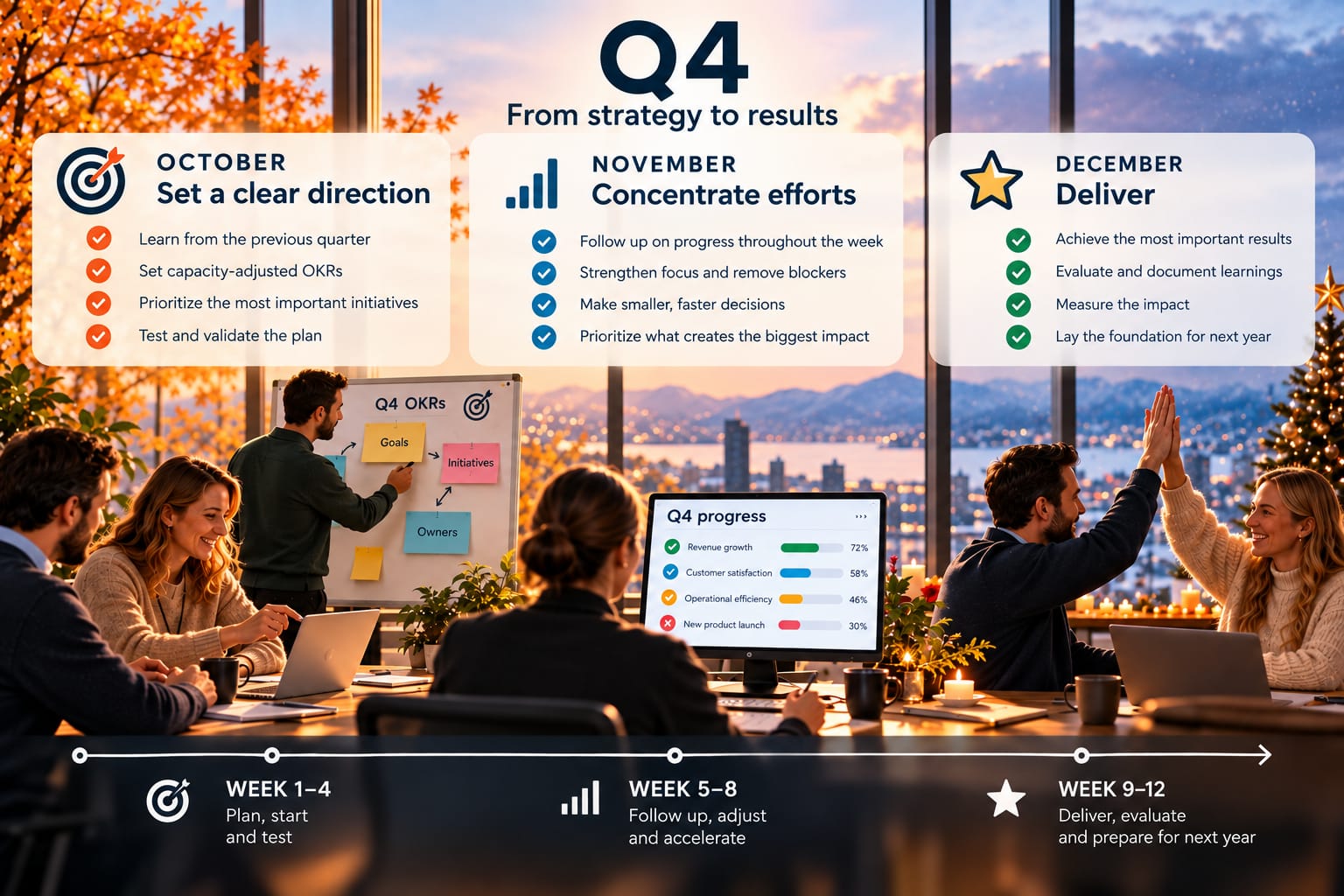
The year's final quarter has its own rhythm, and it helps to think of it as three phases.
October is about testing the direction. Do the hypotheses behind the OKRs hold up? Are you seeing movement, are the initiatives working, and are the teams pulling in the same direction? This is when it's cheapest to correct course.
November is about concentrating effort. By now you know more. What's working should get more attention, and what isn't should be challenged. Priorities should get sharper, not broader.
December is about finishing and learning. It's rarely the right moment to launch five new initiatives to rescue an OKR. Use December instead to finish what's creating impact, document the learning, and understand what the results mean for 2027.
Q4 as a test of the whole system
It's easy to treat the year's final quarter as a sprint to the finish line: get the numbers in, close the projects, deliver the plan. But Q4 also gives you a rare, good opportunity to test how well your strategy execution actually works.
Do employees see the connection between the strategy and what they're prioritising this week? Can the organisation say no to work that doesn't support the priorities? Do problems get caught early enough that you can do something about them? And does the learning from one quarter actually get used in the next?
If the answer is yes, you've built something worth more than a set of good OKRs. You have an organisation that learns while it executes.
So when the leadership team gathers at the end of December, you should be able to answer more than whether the goals were reached. You should know what you learned, which choices you made because of it, and what that means for the road ahead. That's the difference between using OKR to measure a quarter and using OKR to make the organisation better with every quarter that passes.
Ready to turn strategy into execution?
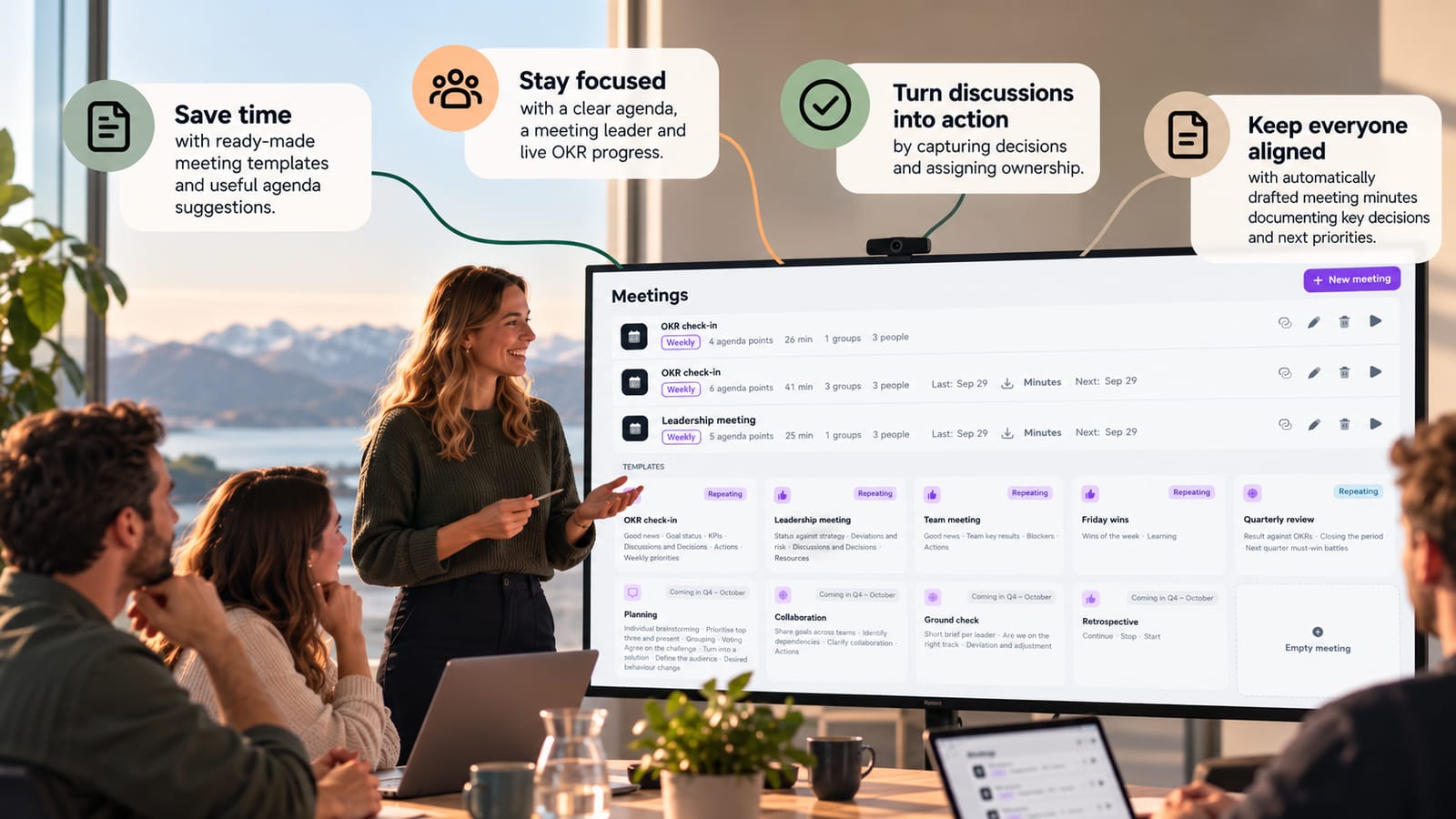
Futureworks brings strategy, OKRs, KPIs, priorities, and ongoing follow-up together in one place. Teams see what matters most, track progress, and adjust course during the quarter. Start Q4 with fewer assumptions, clearer priorities, and a better rhythm for execution.
Want to see how Futureworks can support your Q4 planning? Get in touch for a no-obligation walkthrough.
Ready to put OKRs into practice?
See how Futureworks helps teams align, track, and execute every week.