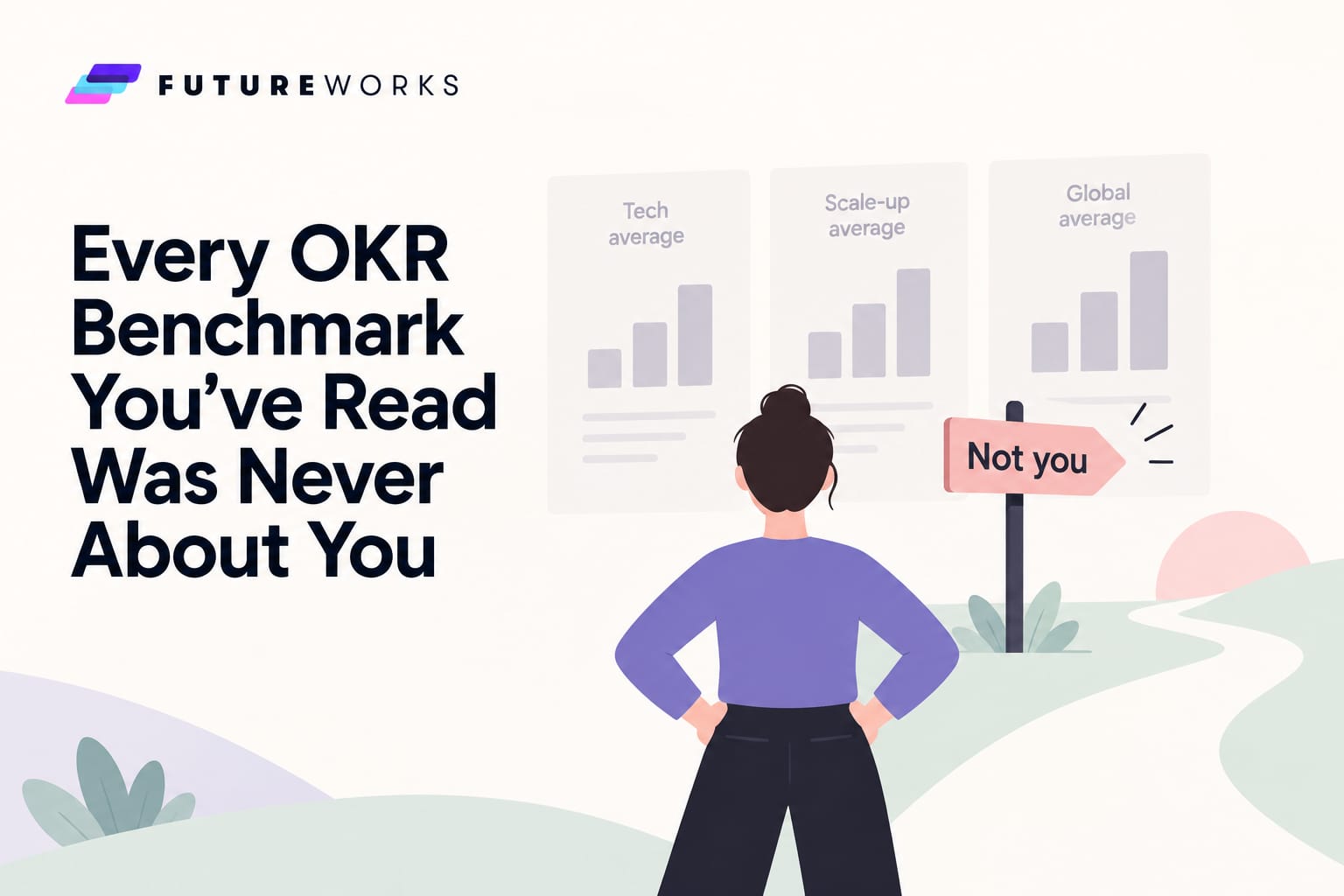
Every OKR Benchmark You've Read Was Never About You
A Futureworks perspective on borrowed data, regional blind spots, and an invitation to help fix one.
You've seen the stat. It's in the deck at the OKR conference, the LinkedIn post with 400 reactions, probably a sales pitch or two (ours included, if we're honest). Only 5% of companies hit more than 75% weekly alignment between their OKRs and the work people actually do that week.
It's a genuinely useful number. It's also not about you.
Whose company is that stat describing?
Almost every OKR benchmark in circulation — the completion rates, the "best practice" percentages, the "here's what great teams do differently" — comes from the same place: a customer base or survey panel that skews heavily American. Nothing wrong with the data. It's honestly collected, and it's the best anyone's published. But it was never built to answer the question a Nordic leader is actually asking, which is some version of: is this normal for a company like mine, here?
That's not a small gap. Nordic organizations don't run like their US counterparts — flatter hierarchies, more consensus in how decisions get made, a different default rhythm for checking in on work. Applying a US-heavy benchmark to a Norwegian, Swedish, or Danish team and calling it diagnosis is a bit like reading someone else's blood test and assuming your numbers match. They might. Nobody's actually checked.
The scale of what we're all guessing about
It's worth being specific about why this particular gap matters right now, not just as a data-nerd complaint. Two independent large studies published this year — one surveying over a thousand leaders globally, one pulling from 200+ organizations' OKR data directly — landed on strikingly similar numbers: the overwhelming majority of companies report real misalignment between departments, and only a slim minority of employees can actually trace their daily work back to a stated company priority. Zoom into the mechanics and it gets sharper still: the majority of teams admit to some form of goal-gaming, key results quietly rewritten as tasks they were already going to do, dressed up as outcomes, because the review process rewards a green checkmark more than an honest one.
None of that is a Nordic-specific finding. It's global. Which is exactly the point: we don't actually know whether the Nordics are better at this, worse at it, or just different, because nobody's asked us specifically. We're citing someone else's homework and hoping it transfers.
We're doing something about it
So we're running the survey that should already exist: State of OKRs in the Nordics 2026, the first benchmark built specifically from Norwegian, Swedish, Danish, Finnish, and Icelandic companies, not a global blend with a regional label stuck on afterward.
Around 12-15 questions, about five minutes: how your organization sets OKRs, how often you check in, how much of what actually happens day-to-day maps to a stated key result, and what tends to get in the way. We're segmenting results by company size and by how long an organization has been running OKRs, so the eventual answer isn't one flattened average — it's "how do companies like mine, here, actually do this."
We're including ourselves in the sample, for what it's worth. We're curious what it says about us too.
What's in it for you
Five minutes gets you three things, once we've closed the survey and built the numbers from everyone who took part (typically a few weeks after launch — a real comparison needs a real sample, not the first ten answers in):
Your own results, benchmarked against other Nordic companies instead of a US-heavy average. A free 30-minute session with our team to walk through what your numbers actually mean and where the fastest wins are, no pitch, just the data. And early access to the finished report, before it's published anywhere else.
One more thing worth knowing, because it's the single fastest lever the research keeps surfacing: organizations that check in on OKR progress every two weeks complete meaningfully more of them than organizations checking in monthly or less, a gap wide enough that it alone is often worth the conversation. Whether that pattern holds up exactly the same way here, or whether the Nordics have their own version of it, is one of the things this survey is about to tell us.
Help us build the number that doesn't exist yet. Five minutes, no fluff, and you get your own results back, benchmarked against companies that actually operate like yours.
Ready to put OKRs into practice?
See how Futureworks helps teams align, track, and execute every week.