Everyone Is Busy. But Are We Actually Making Progress?
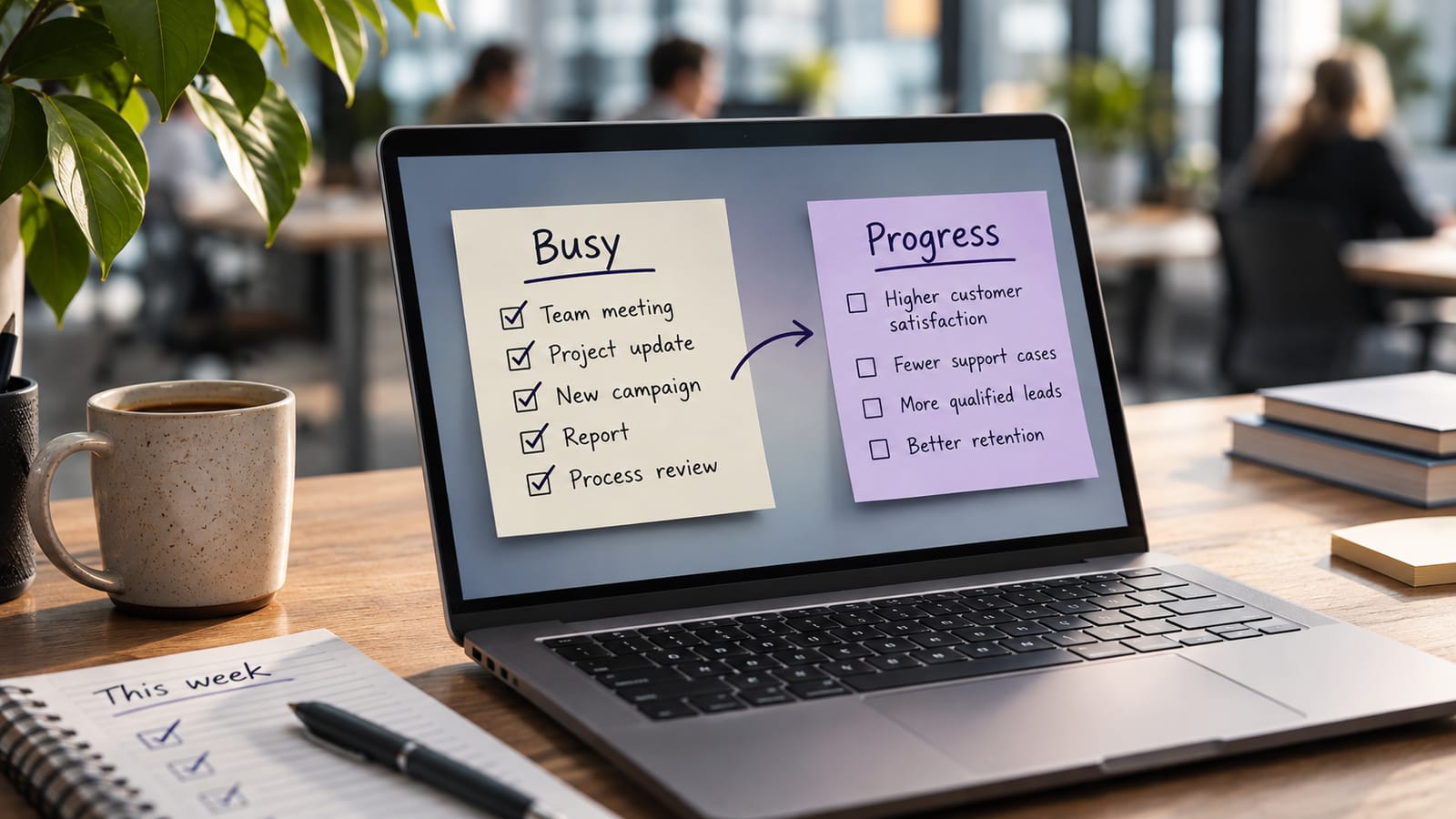
Full calendars, completed tasks, and endless meetings can make a team look productive. But how do you know whether all that activity is actually making a difference?
It's Thursday afternoon, and you're sitting in your weekly team meeting.
Everyone has a lot to report.
One colleague has finished a presentation that took most of the week. Another has been coordinating a project involving three departments. Someone else has handled a difficult customer situation, while two team members have spent the past few days preparing for an upcoming launch.
There have been meetings, deadlines, unexpected problems, and plenty of things crossed off the to-do list.
Nobody has been sitting around.
In fact, everyone seems to be working harder than ever.
As the meeting comes to an end, you thank the team for their efforts. It's been another busy week, and people have clearly put in the hours.
But later that afternoon, a question crosses your mind.
What have we actually achieved?
Not what have we done, or how many tasks have we completed.
What is genuinely better than it was last week?
Are customers happier? Are we closer to our business goals? Have we solved a problem that was holding us back? Have we made something easier, faster, or more effective?
And if the answer isn't obvious, how do we know whether we're spending our time on the right things?
It's an uncomfortable question, particularly when you're managing a team of people who are clearly committed to their work.
But it's also one of the most important questions a manager can ask.
Because being busy and making progress are not necessarily the same thing.
Why being busy can feel so much like being productive
There's something reassuring about a full calendar.
Meetings suggest that important things are happening. Long task lists give us a sense of structure. Completing a project creates a feeling of accomplishment.
And when someone asks how work is going, it's easy to describe everything we've been doing.
We've launched a campaign. Finished a report. Updated the website. Introduced a new process. Held several workshops.
These are all tangible activities. They're relatively easy to plan, assign, and measure.
Progress is more difficult.
Progress often takes longer to become visible. It may depend on several people working together, and it doesn't always follow the schedule we've created.
A marketing team can launch a campaign on time without generating the leads it expected.
A customer support department can answer more tickets without improving the customer experience.
An HR team can deliver a successful training program without seeing any meaningful change in how managers lead their teams.
In each case, the work has been completed.
But the desired result hasn't necessarily been achieved.
This is the difference between activity and outcomes.
Activity describes what people do. Outcomes describe what changes because of that work.
Both matter. Without activity, very little would happen. But if we only measure what gets done, we risk overlooking whether the work is taking us in the right direction.
And that can have consequences for how teams spend their time.
When the to-do list becomes the goal
Imagine you're managing a marketing department.
At the beginning of the quarter, the team agrees on an ambitious plan. There are campaigns to launch, articles to publish, webinars to organize, and improvements to make to the website.
Everyone gets to work.
The content team produces articles. The campaign manager launches paid advertising. The events coordinator organizes two webinars, and the website team delivers several improvements.
By the end of the quarter, almost everything on the plan has been completed.
The team has worked hard, deadlines have largely been met, and there's plenty to show for the effort.
But when you look at the numbers, something is missing.
The company hasn't generated more qualified leads. The sales pipeline hasn't improved. And despite all the activity, the marketing department hasn't made the contribution to business growth that everyone expected.
What went wrong?
Perhaps nothing went wrong with the execution of the individual activities.
The problem may have started earlier, when the team defined success primarily in terms of what it planned to deliver.
The underlying objective was probably to attract more potential customers and create opportunities for the business.
But somewhere along the way, the campaign plan became the goal.
And completing the activities became the measure of success.
This happens in many departments, not just marketing.
IT teams focus on delivering projects. HR departments focus on implementing initiatives. Sales teams focus on the number of meetings booked. Operations teams focus on completing improvement activities.
None of these measures is necessarily wrong.
But they only tell part of the story.
If the real objective is to improve a business outcome, we also need to understand whether the activities are contributing to that outcome.
Otherwise, we can become very efficient at doing things that don't make much difference.
The difference between outputs and outcomes
In management discussions, the terms outputs and outcomes are often used interchangeably.
But there's an important distinction.
An output is something your team produces or delivers. An outcome is the change or result that follows.
Let's take a customer success team as an example.
The team has noticed that new customers often struggle during their first few weeks with a product.
To address this, it decides to develop a new onboarding program.
The team creates training materials, records instructional videos, introduces onboarding meetings, and updates the help center.
After two months, the program is ready.
That's an output.
But the real question is whether the new program makes onboarding better.
Are customers becoming comfortable with the product faster? Are fewer customers contacting support with basic questions? Are more customers continuing to use the product after their first few months?
Those are outcomes.
The distinction changes how we think about success.
If the team focuses on delivering the onboarding program, the work is finished when the program launches.
If the team focuses on improving customer onboarding, the launch is only one step towards achieving the objective.
The team still needs to understand whether the program works.
And if it doesn't, it needs to learn why.
Perhaps customers aren't using the materials. Perhaps the instructions are too complicated. Or perhaps the biggest obstacle has nothing to do with training.
When the focus is on outcomes, these discoveries are valuable.
When the focus is only on completing the project, they can easily be overlooked.
That doesn't mean outputs are unimportant. They are often necessary steps towards achieving results.
But they shouldn't be confused with the results themselves.
Why teams keep taking on more work
One of the reasons organizations become so focused on activity is that adding new initiatives often feels easier than questioning existing ones.
A problem appears, and someone proposes a solution.
Customer satisfaction is falling? Let's introduce a new feedback process.
Sales are below expectations? Let's increase the number of sales activities.
Employees seem disengaged? Let's organize more workshops.
Sometimes these are exactly the right responses.
But sometimes they simply add more work without addressing the underlying problem.
Over time, teams accumulate projects, processes, meetings, and reporting requirements.
Very little gets removed.
And eventually, the working week is so full that there's hardly any room left to think about whether the work still makes sense.
This is especially difficult for team leaders.
You're responsible for delivering results, but you're also expected to respond to requests from other departments, support employees, attend meetings, and handle the unexpected.
Saying yes often feels like the easiest option.
Saying no requires a conversation about priorities.
And those conversations can be uncomfortable.
Yet one of the most useful things a manager can do is help the team distinguish between work that needs to be done and work that genuinely deserves attention.
Not every worthwhile idea needs to become a project.
Not every request needs an immediate response.
And not every activity that made sense six months ago still deserves a place in the calendar.
Sometimes improving team productivity starts with doing less.
What if we started with the result instead?
Imagine going back to that marketing team.
Instead of beginning the quarter by deciding how many campaigns, articles, and webinars to produce, the team starts with a different conversation.
What are we actually trying to achieve?
Perhaps the company needs more qualified sales opportunities.
That becomes the starting point.
The team then looks at its current performance. Where do qualified leads come from? Which activities have generated useful results in the past? Where are potential customers dropping out of the process?
The discussion becomes more interesting.
Perhaps webinars generate fewer leads than paid advertising, but those leads are much more likely to become customers.
Perhaps the company is attracting plenty of website visitors, but very few understand the product well enough to request a demonstration.
Or perhaps the biggest opportunity isn't producing more content, but improving the existing content that already attracts the right audience.
Suddenly, the team has a different basis for deciding what to work on.
The objective hasn't changed. The company still needs growth.
But the team is now choosing activities based on their expected contribution to the result, rather than treating the activity plan as something that must be completed.
This is a small shift in how work is managed, but it can make a considerable difference.
Instead of asking, "Have we done everything we planned?"
The team begins asking, "Are the things we're doing helping us achieve what we set out to do?"
And if the answer is no, the plan can change.
Making progress something the team can actually see
Of course, focusing on outcomes only works if people have some way of understanding whether those outcomes are improving.
This doesn't mean every aspect of work needs to be reduced to numbers.
Some results are difficult to measure precisely, and qualitative feedback can be just as important as quantitative data.
But teams need enough information to distinguish between genuine progress and a feeling of progress.
Consider a department that wants to improve its customer experience.
"Provide better service" might be a perfectly reasonable ambition, but it's difficult to manage without a clearer understanding of what improvement means.
Does it mean resolving customer problems faster? Reducing the number of recurring complaints? Improving customer satisfaction? Making it easier for customers to solve problems themselves?
Different answers would lead to different priorities.
This is where Objectives and Key Results, or OKRs, can be useful.
OKRs provide a way of defining what a team wants to achieve and identifying measurable results that indicate whether it's getting closer.
For example, a customer support team might define an objective such as:
Make it easier for customers to get the help they need.
Its Key Results could include reducing average resolution time from 48 hours to 24 hours, improving customer satisfaction from 80% to 90%, and reducing repeat contacts about the same issue by 25%.
These figures are illustrative. The appropriate measures and targets would depend on the organization.
What matters is that the team now has a shared understanding of the outcome it's working towards.
The objective provides direction, while the Key Results help make progress visible.
The team can still introduce new processes, improve documentation, or invest in training.
But those activities are no longer the definition of success.
They're possible ways of achieving it.
And if the chosen activities aren't working, the team has a reason to reconsider them.
A goal should help people make decisions
There's a tendency to think of goals as something we set at the beginning of a period and evaluate at the end.
But a good goal should be useful in between.
Imagine that your team is halfway through the quarter.
A colleague suggests launching a new initiative. It's a good idea, and under different circumstances, you might decide to pursue it.
But your team is already working towards a small number of important objectives.
The new initiative would require several weeks of effort.
What should you do?
Without clear priorities, the decision may come down to who makes the strongest argument or how enthusiastic people are about the idea.
With a shared understanding of the outcomes you're trying to achieve, you can have a more useful conversation.
Will this initiative help us make progress towards one of our most important objectives?
If so, is it likely to be more valuable than the work we're already doing?
And if we take it on, what will we stop doing?
These are the kinds of questions that turn goals into practical management tools.
They also make it easier for employees to understand why some ideas are prioritized while others have to wait.
People don't necessarily need to agree with every decision.
But they should be able to understand the reasoning behind it.
Why regular conversations matter more than perfect plans
One of the difficulties with outcome-focused work is that we can't always predict which activities will produce the results we want.
We make assumptions.
We choose an approach based on the information available.
And then we learn what happens.
That's why regular follow-up is so important.
Imagine a team that's working to reduce customer churn.
At the beginning of the quarter, it believes that improving onboarding will make the biggest difference.
The team introduces several changes, but after a month, customer retention hasn't improved.
A traditional project review might focus on whether the planned onboarding improvements have been delivered.
An outcome-focused conversation asks something else.
Why aren't we seeing the expected improvement?
Perhaps the team needs more time to see the effect. Perhaps the changes haven't reached enough customers. Or perhaps the assumption about onboarding was wrong.
The point isn't to immediately abandon the plan.
It's to understand what's happening and decide whether anything needs to change.
These conversations don't require complicated processes.
They can happen in ordinary team meetings.
But the questions need to be different.
Instead of spending most of the meeting going through everything people have done, spend more time discussing what has changed, what's working, and where the team is struggling.
If progress is going well, understand why.
If progress has slowed, explore the obstacles.
And when decisions are needed, make them while there's still time to influence the result.
At Futureworks, this is one of the ideas behind Meeting Mode. It's designed to help teams bring their objectives and progress into regular meetings, making it easier to focus conversations on priorities, challenges, and next steps.
Because the real value of tracking progress isn't having an updated dashboard.
It's being able to do something useful with the information.
When working harder isn't the answer
There's another reason why this distinction matters, and it has to do with the people doing the work.
When a team isn't delivering the expected results, the instinctive response can be to increase the effort.
More meetings. More follow-up. More activities. Tighter deadlines.
Sometimes additional effort is necessary.
But if the team is already working hard, asking people to do more may simply make the problem worse.
Imagine a department where employees regularly work late, struggle to find uninterrupted time, and feel they're constantly moving between competing priorities.
Despite the effort, results remain disappointing.
The problem might not be how hard people are working.
It might be that too much of their time is being spent on activities that don't contribute enough to the outcomes that matter.
Adding more work won't solve that.
In fact, it can make it even harder for people to focus.
This is why outcome-focused management shouldn't become another form of performance pressure.
The purpose isn't to monitor employees more closely or demand measurable results from every hour of their day.
It's to help teams make better decisions about where their time and energy should go.
Sometimes that means investing more effort.
Sometimes it means changing the approach.
And sometimes it means recognizing that something the team has been doing for years is no longer worth doing.
For managers, creating space for those conversations can be just as important as setting ambitious goals.
Progress is rarely the responsibility of one team
As organizations grow, another challenge becomes more visible.
Teams can become very good at achieving their own targets without necessarily improving the performance of the organization as a whole.
A sales department may be rewarded for bringing in new customers, while a customer success team is responsible for retaining them.
If sales focuses entirely on volume, it may bring in customers who aren't a good fit for the product.
Sales meets its targets, but customer churn increases.
Both departments may be working hard, yet the company isn't getting the results it wants.
This is why meaningful progress often requires looking beyond departmental boundaries.
If the company's objective is sustainable growth, the relevant outcome may depend on several teams working together.
Sales needs to attract the right customers. Marketing needs to communicate the product's value clearly. Customer success needs to help customers achieve that value, and product development needs to make sure the product delivers on its promises.
No single department can solve the challenge alone.
For a team leader, this means understanding not only what your team is trying to achieve, but also how its work connects to the priorities of other teams.
It may require shared objectives, more transparent priorities, or simply better conversations between managers.
The important thing is to avoid a situation where everyone can demonstrate success individually while the organization struggles collectively.
How can you tell whether your team is making meaningful progress?
If you're managing a busy team and want to shift the focus towards outcomes, you don't necessarily need to introduce an entirely new management process.
A useful place to start is with your next team meeting.
Before the meeting, look at the work your team has been doing over the past month.
Then ask yourself a few questions.
What were we trying to improve?
What evidence do we have that things are getting better?
Which activities have contributed most to that improvement?
And what are we doing that might no longer be necessary?
You may discover that some activities are producing more value than expected.
You may also discover that certain tasks have become routine simply because nobody has questioned them.
Bring those observations into the conversation with your team.
The goal isn't to criticize the work people have done.
It's to understand it better.
You might ask employees which activities they believe are making the biggest difference, where they feel their time is being wasted, or what they would change if they had more freedom to prioritize.
Often, the people closest to the work have a very good understanding of what's helping and what's getting in the way.
They just haven't been asked.
From there, try agreeing on a small number of outcomes that the team wants to improve over the coming weeks or months.
Make sure those outcomes connect to the department's or company's broader priorities.
Decide how you'll recognize progress, and make time to discuss it regularly.
You don't need a perfect set of metrics from day one.
In fact, you'll probably learn quite a lot about which measures are useful as you go.
What's important is that the team starts thinking differently about success.
Not simply as completing everything on the list, but as making a meaningful contribution to something that matters.
Where tools and technology fit in
As teams grow and objectives become more interconnected, keeping track of priorities and progress can become difficult.
Information ends up spread across presentations, spreadsheets, project management tools, and meeting notes.
Managers may have a reasonable overview of their own team's activities but struggle to understand how those activities connect to the organization's broader goals.
This is where goal management software can help.
At Futureworks, we've developed a platform designed to connect company strategy, team objectives, and regular follow-up through OKRs.
The idea is to give teams a clearer view of what they're working towards and how their progress contributes to the bigger picture.
With 360 Vision, organizations can see how objectives connect across different levels and departments. Meeting Mode helps bring those objectives into the conversations teams are already having.
But technology is only part of the solution.
A tool won't tell a team which priorities are most important, and it won't automatically turn completed activities into meaningful outcomes.
Those decisions still require leadership, judgment, and collaboration.
What software can do is make it easier to keep the right information visible and maintain the routines that support progress.
The goal shouldn't be to introduce more reporting.
It should be to help teams spend more time understanding what works and less time trying to piece together what's happening.
What would change if we measured success differently?
Think back to that Thursday afternoon team meeting.
Everyone has worked hard. Projects are moving forward, tasks are being completed, and the calendar is full.
Now imagine the conversation takes a slightly different direction.
Instead of asking each person to report everything they've done, you start by looking at the outcomes the team agreed to focus on.
One objective is progressing well. The team discusses what's working and whether there's anything worth doing more of.
Another is falling behind. Rather than simply asking people to work harder, you explore what's preventing progress.
A third objective hasn't moved much, even though several planned activities have been completed. The team realizes that one of its original assumptions may have been wrong and decides to try a different approach.
By the end of the meeting, people still have work to do.
But there's a clearer understanding of why that work matters.
Some activities are given more attention. Others are postponed. One project is stopped altogether because it no longer appears likely to deliver the expected value.
The team leaves with fewer uncertainties and a better sense of direction.
That's a very different kind of productivity.
And it's often much closer to what organizations actually need.
The goal isn't to be less busy. It's to make the work matter.
Most people want to do a good job.
They want to contribute, solve problems, and feel that their efforts are making a difference.
But in a busy organization, it's easy to lose sight of that.
The work itself becomes the focus.
We move from one deadline to the next, complete tasks, attend meetings, and try to keep everything moving.
And because we're so occupied with getting things done, we don't always stop to ask whether we're getting closer to where we want to be.
For team leaders, this is an important responsibility.
Not to make sure everyone is busy.
But to help people understand what matters, create room for meaningful work, and recognize when the team needs to change direction.
That means being clear about the outcomes you're trying to achieve.
It means making difficult choices about priorities.
It means paying attention to results rather than simply counting activities.
And it means creating an environment where people can question whether the work they're doing is actually producing the value they expected.
None of this happens automatically.
It requires regular conversations, honest reflection, and a willingness to change plans when the evidence suggests a better approach.
But it can also make work more rewarding.
Because when people understand the connection between their efforts and the results they create, progress becomes something they can see and feel.
And that brings us back to the question we started with.
Everyone is busy.
But are we actually making progress?
It's a question worth asking more often.
At Futureworks, we help organizations connect everyday work with meaningful objectives through OKRs, clearer priorities, and regular follow-up.
If you're looking for a more practical way to help your team focus on what matters, you can learn more at futureworks.no.
Frequently asked questions
What is the difference between being busy and being productive?
Being busy means spending time on activities, tasks, and responsibilities. Being productive means using that time effectively to create valuable results. A team can complete many tasks without making meaningful progress towards its goals, which is why productivity should be evaluated in relation to outcomes rather than activity alone.
What is the difference between outputs and outcomes?
Outputs are the things a team produces or delivers, such as reports, campaigns, new processes, or software features. Outcomes are the changes those outputs create, such as increased customer satisfaction, higher conversion rates, or reduced operating costs. Outputs describe what was done, while outcomes help explain whether it made a difference.
How can managers measure team progress?
Managers can measure progress by defining clear objectives and identifying indicators that reflect meaningful improvements. These might include customer satisfaction, quality, efficiency, revenue, retention, or other relevant business outcomes. Combining quantitative measures with qualitative feedback can provide a more complete understanding of progress.
How can teams become more outcome-focused?
Teams can become more outcome-focused by starting with the results they want to achieve rather than immediately planning activities. Managers should help employees understand how their work contributes to broader goals, establish meaningful measures of progress, and regularly review whether current activities are producing the intended results.
How do OKRs help teams focus on outcomes?
OKRs, or Objectives and Key Results, help teams define what they want to achieve and how they will measure progress. By connecting objectives to measurable results, OKRs encourage teams to focus on the impact of their work rather than simply completing tasks.
Can focusing on outcomes improve employee productivity?
Focusing on outcomes can improve productivity by helping teams prioritize work that creates meaningful value. It can also reveal unnecessary activities and encourage better decisions about how time and resources are used. However, outcome measures should be used to support learning and prioritization, not as a way to monitor every individual activity.
How often should teams review their progress?
Many teams benefit from reviewing progress weekly or biweekly, with more substantial evaluations at the end of each month or quarter. The appropriate frequency depends on the nature of the work and how quickly results become visible. The purpose is to identify obstacles and make useful adjustments while there's still time to influence the outcome.
Ready to put OKRs into practice?
See how Futureworks helps teams align, track, and execute every week.