How to Run an Effective Retrospective Meeting (With a Ready-to-Use Agenda)
Retrospective meetings are one of the most underused tools in a leader's arsenal. Done right, they build momentum, strengthen teams, and sharpen strategy. Here's how to run one that actually makes a difference.
What Is a Retrospective Meeting, and Why Does It Matter?
A retrospective meeting is a structured session where a team pauses to review a defined period, a quarter, a project, or a half-year, to reflect on what happened, celebrate progress, extract lessons, and align on what comes next.
They are common in agile software teams, but the format is just as valuable for leadership teams, sales organisations, HR departments, and any group working toward shared goals.
The reason most retrospectives fail isn't the format. It's that they are treated as an afterthought, squeezed into the last 20 minutes of a long team meeting, or skipped entirely because "we're all so busy." When that happens, teams lose one of their most powerful learning opportunities.
A well-run retrospective does three things:
- It creates a shared understanding of where the team stands
- It surfaces insights that would otherwise stay invisible
- It builds the kind of psychological safety that makes teams better over time
The good news is that running an effective one isn't complicated. It just requires intention, a clear structure, and someone willing to hold the space.
When Should You Run a Retrospective?
There's no single right answer, but there are natural checkpoints that work particularly well:
- End of a quarter, to review progress against OKRs and reset priorities
- Mid-year (June), a crucial but often skipped moment to recalibrate before summer
- End of a major project, to capture lessons while they're still fresh
- After a significant setback or success, to understand what actually drove the outcome
- Start of a new planning cycle, so that past learning informs future direction
If you only do one per year, the mid-year retrospective tends to deliver the most value. You're far enough into the year to have real data, and early enough to course-correct before it's too late.
How Long Should a Retrospective Take?
For most teams, a half-day session (three to four hours) hits the sweet spot. This gives you enough time to go deep without exhausting everyone.
For larger organisations or more complex reviews, a full-day offsite can be worthwhile. For smaller teams or quarterly check-ins, a tight 90-minute session can work well, if you keep it focused.
Whatever the format, protect the time. Retrospectives that keep getting interrupted or cut short send a signal that reflection isn't really a priority.
The Retrospective Meeting Agenda
Below is a proven agenda structure you can adapt to your team's context. Share it with participants in advance so everyone arrives prepared.
Before the Meeting
- Send the agenda to all participants at least three days in advance
- Ask team members to come prepared with one or two examples of wins, challenges, and lessons from the period
- Gather relevant data: OKR progress, key metrics, project outcomes, team survey results (if applicable)
- Assign a neutral facilitator, ideally someone who can keep the conversation moving without dominating it
- Book a room (or video call) with enough space and time for open dialogue
- Set the tone: make clear this is a space for honest reflection, not blame
Part 1: Opening and Setting the Stage (10–15 minutes)
- Welcome the group and thank them for making the time
- Restate the purpose: "We're here to reflect honestly on the past period, recognise what's working, and set ourselves up for a strong second half."
- Establish ground rules: speak from your own experience, listen without interrupting, assume good intent
- Do a brief check-in, ask each person to share one word or sentence describing how they're arriving at the session
Why this matters: A good opening creates psychological safety. People need to feel comfortable being honest, and that rarely happens automatically, especially in senior teams where admitting difficulty can feel like a risk.
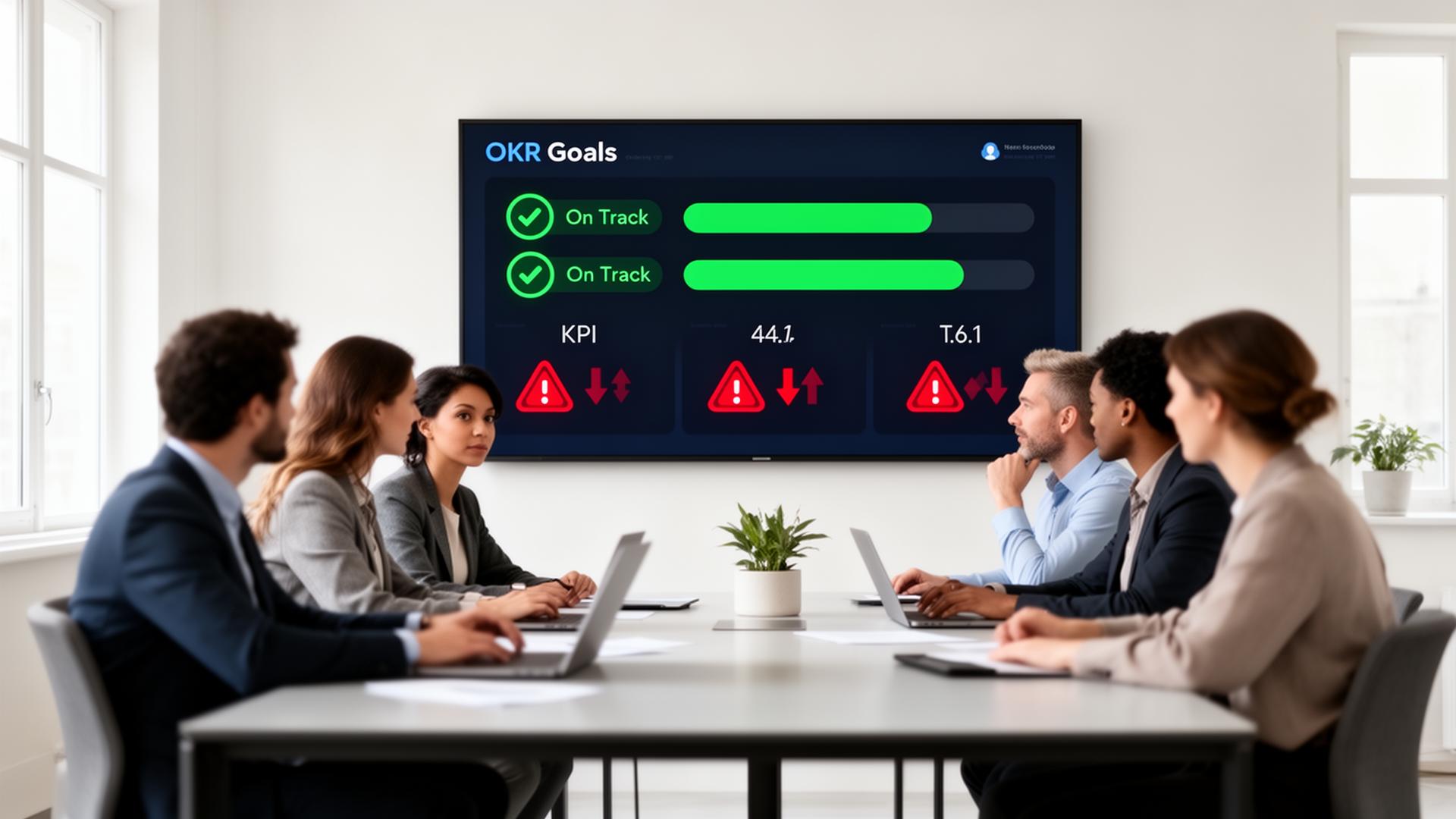
Part 2: OKR and Goals Review (20–30 minutes)
- Walk through the team's OKRs (Objectives and Key Results) or equivalent goals for the period
- For each objective, rate progress: on track, at risk, or off track, and briefly discuss why
- Highlight any goals that were completed, exceeded, or meaningfully advanced
- Flag any that have stalled, shifted, or become less relevant, and note why
- Discuss whether the goals still reflect the right priorities, or whether any need to be revised
Useful questions to ask:
- Which of our objectives made the most progress, and what enabled that?
- Which fell behind, and what got in the way?
- Are there any goals we should retire, reframe, or add?
Why this matters: Starting with the OKR review grounds the conversation in reality. It prevents retrospectives from becoming too abstract or feelings-heavy, and it gives everyone a shared picture of where things actually stand.
Part 3: Celebrating Accomplishments and People (20–30 minutes)
- Open the floor for team members to share wins, big and small, from the past period
- Recognise specific projects, decisions, or moments where the team performed well
- Invite individuals to acknowledge colleagues who made a difference: "Who do you want to call out, and why?"
- As a leader, share your own genuine appreciation, be specific, not generic
- Consider a brief round where everyone names one thing they're proud of from the period
Why this matters: This is the part most teams skip or rush, and it's often the part that matters most to people. Recognition isn't just about morale. It helps the team understand what "good" looks like, and it reinforces the behaviours and contributions worth repeating. Research consistently shows that feeling recognised is one of the strongest drivers of engagement and retention.
Don't treat this as a box to check. Give it real time and genuine attention.
Part 4: Lessons Learned (30–40 minutes)
This is the core of any good retrospective, and the part that requires the most psychological safety to do well.
- Ask the team: "What worked well that we should make sure to keep doing?"
- Ask: "What didn't work, or didn't work as well as we hoped?"
- Ask: "What would we do differently if we were starting this period over?"
- Capture themes, look for patterns, not just individual incidents
- Discuss root causes, not just symptoms: "Why did that happen? What was underneath it?"
- Acknowledge any elephants in the room, the issues everyone knows about but rarely names directly
Common areas to explore:
- Communication and collaboration across teams
- Decision-making speed and clarity
- Resource constraints or competing priorities
- Tools, processes, or workflows that created friction
- Strategic assumptions that turned out to be wrong
Why this matters: Organisations that learn outperform those that simply move fast. The lessons learned section is where that learning actually happens, but it only works if people feel safe enough to be honest. As a facilitator, your job is to hold that space without judgement, and to help the group go beyond surface-level answers.
Part 5: Looking Ahead, Priorities and Focus Areas (20–30 minutes)
- Based on the review and lessons learned, ask: "What should we focus on in the next period?"
- Discuss what should stop, activities, habits, or priorities that are no longer serving the team
- Discuss what should start, new approaches, investments, or behaviours worth trying
- Discuss what should continue, what's working and deserves to be protected and reinforced
- Identify two to four clear priorities for the next quarter or half-year
- Check for alignment: does everyone understand the priorities the same way?
- Discuss dependencies: what do we need from other teams, leaders, or stakeholders to succeed?
Why this matters: Without this step, retrospectives become reflective but not actionable. The goal isn't just to understand the past, it's to make better decisions going forward. This section turns insight into direction.
Part 6: Team Health and Ways of Working (15–20 minutes)
This section is optional but often revealing, particularly if the team has been through a demanding period.
- Ask: "How are we doing as a team, not just in terms of results, but in terms of how we're working together?"
- Invite honest reflection on team dynamics, collaboration, and communication
- Discuss energy levels and sustainability: "Is the pace we're working at healthy and sustainable?"
- Identify any norms or agreements the team wants to revisit or establish
- Surface any support people need, from each other, from leadership, or from the organisation
Why this matters: High-performing teams don't just execute well, they take care of how they work together. Ignoring team health in a retrospective is a missed opportunity to address the invisible factors that either enable or undermine performance.
Part 7: Commitments and Close (15–20 minutes)
- Summarise the key themes from the session: what was celebrated, what was learned, what was decided
- Agree on two to five concrete commitments for the next period, specific, owned, and time-bound
- Assign owners to each commitment: who is responsible, and by when?
- Agree on how and when the team will follow up on these commitments
- Close with a round of final reflections: "What are you taking away from today?"
- Thank the team sincerely for their honesty and engagement
Why this matters: Without clear commitments and owners, retrospective insights evaporate quickly. The close is where reflection becomes accountability.
After the Meeting
- Send a written summary to all participants within 24–48 hours
- Share commitments and owners clearly, make them visible and trackable
- Check in on commitments at your next regular team meeting
- Schedule the next retrospective before the energy from this one fades
Common Mistakes to Avoid
Running it too late. A retrospective works best when the experience is still fresh. Waiting until October to reflect on the first half of the year loses most of its value.
Skipping the celebration. It can feel like a luxury, but recognition is foundational. Teams that only talk about problems and improvements eventually run out of energy to improve.
Staying surface-level. If the lessons learned section produces only vague observations like "we need better communication," push deeper. What specifically broke down? When? What was the real cause?
No follow-through. The fastest way to kill future retrospectives is to run one, capture great insights, and then do nothing with them. Commit to specifics, track them, and come back to them.
Letting the loudest voices dominate. Good facilitation means actively creating space for quieter team members. Some of the most valuable perspectives in a room belong to people who won't volunteer them unprompted.
A Final Word
The teams that perform best over time aren't always the fastest or the most resource-rich. They're the ones that take learning seriously, that regularly pause, reflect honestly, and use what they know to make better decisions going forward.
A retrospective meeting, done well, is one of the simplest and most effective ways to build that kind of culture. It doesn't require a consultant or a complicated framework. It requires a room, a few honest hours, and a genuine commitment to getting better together.
So before the summer break begins, before the new quarter takes over, before everyone gets back on the treadmill, take the time to look back. Celebrate what your team has built. Learn from what didn't go as planned. And step into the next chapter with clarity and purpose.
Your team will feel the difference. And so will your results.
Klar til å ta OKR-er i bruk?
Se hvordan Futureworks hjelper team å samkjøre, spore og gjennomføre hver uke.